
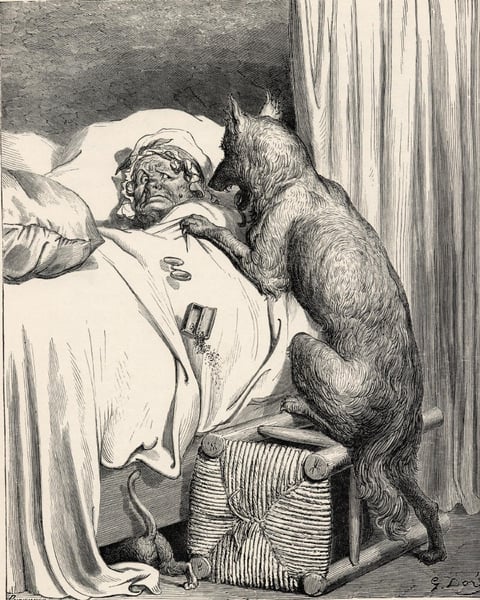
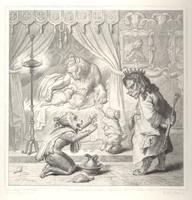
He sprang unpon the old woman and ate her up
Dettagli
Analisi esperta di He sprang unpon the old woman and ate her up di Gustave Dore
Stile: Romanticism · Genere: illustration
Expert Art Historical Analysis
Artwork: "He sprang upon the old woman and ate her up" — Gustave Doré
Style: Romanticism | Genre: Illustration
Gustave Doré (1832–1883) was the preeminent illustrator of the Romantic era, a period that prized emotion, the sublime, and the dramatic interplay of light and shadow. This work, drawn from his cycle of illustrations for classic fairy tales (likely Charles Perrault’s Little Red Riding Hood), exemplifies how Doré harnessed the Romantic sensibility to elevate the humble illustration into a vehicle of profound psychological and narrative intensity.
Visual and Thematic Analysis
Though we cannot view the image directly, the title and Doré’s known techniques allow us to reconstruct the composition’s likely Romantic features:
-
Dramatic Chiaroscuro: Doré was a master of stark contrasts between deep, velvety blacks and raking highlights. In this scene, the wolf’s sudden, savage leap would be rendered with a diagonal thrust of light – perhaps a single moonbeam or fireplace glow – illuminating the old woman’s startled face and the wolf’s bared teeth, while plunging the rest of the cottage into ominous shadow.
-
Expressive Posture and Gesture: Romanticism demanded that figures convey raw emotion through body language. The wolf’s pouncing form would be taut, asymmetrical, and predatory; the old woman’s recoil (if shown) would be captured in a fleeting, unidealized moment of terror – a departure from classical poise.
-
Detailed, Atmospheric Setting: Doré’s backgrounds are never mere backdrops but active participants. He likely filled the scene with rustic, gnarled textures (wooden beams, tattered bedding, cobwebs) that evoke the vulnerability of the domestic sphere and the encroaching wildness of nature – a core Romantic tension.
-
Narrative Moment of Irrevocable Action: The title fixes on the instant after the spring and during the consumption – a choice that amplifies horror and inevitability. This aligns with Romanticism’s focus on the sublime terror of the unknown and the uncontrollable forces of fate or nature.
Significance within Romanticism and the Illustration Genre
-
Elevation of Illustration as High Art
In the 19th century, illustration was often dismissed as a commercial or secondary art form. Doré shattered that hierarchy by bringing full Romantic gravitas – chiaroscuro, emotional depth, and epic scale – to the printed page. This work, like his illustrations for The Divine Comedy or Don Quixote, proves that a grisly fairy-tale moment can achieve the same visual power as a history painting. -
Romantic Macabre and the Grotesque
Romanticism had a dark, Gothic underbelly that reveled in the fantastical and the terrifying. Doré’s wolf is not merely a fairy-tale villain but a force of nature – an embodiment of the Romantic sublime, where beauty and horror fuse. The act of being “eaten up” is rendered not as cartoonish but as a visceral, fateful event, forcing the viewer to confront mortality and primal fear. -
Narrative Compression and Psychological Impact
Unlike earlier, more decorative illustration styles, Doré’s approach is intensely psychological. The scene does not simply show a wolf and a woman; it freezes the exact moment of violation, making the viewer complicit in the horror. This aligns with Romanticism’s interest in the inner life – the shock, the adrenaline, the sudden irruption of chaos into order. -
Influence on Later Visual Storytelling
Doré’s dramatic chiaroscuro and kinetic compositions directly prefigure the visual language of cinema (especially horror and noir) and graphic novels. The way he captures a split-second of violent action here anticipates the “punctum” of film editing – the single, pregnant frame that tells the whole story.
Conclusion
“He sprang upon the old woman and ate her up” is a consummate example of Romantic illustration: it transforms a familiar folk narrative into a moment of sublime terror, uses light and shadow to evoke emotional extremes, and proves that the illustrator’s art can command the same aesthetic and intellectual respect as painting. Doré’s work remains significant because it bridges the gap between popular storytelling and high art, and because it shows Romanticism’s enduring power to make us feel, with full force, the primal shock of a predator’s leap.
Visivamente simili
20 opere con composizione e palette affini
Title Page: Animals of Various Species Accurately Drawn
Francis Barlow
Reineke Fuchs1
Wilhelm von Kaulbach
Joseph and Potiphar`s wife
Rembrandt
Punctual
Paul-Albert Besnard
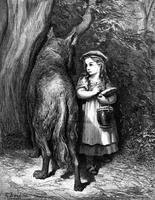
Red Riding Hood meets old Father Wolf
Gustave Dore
The Adventure of the Chamber Pot, plate four from Scènes du Roman Comique
Jean-Baptiste Oudry
Illustration for the Poem "the Sailor's Bride"
Frederick Sandys
Illustration to "A Week of Kindness"
Max Ernst
Discreet (discrète)
Paul-Albert Besnard
Illustration to "A Week of Kindness"
Max Ernst
In Bed
Rembrandt
Illustration to "A Week of Kindness"
Max Ernst
Illustration to "A Week of Kindness"
Max Ernst
The little thumb
Gustave Dore
Coquette
Paul-Albert Besnard
Charitable
Paul-Albert Besnard
Illustration to "A Week of Kindness"
Max Ernst
Importunate
Paul-Albert Besnard
Shepherd wolf
Gustave Dore
in König Nobels Schlafgemach
Wilhelm von Kaulbach