Expert analysis of Paul Klee’s Analysis of diverse perversities
Style: Surrealism · Genre: genre painting
Expert Analysis: Analysis of Diverse Perversities by Paul Klee
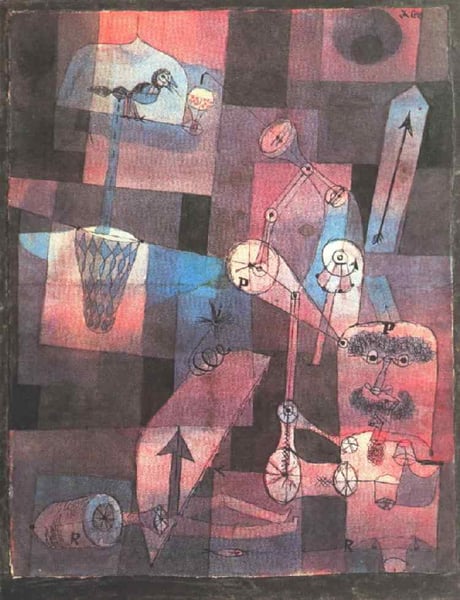
Executed during Klee’s tenure at the Bauhaus (1921–1931), Analysis of Diverse Perversities stands as a compelling intersection of Surrealist psychology and Bauhaus formal discipline. While Klee is not a conventional Surrealist, this work aligns with the movement’s fascination with the subconscious, Freudian drives, and the irrational—yet it is filtered through the Bauhaus’s emphasis on geometric structure, color theory, and elemental form.
Significance within Surrealism
The title itself signals a clinical, quasi-scientific investigation into human aberrations, a theme Surrealists often explored through dream-like imagery and symbolic distortion. Klee, however, avoids overt shock or eroticism. Instead, he presents “perversities” as abstract signs: fragmented lines, floating biomorphic shapes, and delicate color fields that suggest latent psychological tensions. The work exemplifies Surrealism’s interest in revealing hidden layers of the psyche, but Klee’s method is more analytical than automatic—a “surgery of the soul” rendered in subtle, algebraic marks.
Significance within the Bauhaus Period
As a Bauhaus master, Klee synthesized art and theory. Analysis of Diverse Perversities reflects his lectures on visual grammar: each shape and line acts like a phoneme in a private language. The composition likely employs his “taking a line for a walk” principle, where meandering contours create ambiguous figures that resist single interpretation. The muted palette and precise placement of forms demonstrate Bauhaus ideals of clarity and purpose—yet the subject matter deliberately subverts order, introducing chaos into the rational Bauhaus framework. This tension—between analytical structure and irrational content—makes the work a key example of Klee’s attempt to map the unconscious using the tools of modern design.
Genre Painting Context
Despite its abstract appearance, the genre classification hints at a narrative of everyday life, however distorted. Klee transforms the conventional genre scene—people, interactions, moral lessons—into a diagram of hidden drives. The “diverse perversities” might be read as a modern vanitas, a meditation on human frailties rendered not with moral judgment but with the detached curiosity of a scientist examining specimens. This reframing elevates genre painting from anecdotal depiction to a philosophical inquiry into human nature.
Conclusion
Analysis of Diverse Perversities is significant because it bridges the psychological exploration of Surrealism with the formal rigor of the Bauhaus. It shows Klee as a master of ambiguity—neither fully abstract nor fully figurative, neither purely rational nor purely instinctual. The work challenges viewers to decode its inner logic, much as a psychologist decodes a dream. In doing so, it represents a high point of early modernism’s attempt to visualize the invisible, laying groundwork for later conceptual and abstract expressionist movements.
Visually similar
20 works with related composition and palette
Untitled
Eva Hesse
Harlequin's Carnival
Joan Miro
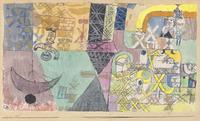
Asian entertainers
Paul Klee
The Sky Above the City
Alice Rahon
Le Cirque
Alice Rahon
Acrobats
Jorge Camacho
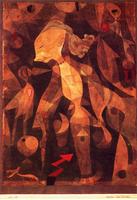
A young ladys adventure
Paul Klee
Painting (Man with a Pipe)
Joan Miro
Still life with harp and violin
Georges Braque
Forms
Paule Vézelay
Homesickness
Endre Balint
The Hunter
Joan Miro
Catalan Landscape (The Hunter)
Joan Miro
Groynes
Paul Klee
Fantasy
Mark Rothko
Contrasting sounds
Wassily Kandinsky
Dancers
Boris Margo
From an Omnious Chord
Boris Margo
Untitled
Mark Rothko
Primeval Landscape
Mark Rothko