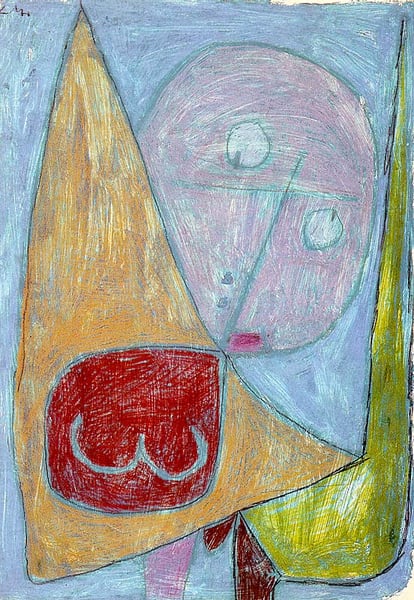
Paul Klee sanatçısının Angel Still Feminine eseri hakkında uzman analizi
Tarz: Expressionism · Tür: portrait
Expert Analysis: "Angel Still Feminine" by Paul Klee
Paul Klee’s Angel Still Feminine (c. 1939–1940) belongs to his Late Works period, a time when the artist, suffering from the debilitating autoimmune disease scleroderma, turned increasingly toward spiritual and existential themes. Executed in his signature Expressionist style, the work is a portrait—but one that defies conventional representation, blending figuration with abstraction to convey a psychological or metaphysical presence.
The painting is significant for several reasons:
-
Ambiguity of Identity – The title insists on a feminine angel, yet Klee deliberately destabilizes gender binaries. The figure’s elongated, androgynous form, with large eyes and a fragile, linear structure, evokes both vulnerability and ethereality. This reflects Klee’s broader exploration of angels as liminal beings—neither fully human nor divine, neither male nor female.
-
Expressionist Emotionalism – The work’s rough, sketch-like lines and muted, earthy palette (ochres, grays, blues) convey a sense of melancholy and inwardness. Klee abandons naturalistic proportion, distorting the face into a mask-like emblem of suffering or grace. The hallmark of Expressionism—the translation of inner feeling onto the canvas—is evident in the trembling, almost hesitant strokes.
-
Late Period Synthesis – In his final years, Klee synthesized earlier influences (Cubist space, Surrealist whimsy, childlike drawing) into a more austere, symbolic language. Angel Still Feminine shares motifs with his famous “angel” series, such as Angelus Novus (1920), but here the tone is more resigned. The “still” in the title hints at persistence—an angel that remains feminine despite the world’s brutality (a veiled allusion to the Nazi regime’s suppression of “degenerate art,” which branded Klee’s work).
-
Portrait as Icon – Though categorized as a portrait, the image is not a likeness but an archetype. Klee treats the face as a hieroglyph of spiritual states. The large, asymmetrical eyes and downturned mouth suggest a being burdened by knowledge—perhaps a self-portrait of the artist as a wounded angelic witness.
In sum, Angel Still Feminine exemplifies Klee’s late genius: a stripped-down, poetic fusion of Expressionist emotion and symbolic portraiture, capturing the tension between frailty and transcendence. It stands as a testament to the artist’s ability to find the sacred in the fragile, and the universal in the deeply personal.
Görsel olarak benzer
İlişkili kompozisyon ve renk paletine sahip 20 eser
Couple et pigeon
Corneille
Girl
Vilen Barsky
Face and Figure
Christo Coetzee
The Luxury of Tenderness
Marlene Dumas
study #043
Toshihiko Okuya
Man and Woman
Pablo Picasso
Eternitè
Mario Tozzi
Naturaleza Muerta Con Tijeras
Maria Blanchard
Cubist Figure
Salvador Dali
The Wave
Willem de Kooning
Blue Figure in a Chair
Arshile Gorky
St. Tropez (Abstract)
John Ferren
Bild
Pablo Picasso
Composition
Arshile Gorky
Seated woman
Pablo Picasso
Vajda Lajos Madonna Gyermekkel 1938
Vajda Lajos
Dark Blue World
Endre Balint
The arrival of the bird
Corneille
Woman's head
Pablo Picasso
The rumors
Paul Klee