Expertenanalyse zu Paul Klees Evening shows
Stil: Surrealism · Genre: portrait
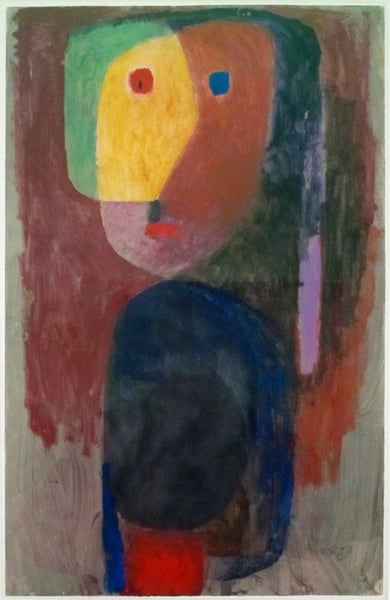
Paul Klee’s Evening Shows (a portrait from his Late Works period, executed in a Surrealist idiom) stands as a distilled example of the artist’s final, most profoundly symbolic phase. Created when Klee was already grappling with the debilitating effects of scleroderma, his late style abandoned the delicacy of his Bauhaus-era watercolors for a stark, almost hieroglyphic vocabulary of thick black lines and heavily textured color fields.
Significance within Surrealism:
Klee was never an official member of the Surrealist group, but his work was deeply admired by André Breton and the movement’s theorists for its uncanny ability to tap into the subconscious without rational interference. Evening Shows exemplifies this through its fusion of portraiture with dreamlike fragmentation. The “portrait” is not a likeness but a configuration of signs—a crescent-like eye, a schematic head, floating geometric limbs—that suggests a nocturnal, theatrical encounter. The title itself, Evening Shows, evokes the liminal moment of dusk when reality yields to fantasy, a core Surrealist concern. Klee’s use of “automatic” drawing infuses the work with a sense of spontaneous psychological revelation, even as the composition is carefully balanced.
Significance within Klee’s Late Works:
This painting belongs to Klee’s final period (1937–1940), marked by an intensified simplification and a return to the childlike, “primal” forms he had explored decades earlier. The portrait genre here becomes a vehicle for exploring the tension between figuration and abstraction. The heavy, incised lines—almost like graffiti or prehistoric cave markings—communicate a sense of existential urgency. The face is reduced to a mask of exaggerated features, suggesting a performer on a stage, which aligns with Klee’s lifelong fascination with theater and music. The somber palette (muted grays, browns, and a single accent of deep red or blue) reflects the artist’s awareness of mortality, yet the playful asymmetry of the composition retains his characteristic humor.
Art-Historical Importance:
Evening Shows embodies the late Klee’s radical synthesis of inner vision and formal restraint. It demonstrates how Surrealist principles could be adapted into a highly personal, almost calligraphic language—one that would influence later artists from Abstract Expressionists to Neo-Expressionists. The work’s significance lies in its ability to convey profound emotion through seeming simplicity: a portrait that is less an image of a person than a diagram of the psyche at twilight.
Genre
Stil
Visuell ähnlich
20 Werke mit ähnlicher Komposition und Farbpalette
A012 - Le Roy
Ramiro Martín Martín
Cadet
Vilen Barsky
Painting A 63
Fernando García Ponce
Asklepois
Hans Hofmann
De Visvangst
Corneille
Concert
Louis Marcoussis
1951
Karel Appel
Cubist Composition
Maria Blanchard
Untitled
Albert Oehlen
Self Portrait
Alexander Bogen
Crazy Portrait No. 2
Anima Ehtiat
Vajda Lajos Zöld Bohócmaszk 1938
Vajda Lajos
Untitled
Luigi Guardigli
Bodegón Con Frutero, Periódico Y Vaso. Naturaleza Muerta (La Botella)
Maria Blanchard
The Mannequin
Hans Hofmann
Cyclops
William Baziotes
Composition
Afro
Criptis
Modest Cuixart
Head Portrait
Jean David
Figure of Piety
Alfred Manessier