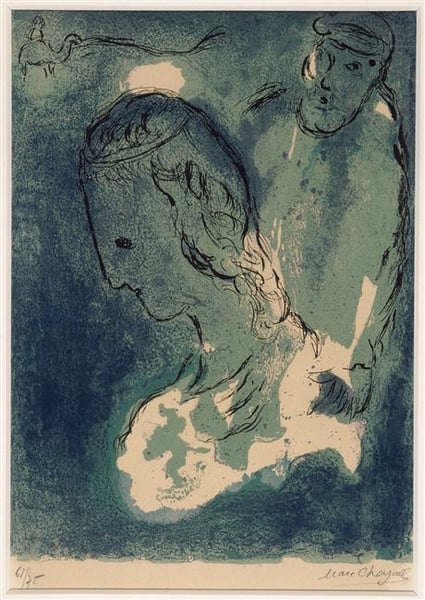
Abraham and Sarah
Dettagli
Analisi esperta di Abraham and Sarah di Marc Chagall
Stile: Naïve Art (Primitivism) · Genere: religious painting
Bathed in the ethereal, dreamlike blues that define much of Marc Chagall’s mature oeuvre, "Abraham and Sarah" (1956) serves as a poignant example of the artist's lifelong engagement with biblical themes. Created as part of his monumental series of lithographs illustrating the Bible, the work rejects classical perspective in favor of a fluid, emotive composition characteristic of Naïve Art. The viewer is immediately drawn to the large, floating profile of Sarah, rendered with delicate, sketchy lines that suggest both fragility and endurance. Behind her stands Abraham, his face open and perhaps slightly weary, enveloping her in a composition that suggests deep intimacy and shared burden. The wash of teal and aquamarine ink creates a spiritual atmosphere, lifting the figures out of the mundane world and into a realm of timeless myth.
The symbolism within the piece relies on narrative shorthand typical of Chagall’s visual vocabulary. In the upper left corner, a tiny, sketched camel and rider traverse the horizon, acting as a visual anchor that contextualizes the couple as the nomadic Patriarch and Matriarch of the Old Testament. This small detail emphasizes the theme of the journey—both the physical trek to Canaan and the spiritual journey of faith. The use of negative space is masterfully handled; the uncolored paper illuminates the faces of the couple, suggesting an inner light or divine presence amidst the darker, textured currents of the lithographic stone.
Historically, this work represents the culmination of a project Chagall began in the 1930s, which was interrupted by the trauma of World War II and the Holocaust. By 1956, when this was published, Chagall’s interpretation of the Bible had evolved into a personal reconciliation of his Jewish heritage with universal humanism. Unlike traditional religious art that often focuses on grandeur or judgment, Chagall presents Abraham and Sarah with a profound, quiet humanity. The artwork is significant not just for its aesthetic beauty, but for how it captures the "poetic reality" Chagall saw in the scriptures—viewing these ancient figures not as distant icons, but as living, breathing ancestors defined by love and wandering.
Visivamente simili
20 opere con composizione e palette affini
Drawing of a Male Face in a Non Figurative Ground
Frances Hodgkins
Tomb of Evrion
Dimitris Mytaras
Job in despair
Marc Chagall
David and Absalom
Marc Chagall
Ruth gleaning
Marc Chagall
Rahab and the Spies of Jericho
Marc Chagall
Czóbel Béla Női Portré
Bela Czobel
Czóbel Béla Women Head Water Color
Bela Czobel
Head of a Sleeping Woman
Odilon Redon
Composition
Albert Bitran
Untitled
Dimitris Mytaras
Mirella
Tano Festa
Study to "Exodus"
Marc Chagall
Ukrainian Evening
Vilen Barsky
Silueta
Lilia Carrillo
Teresa
Amedeo Modigliani
Self-portrait
Ernst Ludwig Kirchner
Naomi and her daughters-in-law
Marc Chagall
Anna Margit, Akt,.
Anna Margit
Jacob Wrestling with the Angel
Marc Chagall