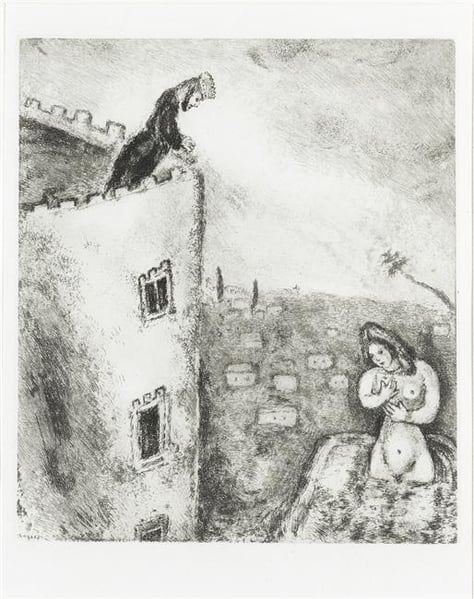
From the terrace of his palace David sees bathing Bathsheba (II Samuel, XI, 2-3)
Dettagli
Analisi esperta di From the terrace of his palace David sees bathing Bathsheba (II Samuel, XI, 2-3) di Marc Chagall
Stile: Naïve Art (Primitivism) · Genere: religious painting
Based on the structured facts provided, this artwork is a significant example of how a highly trained, avant-garde artist deliberately adopts the visual language of Naïve Art (Primitivism) to present a biblical narrative with renewed emotional directness and symbolic power.
Analysis of "From the terrace of his palace David sees bathing Bathsheba (II Samuel, XI, 2-3)" by Marc Chagall
1. Significance within the Style (Naïve Art / Primitivism): Although Marc Chagall was a sophisticated, academically trained artist deeply involved in the Parisian avant-garde, this work is here classified within Naïve Art. Its significance lies in Chagall’s conscious appropriation of a "primitive" or naïve aesthetic—not out of technical limitation, but as a radical artistic choice. By flattening perspective, distorting scale, and employing a childlike, intuitive sense of space, Chagall strips the biblical scene of academic naturalism. This approach imbues the ancient story with a dreamlike, folkloric quality that makes the divine and the human feel intimately intertwined. In the context of Primitivism, Chagall’s work stands out because he was not a self-taught amateur; rather, he used the naïve style to access a universal, pre-linguistic emotional truth, much like his contemporaries who looked to African and Oceanic art for raw expression. His version of "naïve" is filtered through Jewish folk traditions, Eastern European shtetl imagery, and a personal mythological vocabulary, making it a unique hybrid within the movement.
2. Significance within the Genre (Religious Painting): Chagall’s treatment of this Old Testament story is significant because it democratizes and humanizes a sacred, often morally charged narrative. In traditional religious painting, the scene of David spying on Bathsheba is typically rendered with dramatic chiaroscuro and a focus on the king’s power or impending sin. Chagall, however, uses the naïve style to transform the moment into a floating, poetic vision. The figures—David on his terrace, Bathsheba at her bath—are not rendered realistically but as symbolic presences, often floating or defying gravity. This reflects Chagall’s belief that biblical stories are not historical events locked in the past but eternal, mystical experiences that hover in the present. The bright, arbitrary colors (a hallmark of his work) and the simplified, almost cartoonish outlines remove the judgmental tone typical of earlier religious art, replacing it with a sense of wonder and inevitability. By fusing the sacred text with a folk-art sensibility, Chagall makes the story accessible to all, emphasizing the human passion and divine plan over moralizing.
3. Core Significance (What Makes It Important): The artwork is most significant as a bridge between modernist experimentation and traditional devotional imagery. Chagall demonstrates that Naïve Art is not merely quaint or primitive but can carry profound theological and psychological weight. The biblical subject allows him to explore themes of love, desire, destiny, and revelation through a lens that feels both ancient and utterly contemporary. The title itself—specifying the biblical chapter and verse—grounds the work in scripture, while the naïve execution frees it from literal interpretation. This tension between precise textual reference and fantastical, dreamlike representation is the hallmark of Chagall’s genius. In the broader history of 20th-century art, this piece exemplifies how Primitivism was not just a fascination with the "exotic" but could also be a powerful tool for reimagining one’s own cultural and religious heritage. Chagall’s David and Bathsheba are not figures in a Renaissance palace; they are archetypes floating in a timeless, magical universe—a world made possible only through the deliberate, sophisticated simplicity of the naïve style.
Visivamente simili
20 opere con composizione e palette affini
David and Bathsheba
Marc Chagall
Michal saves David from Saul
Marc Chagall
Elsinore
Tano Festa
Illustration for Louis Aragon's work "One who says things without saying anything"
Marc Chagall
Queen Anna's tower
Nicholas Roerich
Esther
Marc Chagall
The task
Remedios Varo
Illustration for Louis Aragon's work "One who says things without saying anything"
Marc Chagall
Illustration for Louis Aragon's work "One who says things without saying anything"
Marc Chagall
Fanciful Ink Drawing II
Franz Sedlacek
La Maison
Hans Bellmer
Vignette for book "N. K. Roerich"
Nicholas Roerich
Italian plaza with a red tower
Giorgio de Chirico
Illustration for Louis Aragon's work "One who says things without saying anything"
Marc Chagall
Death Awaiting his Family
Yves Tanguy
Happy future of Jerusalem have found favor with God (Isaiah, LXII, 1 5)
Marc Chagall
Truth Lies at the Bottom of the Well
Frances Macdonald
The First Day of Spring
Salvador Dali
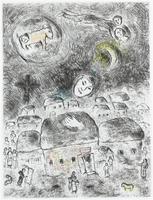
Illustration for Louis Aragon's work "One who says things without saying anything"
Marc Chagall
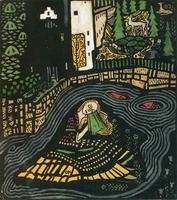
Sleeping Woman
Oskar Kokoschka