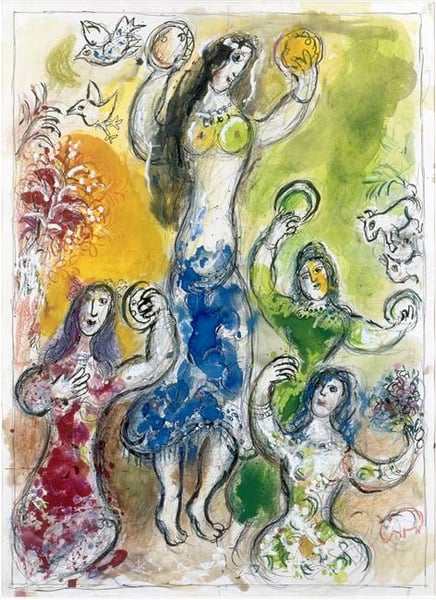
The dance of Myriam
Dettagli
Analisi esperta di The dance of Myriam di Marc Chagall
Stile: Naïve Art (Primitivism) · Genere: religious painting
Marc Chagall's The Dance of Myriam is a striking example of Naïve Art (Primitivism) applied to a religious painting—specifically the biblical scene of Miriam (Myriam) leading the Israelite women in song and dance after the Exodus. What makes this work significant within its style and period is Chagall’s ability to fuse a childlike, folk-art sensibility with profound spiritual storytelling, a hallmark of his mature practice.
In the Naïve Art tradition, Chagall employs flattened, simplified figures, vivid and often unnatural colors, and a disregard for conventional perspective. Here, Myriam’s dance is rendered as a joyous, almost floating motion—her body and garments swirl in rhythmic arcs, echoing the musicality of the event. The background likely features a dreamlike landscape, with the Red Sea behind her, treated in ornamental, curving lines that blur the boundary between nature and miracle. This unschooled, intuitive approach allows the painting to feel both immediate and transcendent: the joy of salvation is conveyed not through realistic anatomy or dramatic chiaroscuro, but through the pure energy of line and color.
The religious subject matter is central to Chagall’s identity as a Jewish artist working in the early 20th century. Unlike academic religious art, which often adheres to historical or liturgical conventions, The Dance of Myriam personalizes the biblical narrative through a primitivist lens—the flattened forms and bold hues recall stained glass, Eastern European folk art, and the devotional icons of his Russian childhood. This fusion of Naïve style with sacred story imbues the work with a sense of universal, celebratory faith, while rooting it in the specific cultural memory of the Jewish people.
The significance of The Dance of Myriam lies in how it expands the expressive range of religious painting. Chagall proves that a deliberately “naïve” technique, often associated with children or untrained artists, can carry profound theological weight. The work stands as a bridge between folk tradition and modernism, demonstrating that spiritual rapture can be communicated through the simplest, most direct visual language. In doing so, it challenges the viewer to see the Bible not as a remote, solemn text, but as a living, dancing source of joy—perfectly suited to the primitivist desire for authentic, unmediated emotion.
Visivamente simili
20 opere con composizione e palette affini
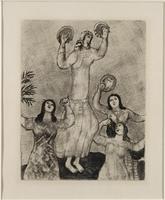
Miriam, sister of Moses, dances with her friends to celebrate the deliverance of Israel (Exodus, XV,19-21)
Marc Chagall
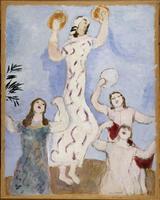
Miriam dances
Marc Chagall
Jacob Wrestling with the Angel
Marc Chagall
Carnival Figures
Rene Portocarrero
Dance
Marc Chagall
Moses is saved from the water by Pharaoh's daughter
Marc Chagall
Peasants
Pablo Picasso
Sarah and angels
Marc Chagall
Adam and Eve with the forbidden fruit
Marc Chagall
Moses with the Burning Bush
Marc Chagall
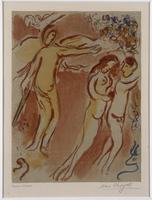
Adam and Eve expelled from Paradise Land
Marc Chagall
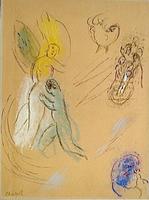
Study to "Jacob Wrestling with the Angel"
Marc Chagall
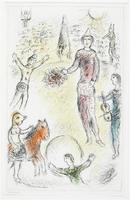
Clowns musicians
Marc Chagall
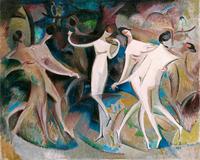
Beauties' Fancy
Alice Bailly
In the Garden
Marc Chagall
Abdullah discovered before him...
Marc Chagall
Naomi and her daughters-in-law
Marc Chagall
Night Dreamers
Guity Novin
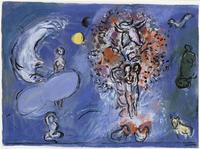
Paradise
Marc Chagall
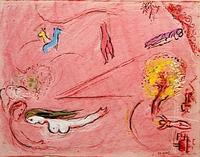
Study to "Song of Songs I"
Marc Chagall