Expert Analysis: "The Feast of the Tabernacles" by Marc Chagall
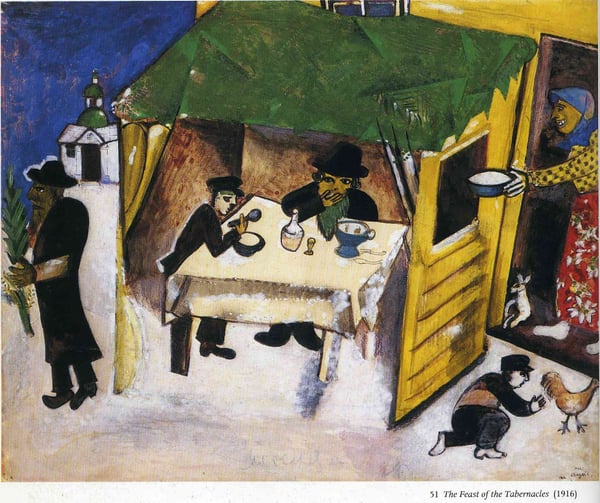
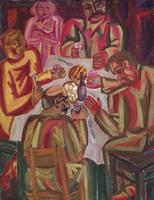
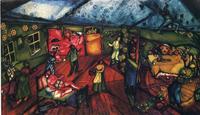
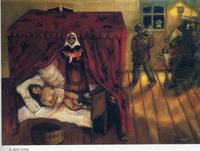
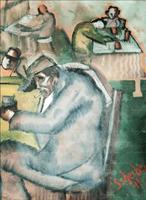
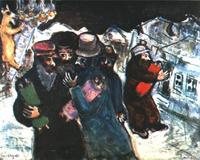
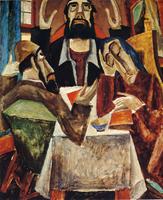
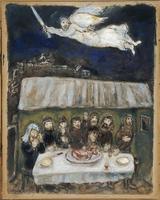
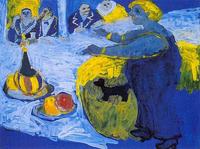
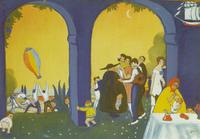
In this work, Chagall approaches the Cubist idiom not as a strict analytical exercise but as a vehicle for narrative and cultural expression. While the painting is classified under Cubism—with its fragmented planes, tilted perspectives, and simplified geometric forms—Chagall infuses the style with an unmistakable warmth and symbolic resonance. The subject, a genre painting depicting the Jewish holiday of Sukkot (the Feast of Tabernacles), is rendered through a distinctly personal lens. Figures, a festive canopy, and ritual objects are broken into facets and reassembled in a shallow, quasi-abstract space, yet they remain legible as a communal scene.
What makes this artwork significant is its daring synthesis of avant-garde technique with traditional, deeply rooted cultural content. At a time when many Cubists focused on still-life or portraits in a neutral, formalist manner, Chagall harnessed Cubism’s dislocation of form to express the ecstatic, timeless quality of religious celebration. The fractured planes serve not just to deconstruct visual reality but to convey the layered memories and spiritual dimensions of the festival. By applying Cubist structure to a genre scene with explicit Jewish iconography, Chagall expands the movement’s emotional and narrative range—demonstrating that abstraction could carry folkloric and liturgical meaning, bridging the gap between early modern innovation and lived tradition.