Analisi esperta di The heart of the circus di Marc Chagall
Stile: Naïve Art (Primitivism) · Genere: genre painting
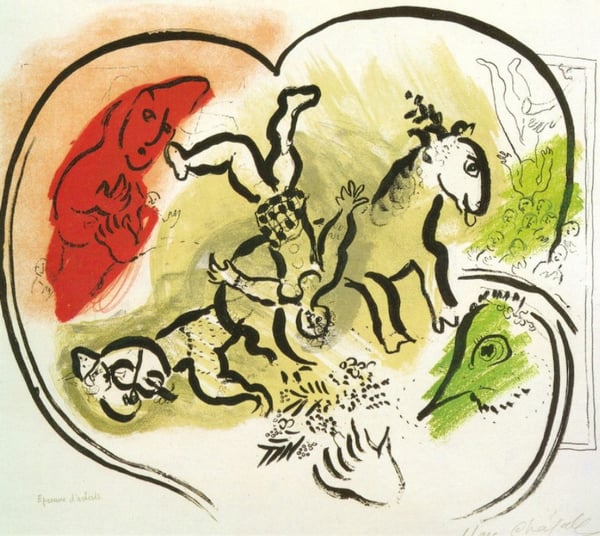
Marc Chagall’s "The Heart of the Circus" is a quintessential example of his unique blend of Naïve Art (Primitivism) and deeply personal symbolism. While Chagall was a formally trained artist, he deliberately adopted a childlike, untutored aesthetic—favoring flat perspectives, simplified forms, and intense, non-naturalistic color—to evoke raw emotional and spiritual truth rather than literal representation.
Significance within Style and Period:
As a genre painting, the work captures a bustling circus scene—a recurring motif in Chagall’s oeuvre—but transcends mere documentation. The circus, for Chagall, was a microcosm of life’s joy, chaos, and sorrow. Here, the "heart" of the title likely refers both to the emotional core of the spectacle and to a literal, floating heart shape—a hallmark of his surreal, dreamlike vocabulary. The composition’s naïve primitivism strips away academic perspective, instead stacking figures and animals in a compressed, gravity-defying space. Acrobats, clowns, and musicians intermingle with fantastical creatures, all rendered in vivid reds, blues, and golds that pulse with vitality. This deliberate simplicity amplifies the sense of wonder and timelessness, while the disjointed scale (performers looming over tents) reflects the subjective, memory-soaked reality of the artist.
What Makes It Significant:
Chagall’s naïve style here is not a regression but a radical rejection of naturalism in favor of emotional immediacy. By flattening depth and emphasizing rhythmic, decorative patterns, he aligns himself with early 20th-century primitivist movements (like the Fauves and Die Brücke) that sought to bypass academic conventions. Yet Chagall infuses his primitivism with a distinctly personal iconography: the floating figures, the oversized heart, and the fusion of human and animal forms all speak to his Russian-Jewish heritage and his belief that art should access the unconscious. "The Heart of the Circus" thus stands as a bridge between folk art, modernism, and the fantastical—a work where naiveté becomes a sophisticated tool for exploring the magic and melancholy of human experience.
Visivamente simili
20 opere con composizione e palette affini
Acrobates
Marc Chagall
Acrobatics
Marc Chagall
Centaurs and Lapiths
Yiannis Tsaroychis
A blue cow
Marc Chagall
The Blue Nymph
Marc Chagall
The trap
Marc Chagall
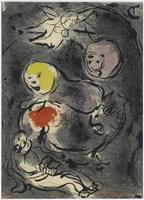
Prophet Daniel with lions
Marc Chagall
Orfeova Smrt
Emil Filla
Lessons
Paula Rego
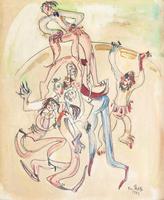
Acrobaţi la circ
Tia Peltz
Paradise
Marc Chagall
Untitled
Vasile Kazar
Untitled
Pablo Picasso
Song of Songs II
Marc Chagall
Salome
Jules Pascin
Noah's Ark
Marc Chagall
Untitled
Mark Rothko
Da Guernica
Renato Guttuso
Song of Songs II
Marc Chagall
Parade in circus
Marc Chagall