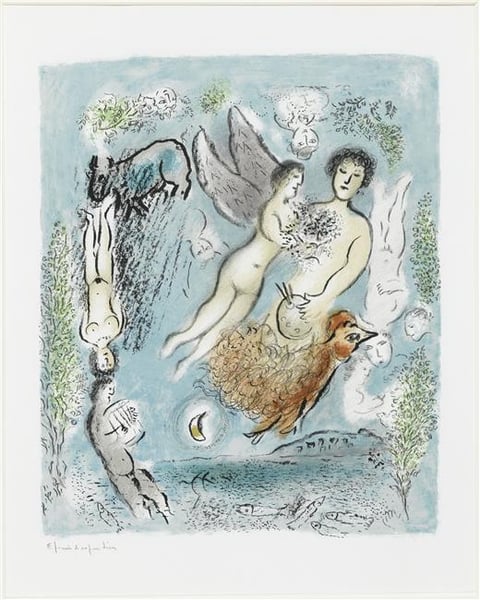
The island of Poros
Dettagli
Analisi esperta di The island of Poros di Marc Chagall
Stile: Naïve Art (Primitivism) · Genere: symbolic painting
Expert Analysis of Marc Chagall’s The Island of Poros
Significance within Naïve Art (Primitivism)
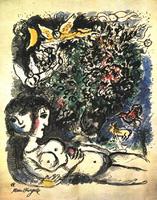
This work exemplifies Chagall’s distinctive fusion of Naïve Art’s deliberate simplicity with sophisticated symbolic storytelling. In the Naïve tradition, artists reject academic perspective and naturalism in favor of flat, vibrant color fields, childlike forms, and intuitive composition. Chagall’s handling of the island of Poros—likely rendered with bright, unmodulated hues and simplified, often floating figures—embodies the movement’s celebration of raw emotion and folkloric spontaneity. The lack of hierarchical scale and the whimsical arrangement of elements challenge the viewer’s expectations, reinforcing the Naïve aesthetic’s rebellion against rigid artistic conventions.
Symbolic Painting as a Hallmark of Chagall’s Vision
As a symbolic painting, The Island of Poros transcends mere landscape representation. Chagall infuses the Greek island with personal and universal symbols—flying lovers, animals, musical motifs, or hybrid creatures—that are hallmarks of his dreamlike iconography. The island becomes a metaphorical space where memory, mythology, and emotional truth coexist. By combining the directness of Naïve Art with layered symbolism, Chagall creates a work that feels both timeless and deeply intimate, inviting multiple interpretations.
Why It Matters
The Island of Poros is significant because it demonstrates how Naïve Art can serve as a vehicle for complex, poetic content. Chagall’s ability to render a specific location (Poros) as a universal, transcendent realm underscores the power of symbolic painting to bridge the concrete and the mystical. This work stands as a testament to Chagall’s unique role within Primitivism: he did not merely mimic a “naïve” style but used it to unlock a world of personal mythology, making the familiar strange and the strange profoundly moving.
Visivamente simili
20 opere con composizione e palette affini
Surging Magic
Marc Chagall
Darkness and Light (biblical symbols)
Marc Chagall
The Creation of Man
Marc Chagall
In the Garden
Marc Chagall
Adam and Eve expelled from Paradise Land
Marc Chagall
Paradise
Marc Chagall
Youthfulness
Marc Chagall
A tree in blossom
Marc Chagall
Jacob Wrestling with the Angel
Marc Chagall
Illustration for Louis Aragon's work "One who says things without saying anything"
Marc Chagall
Jacob Wrestling with the Angel
Marc Chagall
Adam and Eve with the forbidden fruit
Marc Chagall
Paradise
Marc Chagall
Song of Songs II
Marc Chagall
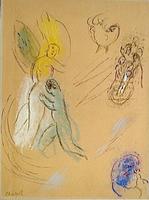
Study to "Jacob Wrestling with the Angel"
Marc Chagall
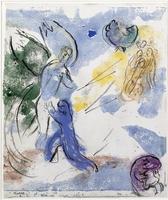
Jacob Wrestling with the Angel
Marc Chagall
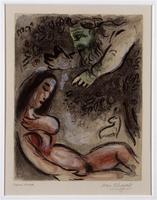
Eve is cursed by God
Marc Chagall
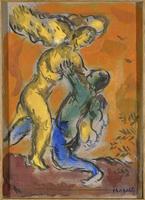
Jacob Wrestling with the Angel
Marc Chagall
Eve
Marc Chagall
Song of Songs II
Marc Chagall