Marc Chagall の The procession の専門的な分析
スタイル:Naïve Art (Primitivism) · ジャンル:illustration
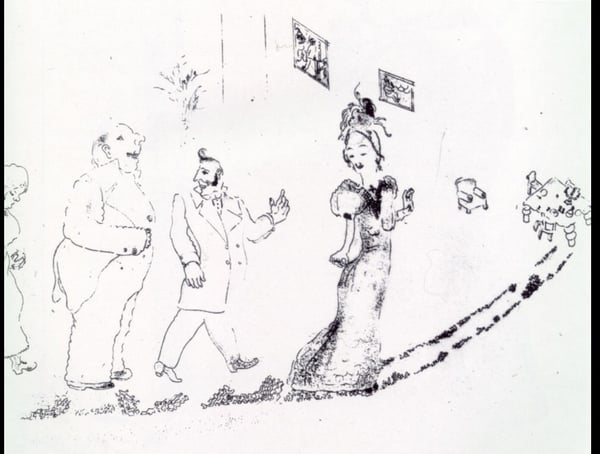
As an expert in art history, I will provide an analysis of Marc Chagall's "The Procession" based solely on the given facts: the artwork is an illustration executed in the Naïve Art (Primitivism) style.
Significance within Naïve Art and Chagall's Oeuvre
Chagall's "The Procession" is a quintessential example of how Naïve Art—often characterized by a childlike perspective, flat planes of color, and a disregard for classical perspective—can be elevated from mere folk simplicity to profound symbolic narrative. While the Naïve style typically evokes rustic innocence, Chagall infuses it with the complexity of memory, folklore, and spiritual longing.
Key aspects of its significance:
-
Transformation of Naïve Art into Personal Myth: Unlike many Naïve artists who painted everyday rural life, Chagall used this deliberately unsophisticated style to render deeply personal, often fantastical scenes. In "The Procession," the flat, illustrative composition likely presents a wedding or ceremonial march—a common motif in his work. Here, the Naïve technique does not signal a lack of skill but rather a conscious rejection of academic naturalism. It allows the figures to float, overlap, and exist in a dreamlike space, merging the earthly with the celestial. This makes the work significant as a bridge between folk art and early Modernism.
-
Illustration as Poetic Storytelling: Given that the genre is illustration, this work likely serves as a visual poem. Chagall was deeply influenced by his Hasidic Jewish upbringing in Vitebsk, where religious and folk traditions were alive. In "The Procession," the Naïve style becomes the perfect vehicle for conveying the joy, solemnity, and collective ecstasy of a communal ritual. The simplified, almost cartographic rendering of figures and buildings gives the scene a timeless, universal quality—as if the procession exists outside of linear history, in a realm of pure feeling.
-
Primitivism as Emotional Authenticity: The Primitivist aspect of the style is crucial. By adopting the direct, unmediated vision of a child or a folk craftsman, Chagall achieves an emotional authenticity that complex realism might obscure. The skewed scale, bright colors, and rhythmic repetition of figures in "The Procession" emphasize the hypnotic, celebratory nature of the event. This makes the work significant for demonstrating how Primitivism could be used not to depict the "primitive" Other, but to access a pure, pre-rational layer of human experience—specifically, the joy and sorrow of Jewish life in the Pale of Settlement.
In summary, "The Procession" is significant because it exemplifies how Marc Chagall took the formal vocabulary of Naïve Art—its flatness, directness, and vibrant color—and transformed it into a sophisticated language of memory and mysticism. It stands as a key work showing that illustration, when filtered through this style, can achieve the narrative power and emotional resonance of a modern myth.
Museum / Gallery
視覚的に類似
構図やパレットが近い作品 20 件
Six Croquis de Personnages
Theophile Steinlen
Banquet degenerates into brawl
Marc Chagall
Two Women and a Man on an Avenue
August Macke
The Repentance of Mrs...
Aubrey Beardsley
Three Musicians
Aubrey Beardsley
'La Fanciulla Del West' Rehearsal
Enrico Caruso
Illustration for 'The Cinnamon Shops'
Bruno Schulz
Deux Trottins-4056-
Theophile Steinlen
Nozdriov
Marc Chagall
Sauvee
Theophile Steinlen
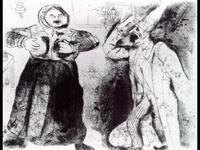
Disputation of Pliushkin and Mavra
Marc Chagall
Vienna
Thomas Hart Benton
Couple
Theodor Severin Kittelsen
Faen til kar
Theodor Severin Kittelsen
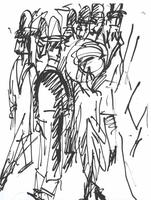
Street Scene in Berlin
Ernst Ludwig Kirchner
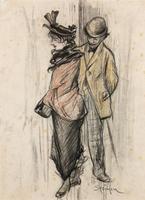
Le Flaneur Parisien
Theophile Steinlen
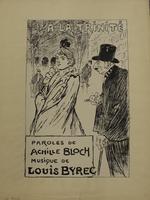
A La Trinite
Theophile Steinlen
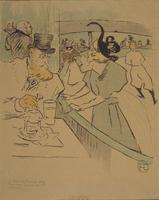
Skating
Henri de Toulouse-Lautrec
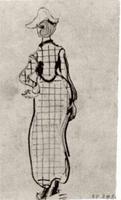
Lady with Checked Dress and Hat
Vincent van Gogh
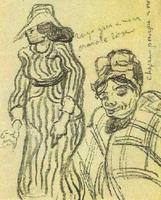
Sketch of a Lady with Striped Dress and Hat and of Another Lady, Half-Figure
Vincent van Gogh