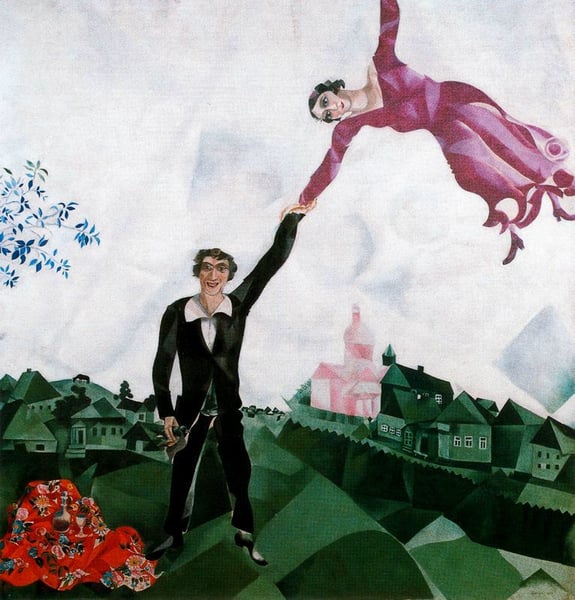
The Promenade
Details
Expert analysis of Marc Chagall’s The Promenade
Style: Cubism · Genre: genre painting
Expert Art Historical Analysis: "The Promenade" by Marc Chagall
In "The Promenade," Marc Chagall synthesizes the formal innovations of Cubism with the deeply personal, poetic sensibility that defines his oeuvre. Executed between 1917 and 1918, this genre painting—depicting a couple’s leisurely stroll—transcends the typical subject matter of everyday life by infusing it with a dreamlike, transcendent quality.
Cubist Language Reimagined
Though grounded in the Cubist vocabulary of fractured planes, geometric simplification, and a flattened pictorial space, Chagall deploys these techniques not for analytical deconstruction but for emotional expression. The figures are composed of angular, interlocking shapes that suggest volume and movement, yet their contours remain soft and lyrical. The background—a patchwork of vibrant greens, reds, and ochres—dissolves into a mosaic of cubist facets, echoing the rhythmic sway of the promenade. This is not the austere, monochromatic Cubism of Picasso and Braque; Chagall bathes his canvas in vivid, Fauve-like color, using Cubist structure to intensify the scene’s joyous, almost supernatural atmosphere.
Genre Painting as Poetic Vision
As a genre scene, "The Promenade" portrays a quotidian activity—a man and woman walking hand in hand—but Chagall elevates it into a celebration of love and liberation. The male figure (often identified as the artist himself) floats horizontally above the ground, his body levitating in a gesture of ecstatic flight, while his wife Bella is tethered to him, both airborne and rooted. This impossible defiance of gravity becomes a metaphor for the transcendence of earthly bonds through love. The Cubist fragmentation of space allows Chagall to depict multiple viewpoints simultaneously: the couple is seen from above, from the side, and in profile, creating a sense of weightless omnipresence.
Significance Within Cubism
What makes "The Promenade" particularly significant is how it expands Cubist practice beyond its usual intellectual constraints. Chagall grafts the formal discipline of Cubism onto a narrative that is intimate, folkloric, and emotionally charged. Where orthodox Cubism suppressed narrative and emotional content, Chagall embraces both, producing what art historians often call "lyrical Cubism" or "Cubo-Expressionism." The painting becomes a bridge between the avant-garde abstraction of early modernism and the deeply subjective, symbolic languages that would later flourish in Surrealism. In doing so, Chagall demonstrates that Cubism need not be cold or analytical; it can be a vehicle for wonder, memory, and personal mythology. "The Promenade" thus stands as a testament to the artist’s ability to bend a dominant style to his own visionary ends, creating a work that is at once formally radical and profoundly human.
Visually similar
20 works with related composition and palette
Over the town
Marc Chagall
Double portrait with a glass of wine
Marc Chagall
The Betrayal
Stanley Spencer
Two Acrobats
Charles Demuth
Spring
Kuzma Petrov-Vodkin
Catchers (left part of the diptych)
Vasiliy Ryabchenko
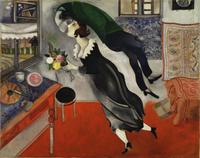
The Birthday
Marc Chagall
The Angel of Hearth and Home
Max Ernst
Eifersucht
Thomas Theodor Heine
They have flown
Francisco Goya
The Straw Manikin (Goya)
Gregorio Undurraga
Family Excursions
Max Ernst
Il Circo
Mario Tozzi
The Invisible Harp
Salvador Dali
Bella with White Collar
Marc Chagall
Illustration to "A Week of Kindness"
Max Ernst
The Birth of Venus
Mark Ryden
Festival in Figueras
Salvador Dali
The Wandering Moon
William Blake
Dreamland
Bo Bartlett