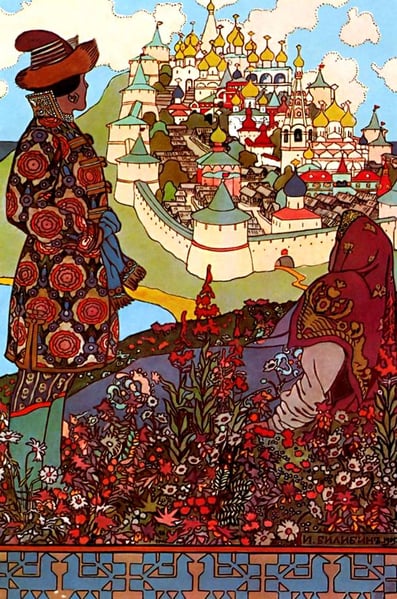
Illustration for Alexander Pushkin's 'Fairytale of the Tsar Saltan'
Dettagli
Analisi esperta di Illustration for Alexander Pushkin's 'Fairytale of the Tsar Saltan' di Ivan Bilibin
Stile: Art Nouveau (Modern) · Genere: illustration
Expert Analysis: Ivan Bilibin’s Illustration for Alexander Pushkin’s ‘Fairytale of the Tsar Saltan’ (Art Nouveau Period)
This work stands as a masterful synthesis of Russian folkloric storytelling and the decorative elegance of Art Nouveau. Bilibin, a leading figure in the revival of traditional Russian book illustration, created this image as part of his celebrated series for Pushkin’s narrative poem.
Significance within Style and Genre:
-
Art Nouveau’s Decorative Line – The composition is defined by sinuous, flowing outlines that contour figures, costumes, and architectural elements. Bilibin employs the signature “whiplash” curves of Art Nouveau, yet grounds them in motifs drawn from medieval Russian manuscript illumination and folk embroidery. This blend elevates the illustration beyond mere accompaniment into a self-contained ornamental artwork.
-
Integration of Text and Image – True to the genre of modern illustrated books, Bilibin treats the page as a unified design. Borders, initial letters, and marginalia often frame the scene with stylized vines, flowers, and mythical beasts, echoing Art Nouveau’s ideals of total aesthetic harmony. The illustration does not simply depict a moment; it envelops the viewer in a fairy-tale world where typography and picture are inseparable.
-
Cultural and Narrative Resonance – Pushkin’s tale—of a tsar deceived, a queen exiled, and a magic island—is rendered with precise ethnographic detail (e.g., traditional Russian headdresses, onion domes, embroidered textiles). Yet the flattened perspective and bold color patches (often in muted greens, crimsons, and golds) reflect Art Nouveau’s fascination with two-dimensional surface pattern, ensuring the image feels both timeless and modern.
-
Legacy in Illustration – Bilibin’s work for Tsar Saltan (first published in 1905) helped redefine children’s book illustration as a high art form. His stylized, anti-naturalistic approach—rejecting realistic shading in favor of clear silhouettes and decorative density—influenced later generations of illustrators and cemented his role as a bridge between Russian folk tradition and the pan-European Art Nouveau movement.
In sum: This illustration is significant because it transforms a beloved literary fairy tale into a vivid tapestry of Art Nouveau design, merging national identity with international modernist style, and demonstrating how the genre of illustration can function as independent, highly crafted art.
Visivamente simili
20 opere con composizione e palette affini
Illustration for Alexander Pushkin's 'Fairytale of the Tsar Saltan'
Ivan Bilibin
Procopius the Righteous
Nicholas Roerich
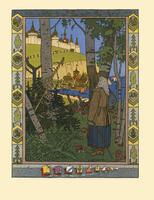
Illustration for the Russian Fairy Story "Feather Of Finist Falcon"
Ivan Bilibin
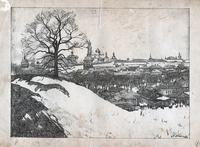
Sergiyev Posad. View of the Monastery with Oak
Konstantin Yuon
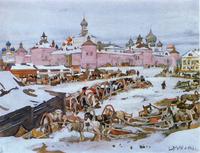
The Rostov Kremlin
Konstantin Yuon
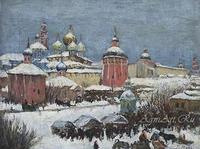
Sergiyev Posad
Konstantin Yuon
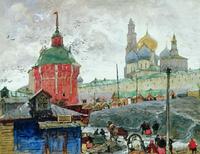
Troitse-Sergiev Posad
Konstantin Gorbatov
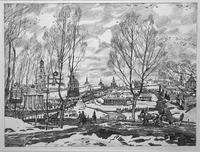
Sergiyev Posad. March
Konstantin Yuon
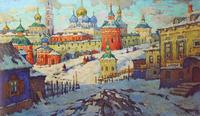
The Trinity Monastery
Konstantin Gorbatov
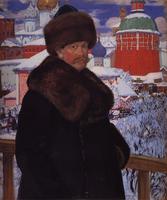
Self Portrait
Boris Kustodiev
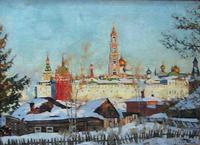
The View of Troitse-Sergiyev Monastery from West
Konstantin Yuon
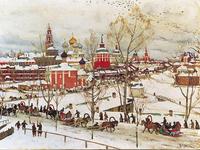
In Sergiyev Posad
Konstantin Yuon
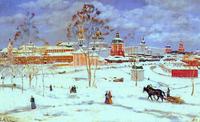
Troitse-Sergiyev Monastery
Konstantin Yuon
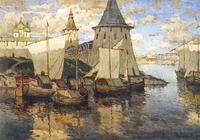
Pskov
Konstantin Gorbatov
The Troitse-Sergiyev Monastery in winter
Konstantin Yuon
Illustration for the epic "Volga"
Ivan Bilibin
Troitse-Sergiyev Monastery
Konstantin Yuon
Sadko
Ivan Bilibin
Strelets Patrol at Ilyinskie gates in the old Moscow
Andrei Ryabushkin
To Troyitsa
Konstantin Yuon