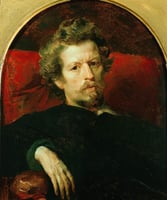
Analisi esperta di Siege of Pskov by Polish King Stefan Batory in 1581 di Karl Bryullov
Stile: Romanticism · Genere: history painting
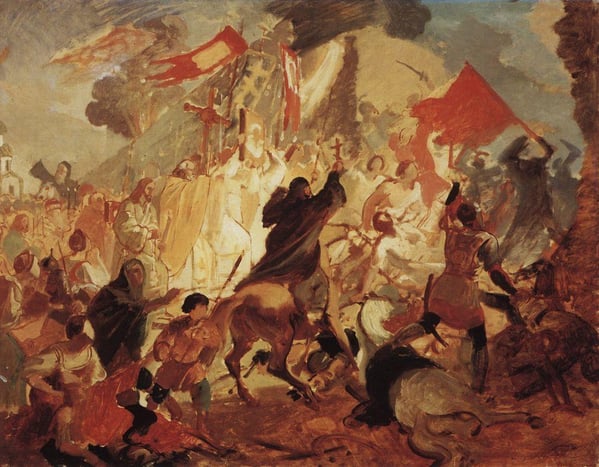
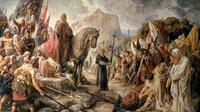
Karl Bryullov’s Siege of Pskov by Polish King Stefan Batory in 1581 (also known as The Siege of Pskov) stands as a quintessential example of Romantic history painting, blending nationalistic fervor with dramatic emotion. Executed between 1839 and 1843, the work commemorates a pivotal moment in Russian history: the failed Polish-Lithuanian siege during the Livonian War. Its significance lies in how Bryullov transforms a historical event into a moral and patriotic allegory, embodying the Romantic ideals of heroism, collective sacrifice, and spiritual resistance.
Dramatic Composition and Emotional Intensity
True to the Romantic style, Bryullov rejects the static, balanced compositions of Neoclassicism in favor of a swirling, crowded tableau that thrusts the viewer into the chaos of battle. The painting is dominated by the towering figure of a Russian bishop blessing the defenders—a clear symbol of orthodoxy and national unity—while the besieged city’s walls crumble under attack. Bryullov uses dramatic chiaroscuro, with shafts of light illuminating the determined faces of the defenders and the central religious icon, contrasting with the smoky, darkened sky and the distant Polish army. This lighting not only heightens the emotional stakes but also suggests divine favor, a common Romantic device that elevates the historical event to a spiritual struggle.
Historical Context and National Identity
Created during a period of rising Russian nationalism under Nicholas I, the painting underscores the resilience of the Russian people against foreign invasion. Bryullov’s meticulous attention to period armor, weaponry, and architectural details grounds the work in historical verisimilitude, yet he freely romanticizes the defenders’ stoicism. The composition emphasizes collective heroism over individual leaders; no single commander dominates, reflecting the Romantic fascination with the “folk” as the true agent of history. This aligns with the era’s interest in national epics and medieval chronicles, positioning the siege as a foundational myth of Russian indomitability.
Artistic Significance
Bryullov, already famous for The Last Day of Pompeii, demonstrates his mastery of large-scale history painting. The Siege of Pskov showcases his ability to orchestrate complex multi-figure scenes with dynamic diagonals and overlapping planes, creating a sense of urgency and mass movement. The work’s unfinished state—Bryullov abandoned it in 1843—adds a layer of Romantic pathos, as if the chaos of history itself resists neat resolution. Though less well-known than his masterpiece Pompeii, this painting is crucial for understanding how Russian Romanticism adapted Western European models to articulate a distinctly national identity, merging historical accuracy with passionate storytelling to inspire patriotic sentiment.
Visivamente simili
20 opere con composizione e palette affini
Siege of Pskov by Polish King Stefan Batory in 1581
Karl Bryullov
Varna
Jan Matejko
The Battle of Nazareth
Antoine-Jean Gros
Battle of Grunwald
Jan Matejko
The seventh crusade against Jerusalem
Francesco Hayez
Sobieski Sending Message of Victory to the Pope
Jan Matejko
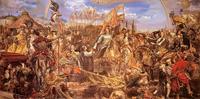
Sobieski II
Jan Matejko
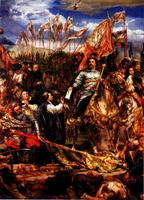
Sobieski at Vienna
Jan Matejko
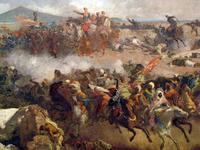
The Battle of Tetouan (detail)
Marià Fortuny
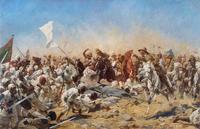
Charge of the 21th Lancers at Ondurman
William Barnes Wollen
The battle of the Taro
Tintoretto
The Battle of Tetouan (detail)
Marià Fortuny
Death of the Greek hero Markos Botsaris
Jean-Charles Langlois
Batalha do Avaí
Pedro Américo
Congress of the Kings
Jan Matejko
Battle of Arab Horsemen Around a Standard
Theodore Chasseriau
The Charge of the 21st Lancers at Omdurman
Richard Caton Woodville Jr.
Jan Zizka
Jan Matejko
Irminsul
Hermann Wislicenus
The Defence of Rhodes by the Knights of St John of Jerusalem
Gustaf Wappers