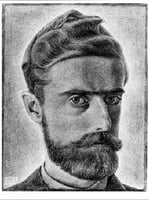
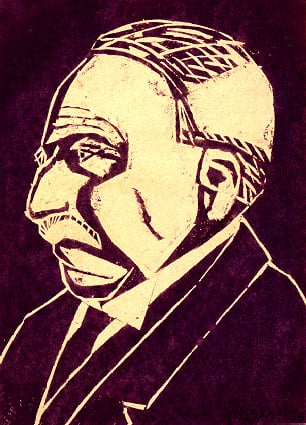
Analisi esperta di Escher's Father di M.C. Escher
Stile: Expressionism · Genere: portrait
Expert Analysis: "Escher's Father" by M.C. Escher
While M.C. Escher is globally celebrated for his mathematically precise, surrealist mind-bending prints, this early portrait—"Escher's Father"—reveals a lesser-known but crucial phase of his artistic development. Executed in an Expressionist idiom, the work departs from the cool, geometric logic of his mature style, instead embracing emotional intensity and subjective distortion.
Significance within Expressionism: As an Expressionist portrait, the painting prioritizes psychological truth over literal likeness. Escher likely uses exaggerated features, heightened color contrasts, and loose, energetic brushwork to capture his father’s character—perhaps his authority, stoicism, or the emotional weight of their relationship. This aligns with Expressionism’s core goal: to convey inner experience through visible deformation.
Significance within Escher’s Oeuvre:
- Roots in Academic Training: Escher studied under Expressionist-influenced teachers at the Haarlem School of Architecture and Decorative Arts (Samuel Jessurun de Mesquita). This portrait shows him grappling with modernist emotionalism before turning to his iconic tessellations and impossible objects.
- Subjective vs. Objective: Unlike his later prints—where systems and patterns govern the image—here the human subject is dominant. It demonstrates that Escher was initially drawn to the raw expressiveness of the human face, a sensitivity he would later channel into his figurative woodcuts (e.g., Day and Night, 1938).
- Personal Resonance: The choice to depict his father, a judge, adds biographical depth. The expressionist treatment may reflect Escher’s own struggle between filial duty and artistic freedom, making this work a key document of his creative genesis.
Conclusion:
"Escher's Father" is significant as an early experiment in emotional realism, bridging the gap between traditional portraiture and the visionary graphic world Escher would later construct. It reminds us that even the most logical of artists once wrestled with the subjective, the messy, and the deeply personal.
Visivamente simili
20 opere con composizione e palette affini
Dr. O. Kohnstamm
Ernst Ludwig Kirchner
Self-portrait
Felix Vallotton
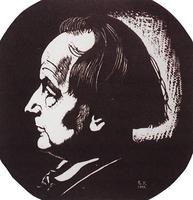
Portrait of V. Zamirailo
Boris Kustodiev
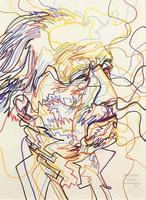
Marcel (portrait de Marcel Duchamp)
Gerard Fromanger
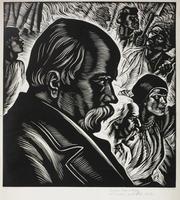
Taras Shevchenko
Vasyl Kasiyan
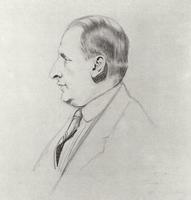
Portrait B.A.Gorin-Goryainov
Boris Kustodiev
Ivan Olbracht: Good Old Times
Maria Bozoky
Portrait of the Novelist Thomas Mann
Max Oppenheimer
Man in Profile
Enrico Caruso
Portrait of French writer Henri Mazel
Felix Vallotton
Sergey Paradzhanov
Georgyi Yakutovytch
Don Juan
Theo van Doesburg
Untitled
Max Pechstein
Cover Design, Portrait of Kamal-Al-Molk
Aydin Aghdashloo
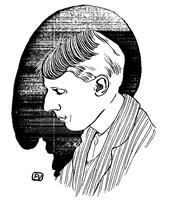
Portrait of English writer and illustrator Aubrey Beardsley
Felix Vallotton
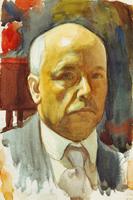
Self-portrait
Eero Järnefelt
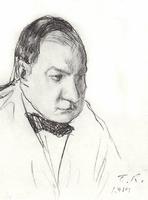
Portrait of N.G. Aleksandrov
Boris Kustodiev
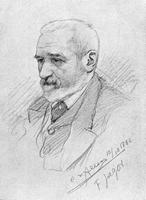
Portrait of Fedor Jagor
Christian Wilhelm Allers
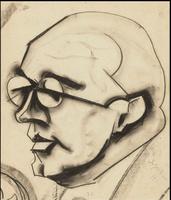
Scheiber Hugó.. . Férfi Portré
Scheiber Hugó
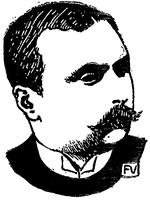
Portrait of Danish writer Peter Nansen
Felix Vallotton