
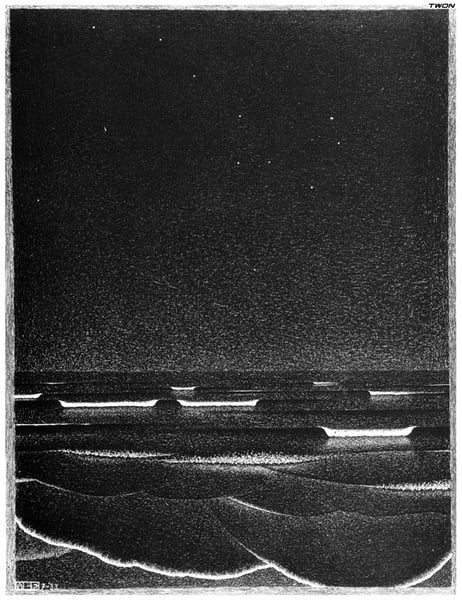
Analisi esperta di Fluorescent Sea di M.C. Escher
Stile: Surrealism · Genere: marina
Expert Analysis of "Fluorescent Sea" by M.C. Escher
Within the framework of Surrealism, M.C. Escher’s Fluorescent Sea stands as a remarkable hybrid: it takes the traditional maritime genre—the marina—and subverts it through the dreamlike, paradoxical logic that defines Surrealist practice. While Escher is more widely known for his mathematically rigorous tessellations and impossible architectures, this work demonstrates his ability to infuse a familiar subject (a seascape) with an otherworldly, phosphorescent quality that blurs the boundary between the natural and the hallucinatory.
Significance within Surrealism
The painting’s significance lies in its transformation of a conventional coastal view into a space of psychological and perceptual tension. By labeling the sea “fluorescent,” Escher introduces an unnatural, glowing luminescence—a phenomenon that is at once visually arresting and conceptually disorienting. This aligns with Surrealism’s core aim: to disrupt everyday reality and access the subconscious. Unlike dreamscapes that rely on impossible objects or disjointed imagery, Fluorescent Sea achieves its surreal effect through an exaggeration of a single natural element (light itself), making the ordinary sea appear alive with an eerie, autonomous radiance. The fluorescence suggests a hidden, bioluminescent energy—perhaps a metaphor for the unseen forces of the mind—and invites the viewer to question what is real and what is projected.
Innovation within the Marina Genre
The genre of the marina has historically been tied to realism, romanticism, or impressionistic capture of water and sky. Escher’s contribution is to inject the marina with the uncanny. The fluorescent glow disrupts the expected palette and texture of seawater, turning the sea into a synthetic, almost toxic spectacle. This move foreshadows later currents in surrealist and fantastic art that treat natural landscapes as arenas for psychological or even alien occurrences. The work is significant because it demonstrates that Surrealism does not require bizarre assemblages of objects; it can be achieved by distorting the very substance of a familiar scene—in this case, the illuminated surface of the sea itself.
In sum, Fluorescent Sea is a landmark that marries the precision of Escher’s draughtsmanship with the liberating irrationality of Surrealism, all while reinventing the humble marina as a theatre for the sublime and the unsettling.
Visivamente simili
20 opere con composizione e palette affini
Boats on Coast
Lin Fengmian
Two Friends on the Shore of Long Island
Devin Leonardi
Sea wave
Grace Cossington Smith
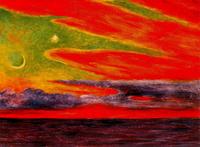
Evening Twilight at Acapulco
Diego Rivera
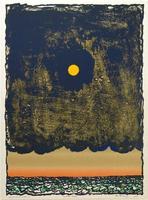
Low Tide (Marée basse)
Pierre Alechinsky
Swimmer
Alex Colville
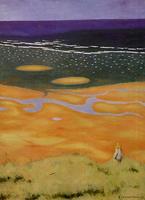
The Rising Tide
Felix Vallotton
Sunset, Gray Blue High Tide
Felix Vallotton
Untitled
Don Kenn
Punta Animas
Peter Alexander
Untitled
Mostafa Dashti
Black Sea
Pierre Alechinsky
Sorgen
Theodor Severin Kittelsen
Green Sea
Milton Avery
Young Man with Red Scarf
Leon Spilliaert
Estuary I
John Miller

Tibet
Nicholas Roerich
Sea
Arkhyp Kuindzhi
Himalayas
Nicholas Roerich
Seascape
L. S. Lowry