
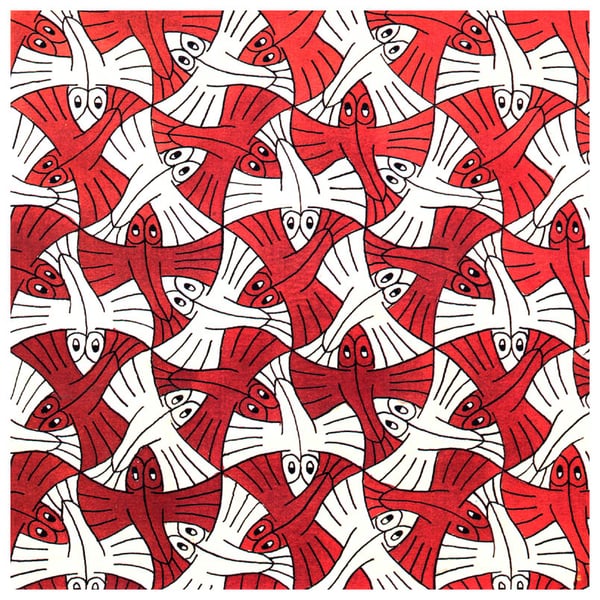
Flying Fish
Expertenanalyse zu M.C. Eschers Flying Fish
Stil: Op Art · Genre: tessellation
Expert Analysis: Flying Fish by M.C. Escher
M.C. Escher’s Flying Fish stands as a masterful intersection of Op Art and tessellation—a genre where the artist famously elevated mathematical patterning into perceptual illusion. As a tessellation, the work achieves a seamless, interlocking composition of fish forms that repeat across the plane without gaps or overlaps, demonstrating Escher’s hallmark precision in geometry.
Within the Op Art movement, Flying Fish is significant for its ability to generate optical movement and ambiguous depth. The repeated fish shapes, through subtle shifts in orientation and positive-negative space, create a rhythmic, almost kinetic visual experience. The viewer’s eye is drawn into a paradoxical play between figure and ground, where the fish appear to both swim and fly across the picture plane. This dual reading—part biological, part geometric—exemplifies Escher’s genius for merging natural forms with systematic abstraction, making Flying Fish a compelling study of pattern perception and a seminal work in the Op Art lexicon.
Visuell ähnlich
20 Werke mit ähnlicher Komposition und Farbpalette
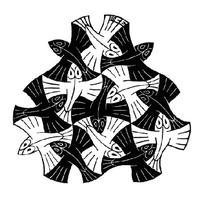
7 Black and 6 White Fishes
M.C. Escher
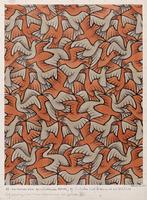
Twelve Birds
M.C. Escher
Square Limit
M.C. Escher
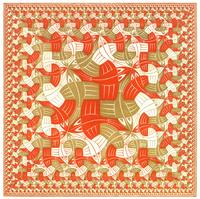
Square Limit Colour
M.C. Escher
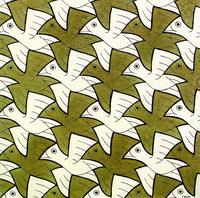
Symmetry Watercolor 106 Bird
M.C. Escher
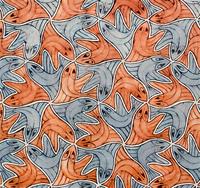
Symmetry Watercolor 94 Fish
M.C. Escher
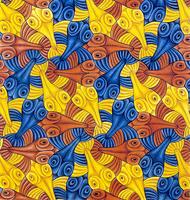
Symmetry Watercolor 55 Fish
M.C. Escher
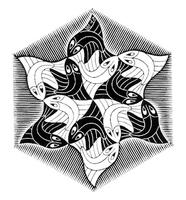
Hexagonal Fish Vignette
M.C. Escher
Opus 114
Hans Hinterreiter
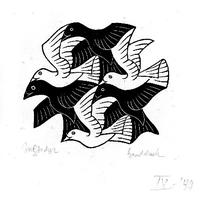
Plane Filling Motif with Birds
M.C. Escher
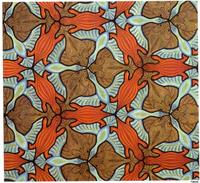
Symmetry Drawing
M.C. Escher
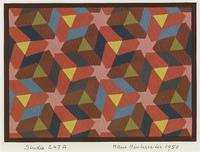
Studie 247A
Hans Hinterreiter
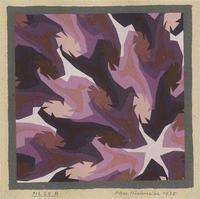
ME 25 B
Hans Hinterreiter
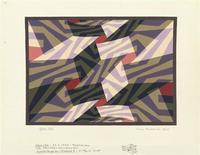
Opus 153
Hans Hinterreiter
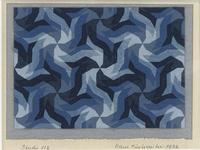
Studie 112
Hans Hinterreiter
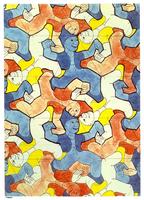
Dwarves
M.C. Escher
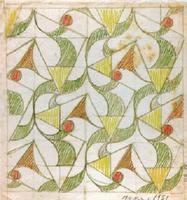
Ornament
Vasyl Hryhorovych Krychevsky
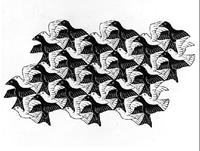
Regular Division of The Plane with Birds
M.C. Escher
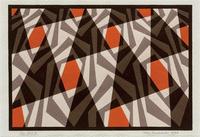
Opus 103 D
Hans Hinterreiter
Waves on the Hudson River
Yayoi Kusama