
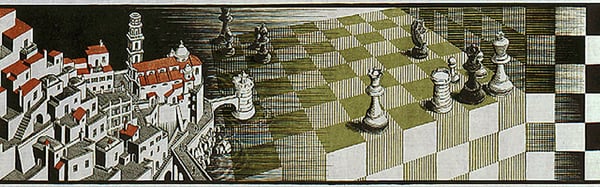
Analisi esperta di Metamorphosis II excerpt 6 di M.C. Escher
Stile: Op Art · Genere: tessellation
Expert Analysis: "Metamorphosis II excerpt 6" by M.C. Escher
Executed in the Op Art style within the tessellation genre, "Metamorphosis II excerpt 6" exemplifies Escher’s pioneering fusion of mathematical precision and perceptual illusion. As a detail from his monumental 1967–1968 woodcut Metamorphosis II, this excerpt captures a critical transitional moment where geometric forms systematically morph into representational motifs—a hallmark of Escher’s genius in transforming rigid tessellations into fluid visual narratives.
Significance within Op Art and Tessellation
-
Op Art Context: Op Art (Optical Art) emerged in the mid‑20th century, emphasizing visual effects like movement, vibration, and afterimages through precise, often black‑and‑white patterns. Escher’s Metamorphosis series aligns with Op Art’s core intent—stimulating the retina with ambiguous, shifting forms—but transcends mere optical trickery by embedding narrative progression. In excerpt 6, the viewer experiences a gradual, almost hypnotic transformation that forces the eye to oscillate between pattern and subject, a quintessential Op Art experience that predates and informs later works by Vasarely and Riley.
-
Tessellation Innovation: Escher elevated tessellation from decorative patterning to a sophisticated spatial language. This excerpt demonstrates his signature technique: interlocking shapes that evolve organically from abstract tiles into recognizable figures (e.g., birds, fish, or human forms) while maintaining perfect edge‑to‑edge coverage. The “excerpt 6” portion likely captures a pivotal gradient where the rhythm of the plane shifts, highlighting Escher’s mastery of gradual metamorphosis—a concept he famously described as “regular division of the plane” inspired by Islamic tilework and crystallography.
Period Contribution Escher’s work, though often categorized as Op Art, also bridges Surrealism and mathematical art. Metamorphosis II—a nearly 13‑foot‑long print—is considered his magnum opus of visual transformation. Excerpt 6 showcases the artist’s relentless experimentation with infinity and recursion: the tessellation not only repeats but changes as it repeats, anticipating later interest in algorithmic and generative art. Its significance lies in demonstrating how strict formal constraints (the tessellation) can yield limitless perceptual ambiguity—a foundational insight for Op Art’s exploration of unstable vision.
Visivamente simili
20 opere con composizione e palette affini
Metamorphosis III excerpt 7
M.C. Escher
Metamorphosis III excerpt 8
M.C. Escher
Untitled
Toyen
The Chess Board
Victor Vasarely
Governors of Fates
Nina Tokhtaman Valetova
Chess
Volodymyr Loboda
The Chess Game
Charles Blackman
Chess Game
Evan Magar
Untitled
Sonaly Gandhi
Crazy king in the trophy room
Iurie Matei
Masochistic King
Ru
Checkmate
Rene Magritte
Still Life
Juan Gris
Bortnyik Sándor, Sakkozók
Sandor Bortnyik
Obscure Games
Nina Tokhtaman Valetova

Seventh season
Will Barnet
Buck
Barkley L. Hendricks
A Partida de Xadrez
Maria Helena Vieira da Silva
The Patience
Georges Braque
Checker Players
Milton Avery