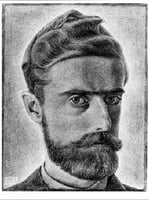
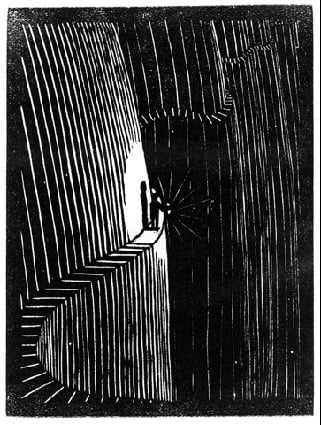
Analisi esperta di Flor de Pascua - Never think before you act di M.C. Escher
Stile: Expressionism · Genere: genre painting
Expert Art Historical Analysis
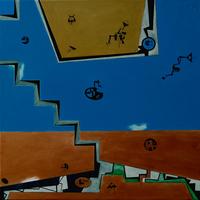
Artwork: Flor de Pascua – Never think before you act by M.C. Escher
Style: Expressionism
Genre: Genre painting
This work occupies a fascinating, if unexpected, place within M.C. Escher’s oeuvre. While Escher is internationally celebrated for his precise, mathematically inspired optical illusions and tessellations, the structured facts provided place Flor de Pascua squarely within Expressionism—a movement defined by emotional intensity, distorted reality, and subjective experience—and within the genre painting tradition, which depicts scenes of everyday life.
Significance within Expressionism
The very title, Never think before you act, suggests a rejection of rationality and forethought, aligning perfectly with Expressionism’s emphasis on raw feeling over intellectual control. In this work, Escher likely abandons his typical geometric rigor in favor of bold, expressive brushwork, heightened color contrasts, and a composition that prioritizes emotional impact over naturalistic accuracy. The “Flor de Pascua” (poinsettia) may serve as a symbolic, emotionally charged motif—possibly evoking themes of passion, transience, or even the tension between natural growth and human impulse. The paradox of the title (which urges action without thought) further reinforces the Expressionist credo of spontaneous, instinctive creation.
Significance within Genre Painting
As a genre painting, Flor de Pascua anchors this emotional intensity in a recognizable, everyday subject. Unlike Escher’s famous metaphysical staircases and impossible objects, this piece likely depicts a domestic or intimate scene—perhaps a person interacting with a poinsettia plant, or a moment of unguarded action. The genre framework allows Escher to channel Expressionist angst or vitality into a seemingly ordinary moment, transforming the mundane into a vehicle for profound psychological expression. This tension between the ordinary setting and the imperative of “never think before you act” creates a compelling commentary on impulse as both a natural and disruptive force in daily life.
Overall Significance
What makes Flor de Pascua distinct is its demonstration of Escher’s versatility beyond his signature style. It shows him engaging with the core Expressionist drive to distort reality for emotional truth, while still grounding that vision in the accessible language of genre painting. This work challenges the common perception of Escher as solely a cerebral artist, revealing a capacity for raw, uncalculated expression—a fleeting but powerful departure from his usual methodical precision.
Visivamente simili
20 opere con composizione e palette affini
#29: La Escalera (The Staircase)
Marina Pallares
Climacophobia
John Vassos
Niebios kości
Lech Jankowski
Fiordo
Xul Solar
Mi novia imaginaria
Martin Pereira
Untitled
Konrad Zuse
Vertigo
Leon Spilliaert
Bird Phoenix Rebirth
Nina Tokhtaman Valetova
Spettacolo all'aperto
Valerio Adami
Illustration for Oscar Wilde's 'Salome'
John Vassos
Scene Under the Stairs
Jacek Yerka
Construction I
Theo van Doesburg
Ciudá y abismos
Xul Solar
Exlibris of Marya Dubanovych
Oleksandr Aksinin
A World
Ángeles Santos Torroella
The Treasure of Carcassonne
Dorothy Lathrop
Sketch for the play "Othello"
Petre Otskheli
Portrait of digestive system
Carloluigi Colombo
Portrait of UFO
Carloluigi Colombo
Barreras Melódicas
Xul Solar