Expert analysis of M.C. Escher’s Path of Life I
Style: Op Art · Genre: tessellation
Expert Analysis: "Path of Life I" by M.C. Escher (1958)
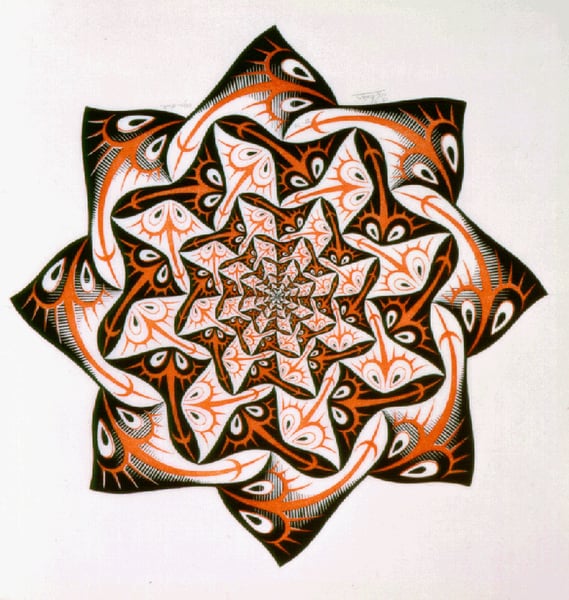
M.C. Escher’s "Path of Life I" stands as a masterful synthesis of tessellation and Op Art, demonstrating the artist’s unparalleled ability to fuse mathematical precision with perceptual illusion. The work is a woodcut in black, gray, and white, depicting a continuous ribbon of interlocking birds and fish that spiral outward from a central vortex. This piece is significant within Escher’s oeuvre and the broader Op Art movement for several reasons:
1. Transformation of the Tessellation Genre
Escher elevates the ancient art of tessellation—traditionally a static, repeating geometric pattern—into a dynamic narrative. Here, the reptilian/bird forms are not merely adjacent but seamlessly morph into one another along a curved path, creating a paradoxical sense of motion within a static image. The black and gray birds fly rightward, while the white fish swim leftward, yet their shared contours bind them in a single, unbroken field. This blurring of figure and ground challenges the viewer’s eye, forcing a constant perceptual shift between positive and negative space—a hallmark of Op Art’s interest in retinal instability.
2. Optical and Conceptual Tensions
As an Op Art piece, "Path of Life I" exploits the viewer’s tendency to oscillate between competing interpretations. The spiral path suggests both inward contraction (toward the center) and outward expansion (away from it), a visual paradox that stimulates the retina without a clear resolution. The monochromatic palette heightens this effect, as the high-contrast black/gray/white bands create moiré-like flicker when scanned. Escher’s design deliberately frustrates the eye’s attempt to fix a stable boundary, embodying Op Art’s core aim: to make perception itself the subject of the work.
3. Symbolism of Infinite Regress
The title “Path of Life” alludes to themes of cyclical existence, transformation, and the interdependence of opposing forces (predator/prey, solid/void, dark/light). The Escher Foundation notes that the interlocking forms represent a “continuous flow of life,” where each creature is defined by its neighbor—a visual metaphor for ecological and existential interdependence. This symbolic layering elevates the piece beyond mere pattern; it becomes a meditation on infinity and relativity, themes Escher explored in works like Drawing Hands and Print Gallery.
4. Technical Virtuosity
Executed as a woodcut with careful registration of two blocks (gray and black), the work showcases Escher’s meticulous craftsmanship. The precision required to carve the tiny, interlocked shapes—each bird’s tail forming the fish’s mouth, each fish’s fin becoming the bird’s wing—is extraordinary. The spiral gradient from dense center to sparse edges also demonstrates Escher’s understanding of visual rhythm, drawing the eye inexorably inward.
Conclusion
"Path of Life I" is significant because it redefines tessellation as an active, perceptual experience rather than a passive decorative scheme. By merging Op Art’s optical trickery with Escher’s iconic metamorphic style, the work stands as a bridge between mathematical art and perceptual psychology—a timeless study of how the mind constructs meaning from ambiguity.
Visually similar
20 works with related composition and palette
Path of Life II Colour
M.C. Escher
Path of Life II
M.C. Escher
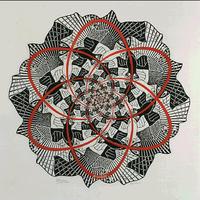
Path of Life III
M.C. Escher
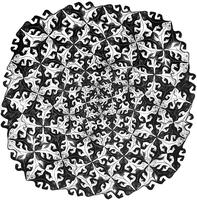
Division
M.C. Escher
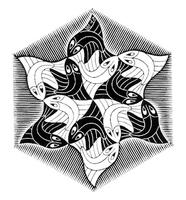
Hexagonal Fish Vignette
M.C. Escher
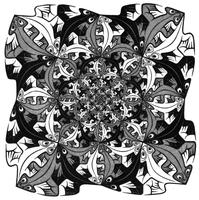
Smaller & Smaller
M.C. Escher
Studie zu Opus 92A
Hans Hinterreiter
GENE mirroring MACHINE
Pirachi
Circle Limit I
M.C. Escher
Circular Fish
M.C. Escher
Postal Greeting Card
M.C. Escher
Square Limit
M.C. Escher
Whirlpools
M.C. Escher
Smaller & Smaller Colour
M.C. Escher
Snakes
M.C. Escher
Square Limit Colour
M.C. Escher
ME 25 B
Hans Hinterreiter
Fish
M.C. Escher
Unspiral - 2
Gianni Sarcone
Opus 73
Hans Hinterreiter