Analisi esperta di Old Olive Tree, Corsica di M.C. Escher
Stile: Realism · Genere: landscape
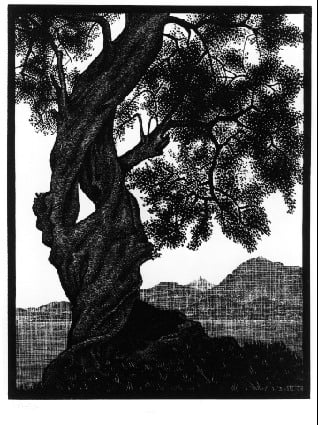
Expert Analysis of "Old Olive Tree, Corsica" by M.C. Escher
M.C. Escher is universally celebrated for his mind-bending tessellations, impossible architectures, and surreal spatial paradoxes. Yet his early work—rooted in painstaking observation of the natural world—reveals the foundational discipline that underpins his later innovations. Old Olive Tree, Corsica stands as a masterful example of Escher’s Realist phase, a period when he honed his technical precision through direct landscape study.
Executed in the early 1930s during Escher’s travels in Corsica, this work captures a gnarled, ancient olive tree with almost botanical rigor. The composition is deceptively simple: the massive, twisting trunk anchors the foreground, its bark rendered with meticulous hatching and crosshatching that conveys texture and age. The branches sprawl asymmetrically, their silvery leaves rendered in delicate, varied strokes that suggest both mass and movement. Beyond the tree, a rugged hillside recedes under a luminous, clear sky, the landscape treated with restrained atmospheric perspective.
What makes this work significant within Escher’s oeuvre is its demonstration of pure mimesis. Here, there is no optical trickery, no metamorphosis—only an unflinching fidelity to form. The olive tree becomes a study in endurance: its contorted limbs and hollowed trunk speak to centuries of wind and sun, a subject that resonates with Escher’s own fascination with growth, decay, and cyclical patterns. This early grounding in Realism gave Escher the visual vocabulary to later manipulate reality so effectively. Without the patience to render an olive tree’s bark as precisely as he does here, his later impossible staircases and morphing fish could never have felt so convincingly tangible.
In the context of the landscape genre, the work stands out for its quiet monumentality. Escher chose not to romanticize the scene or infuse it with dramatic light; instead, he lets the tree’s natural architecture be the event. It is a portrait of resilience, painted with the same obsessive attention that would later map the geometry of a Möbius strip. Old Olive Tree, Corsica is thus a key transitional piece—proof that before Escher could bend nature to his will, he first had to master its every detail.
Visivamente simili
20 opere con composizione e palette affini

Solitary Bonsai
Eyvind Earle
Old trunk
Konstantin Bogaevsky
Olive trees
Konstantinos Maleas
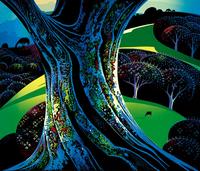
Great Oak
Eyvind Earle
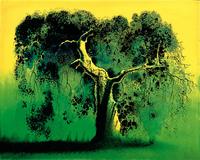
Sycamore
Eyvind Earle
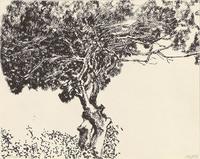
Pine Trees
Avigdor Arikha
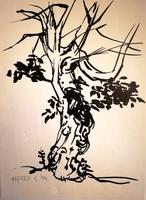
A portrait of the old tree
Alfred Freddy Krupa
Group of deciduous trees and stones
Ivan Shishkin
Old Oaks in Surrey
Jan Toorop
Scheiber Hugó, Vízparti Fák,
Scheiber Hugó
Road from Rome to Albano
Henryk Siemiradzki
Three Oaks
Eyvind Earle
Untitled
Georgyi Yakutovytch
Pine Tree
Eyvind Earle
Jewel Tree
Eyvind Earle
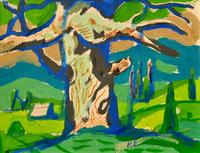
Mighty Oak
Roman Selsky

Fire Magic
Eyvind Earle
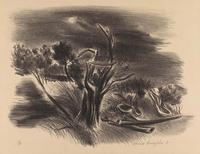
The Storm
Yasuo Kuniyoshi
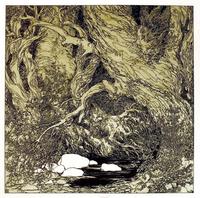
Die Bucher Der Chronika Der Drei Schwestern 2
Heinrich Lefler
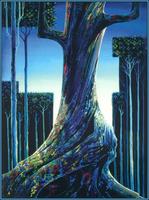
Medieval Forest
Eyvind Earle