
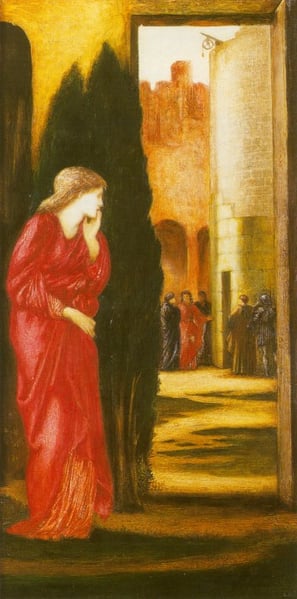
Analisi esperta di Danae and the Brazen Tower di Edward Burne-Jones
Stile: Romanticism · Genere: mythological painting
Expert Analysis: "Danae and the Brazen Tower" by Edward Burne-Jones
Within the Romantic movement, Edward Burne-Jones’s Danae and the Brazen Tower stands as a quintessential example of how 19th-century artists reimagined classical mythology through a lens of emotional intensity, symbolic depth, and medievalizing aesthetic. Painted in the Romantic style, the work reflects the period’s fascination with ancient legends as vehicles for exploring human vulnerability, fate, and transcendence.
Mythological Resonance
The subject derives from the Greek myth of Danae, whom her father, King Acrisius, imprisoned in a bronze (brazen) tower to prevent a prophecy that her son would kill him. Zeus, however, visited her as a shower of gold, impregnating her with Perseus. Burne-Jones captures the moment before the divine intervention—the tension of confinement and the looming, mythic transformation. His choice of this narrative aligns with Romanticism’s preference for dramatic, often tragic, mythological episodes that probe the boundaries between the mortal and the divine.
Significance within Romanticism
Unlike earlier Neoclassical treatments of myth, which prioritized rational order and idealized forms, Burne-Jones infuses the scene with a dreamlike, almost melancholic atmosphere. The brazen tower becomes a metaphor for isolation and desire, central Romantic themes. His elongated, ethereal figures—characteristic of his Pre-Raphaelite-influenced style—drape in flowing robes, their poses emphasizing psychological interiority rather than heroic action. The muted, jewel-like colors and meticulous attention to decorative detail further evoke a medieval manuscript or tapestry, a hallmark of Romanticism’s nostalgia for pre-industrial, spiritual art.
Symbolic and Compositional Highlights
The tower itself, rendered with intricate geometric patterns, dominates the composition, symbolizing both physical entrapment and the constraints of fate. Light filters through a high window, prefiguring the golden shower yet to come, while Danae’s downward gaze and folded hands convey a quiet resignation—a Romantic celebration of melancholy and the sublime. By blending mythological narrative with a mood of poetic introspection, Burne-Jones elevates Danae and the Brazen Tower beyond mere illustration, making it a profound meditation on longing and destiny.
In sum, this work’s significance lies in its synthesis of Romantic emotionalism, mythological revival, and decorative artistry—offering a window into the era’s enduring fascination with the ancient world as a mirror for modern sensibilities.
Museum / Gallery
Visivamente simili
20 opere con composizione e palette affini
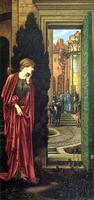
Danae or The Tower of Brass
Edward Burne-Jones
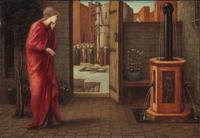
Danaë Watching the Building of the Brazen Tower
Edward Burne-Jones
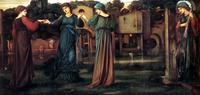
The Mill
Edward Burne-Jones
Fair Rosamond and Queen Eleonor
Edward Burne-Jones
The Pool of Bethesda
Robert Bateman

Episode from the Genesis
Mariotto Albertinelli
Salome with the Head of St John the Baptist
Sandro Botticelli
The Princess Sabra Led to the Dragon Painting
Edward Burne-Jones

The Pilgrim at the Gate of Idleness
Edward Burne-Jones

The Donne Triptych left wing
Hans Memling
Saint Nicholas of Tolentino Reviving a Child
Benvenuto Tisi
The Banishment of Hagar
Johann Friedrich Overbeck
Pygmalion and the Image I: The Heart Desires
Edward Burne-Jones
The Annnciation
Edward Burne-Jones
A Dinner in the Forest
Otto van Veen

Adoration of the Magi
Dosso Dossi

Christ Taking Leave of His Mother
Albrecht Altdorfer
The Prioress's Tale
Edward Burne-Jones
Scenes from the Lives of Joachim and Anne
Luca Signorelli
St. Barbara
Giovanni Antonio Boltraffio