
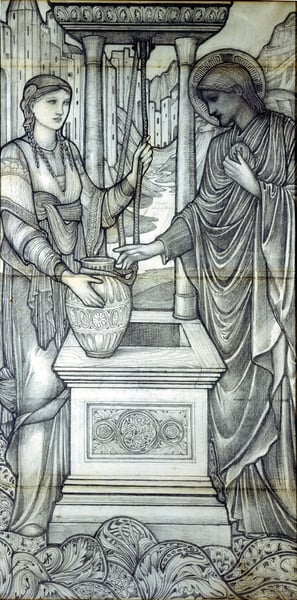
Jesus and Woman at the Well
Analisi esperta di Jesus and Woman at the Well di Edward Burne-Jones
Stile: Romanticism · Genere: religious painting
Expert Analysis: "Jesus and Woman at the Well" by Edward Burne-Jones
Edward Burne-Jones’s Jesus and Woman at the Well reimagines a familiar biblical narrative (John 4:1–42) through the lens of Romanticism’s spiritual and emotional intensity, while also anticipating the symbolist and aesthetic currents that would define his later career. Although Burne-Jones is most often associated with the Pre-Raphaelite Brotherhood and the Aesthetic Movement, this work’s inclusion under the Romanticism label highlights its core commitment to subjective feeling, transcendent beauty, and a reverence for the sublime—hallmarks of the Romantic spirit.
What makes this artwork significant within the Romantic style:
-
Spiritual Transcendence Over Narrative Literalism
Burne-Jones avoids the theatrical drama or moralizing typical of earlier religious painting. Instead, he renders the encounter as a hushed, almost dreamlike communion. The figures of Jesus and the Samaritan woman are placed in a timeless, lyrical landscape, their gestures gentle and inward. This aligns with Romanticism’s valorization of the ineffable—the sense that divine truth is felt rather than explicitly taught. The well itself becomes a sacramental symbol, not just a setting but the source of living water (spiritual grace), echoing Romantic poetry’s use of nature as a conduit for the divine. -
Emotional Depth Through Formal Harmony
Romanticism often prized raw emotion, but Burne-Jones channels feeling through refined, linear elegance and muted, luminous color. The woman’s posture—poised, curious yet vulnerable—and Christ’s calm, steady gaze create a charged stillness. This emotional restraint, combined with the almost abstract decorative patterning in the drapery and foliage, prefigures the Aesthetic movement’s “art for art’s sake,” yet remains deeply Romantic in its insistence on the artwork as a vehicle for personal, affective experience. -
Medievalism and Anti-Industrial Idealism
In true Romantic fashion, Burne-Jones rejects the materialism of the Victorian era. His figures are garbed in anachronistic, quasi-medieval robes, and the composition recalls early Renaissance frescoes (especially works by Fra Angelico). This nostalgic turn to a pre-industrial, faith-centered past was a key Romantic strategy: the painting offers an authentic, spiritually unified world as a counterbalance to the fragmentation of modern life. The woman’s humble identity as a Samaritan outsider also underscores Romanticism’s fascination with the marginalized and the redemptive power of empathy. -
Atmosphere of Mystery and Introspection
The background—a twilight sky, distant hills, and a solitary well—evokes a Romantic sublime: vast, silent, and pregnant with meaning. The light seems to emanate from within the figures, not from an external source, suggesting an internal illumination. This meshes with Romanticism’s focus on the individual’s inner vision and the search for the absolute.
Conclusion:
Burne-Jones’s Jesus and Woman at the Well is significant as a transitional masterpiece that synthesizes Romanticism’s spiritual yearnings with the emerging symbolist and aesthetic ideals of the later 19th century. It moves beyond mere biblical illustration to become a meditation on faith, encounter, and the eternal—qualities that ensure its enduring resonance within the Romantic tradition.
Visivamente simili
20 opere con composizione e palette affini
Christ and the Samaritan Woman at the Jacob's Well
Jan Joest
Lamentation
Jacopo Bellini
The Presentation of the Infant Jesus in the Temple
Giotto
Altar of Philip the Bold, Duke of Burgundy, left wing: Annunciation and Visitation
Melchior Broederlam
Gudrun Setting Fire to Atli's Palace
Edward Burne-Jones
St. Jerome Tempted by Dancing Girls
Limbourg brothers
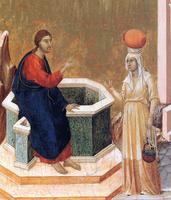
Christ and the Samaritan woman (Fragment)
Duccio
The Visitation
Limbourg brothers

St. Jerome Extracting a Thorn
Limbourg brothers
The Apostles Going Forth to Preach
Limbourg brothers
The Youth of Moses
Sandro Botticelli
Annunciation, Matenadaran
Toros Roslin
Presentation of Christ at the Temple
Giotto
The Annunciation with two Kneeling Donors
Filippo Lippi
The Garden of Opportunity
Evelyn De Morgan
The Archangel Gabriel Appears to Zachary
Limbourg brothers
The Ascension
Limbourg brothers

Saint Louis of Toulouse Saint Jerome Saint Peter and
Carlo Crivelli
Dante and Virgil Entering Purgatory
Luca Signorelli
Annunciation
Limbourg brothers