
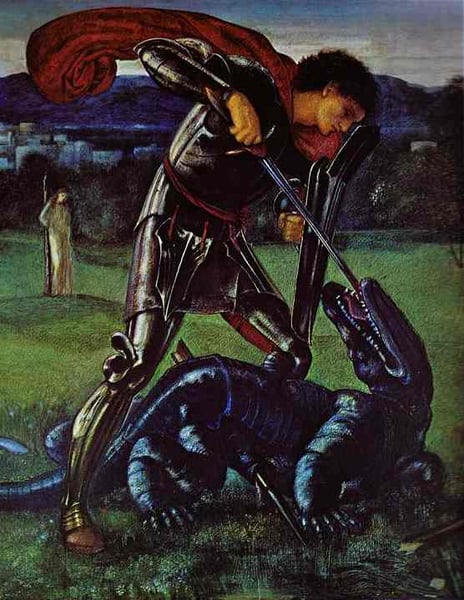
St. George and the Dragon
Details
Expert analysis of Edward Burne-Jones’s St. George and the Dragon
Style: Romanticism · Genre: religious painting
Expert Analysis of "St. George and the Dragon" by Edward Burne-Jones
As a work of Romanticism, Burne-Jones’s St. George and the Dragon transcends its religious subject to embody the movement’s core values: emotional intensity, a longing for the medieval past, and a celebration of individual heroism. The painting reinterprets the classic Christian legend—where the saint rescues a princess from a dragon—not as a mere narrative illustration, but as a symbolic, dreamlike tableau. Its significance lies in how it merges the spiritual drama of religious painting with Romanticism’s fascination with myth and the sublime.
Composition and Symbolism
Burne-Jones frames the confrontation as a poised, almost frozen moment. St. George, armored in a stylized, quasi-medieval suit, stands as an idealized Romantic hero—calm, resolute, and more than human—while the dragon coils in serpentine, decorative rhythms. The princess waits in the background, her figure echoing the passive, pure femininity central to Romantic and Pre-Raphaelite ideals. The landscape is not naturalistic but deliberately archaic, evoking a lost chivalric age. Every element—the dense foliage, the gilded sky, the dragon’s sinuous form—serves to elevate the scene above the literal into a realm of spiritual and emotional truth.
Significance within Romanticism
Within the Romantic period, Burne-Jones’s treatment is significant for three reasons:
- Medieval Revival: The painting rejects industrialization and Enlightenment rationalism, instead immersing the viewer in a medieval dreamworld. This backward glance is a hallmark of Romanticism, which sought authenticity in the pre-modern.
- Emotional and Moral Depth: Rather than depicting violent action, Burne-Jones emphasizes stillness and inner resolve. The dragon’s defeat becomes a metaphor for the triumph of the soul over chaos—a deeply Romantic theme of individual moral struggle.
- Decorative and Aesthetic Unity: The work’s flattened perspective, elaborate patterns, and rich color harmonies anticipate the Aesthetic Movement, but remain rooted in Romanticism’s subordination of nature to feeling. The religious genre here is transformed into a vehicle for expressing the sublime, the mysterious, and the ideal.
Conclusion
St. George and the Dragon stands as a pivotal Romantic religious painting because it merges devotional narrative with the period’s yearning for transcendence, myth, and historical nostalgia. Burne-Jones achieves a visual poem in which faith, heroism, and beauty are inseparably entwined, making the work a landmark in the Romantic reinterpretation of sacred art.
Visually similar
20 works with related composition and palette

Fight Dobrynya Nikitich with seven headed serpent Hydra
Viktor Vasnetsov
The Frog Prince and other stories
Walter Crane

On the bridge Kalinovoye
Konstantin Vasilyev

St. Michael and the Dragon
Antonio del Pollaiolo

Dobrynya's battle with a dragon
Konstantin Vasilyev

The battle with the dragon
Konstantin Vasilyev

Illustration for Perseus
Artuš Scheiner

St. George and the Dragon
Briton Riviere

St George
Tintoretto

Saint Michael Triumphs over the Devil
Bartolome Bermejo

King Arthur Sir Bedivere throwing Excalibur into the lake
Walter Crane

St. George Slaying the Dragon
Hans von Aachen

Saint George
Edward Burne-Jones

St. Michael
Raphael

St. George
Andrea Mantegna

St George Slaying the Dragon
Byam Shaw
Lancelot fights against a dragon at the Castle of Corbin
Arthur Rackham

St. George and the Dragon
Raphael

Victory (Gorynych the Serpent)
Nicholas Roerich
Passion of Christ
Albrecht Altdorfer