
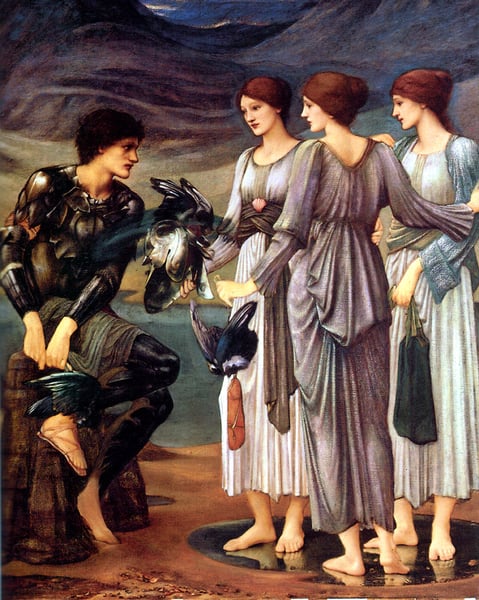
Expertenanalyse zu Edward Burne-Joness The Arming of Perseus
Stil: Romanticism · Genre: mythological painting
Expert Analysis: "The Arming of Perseus" by Edward Burne-Jones
Burne-Jones’s The Arming of Perseus is a striking example of Romanticism’s deep engagement with classical mythology, rendered through the movement’s characteristic emotional intensity and idealized heroism. Within the Romantic tradition, mythological painting served not merely as historical illustration but as a vehicle for exploring human passion, moral struggle, and the sublime—qualities that Burne-Jones amplifies in this work.
The subject itself—the moment when the hero Perseus receives divine gifts (the mirrored shield, sword, and winged sandals) before facing the Gorgon Medusa—epitomizes Romanticism’s fascination with individual destiny and supernatural intervention. Burne-Jones frames this as a taut psychological drama: Perseus stands poised between mortal vulnerability and godlike purpose, his expression a blend of resolve and awe. The attending goddesses (Athena and messengers) are not merely passive donors; their gestures and drapery suggest an urgent, almost otherworldly charge, reinforcing the Romantic belief in art as a conduit for transcendent experience.
The painting’s significance lies in how it synthesizes Romantic ideals with a refined, decorative sensibility. Unlike the turbulent brushwork of earlier Romantics such as Delacroix, Burne-Jones employs a polished, linear precision and rich, jewel-like color—hallmarks of his later style—yet retains Romanticism’s core concerns: the lone hero confronting fate, the mingling of the human with the divine, and the seductive peril of mythic quests. The composition, with its balanced figures and arch-like framing, evokes a sense of ritual, elevating the mythological moment into a timeless emblem of courage and transformation.
In the context of Romanticism, The Arming of Perseus stands out for its quiet intensity. It avoids bombast, instead inviting the viewer into a suspended, meditative space where the hero’s prepare becomes a universal allegory for the Romantic soul’s readiness to face the unknown. Burne-Jones’s work thus bridges Romantic emotional depth with a harmonious, almost Pre-Raphaelite attention to detail, making it a distinctive contribution to the period’s mythological canon.
Museum / Gallery
Visuell ähnlich
20 Werke mit ähnlicher Komposition und Farbpalette
Perseus and the Sea Nymphs
Edward Burne-Jones
The Wedding of Psyche
Edward Burne-Jones
King Cophetua and the Beggar Maid
Edward Burne-Jones
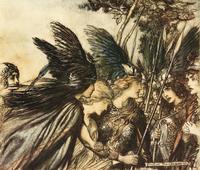
He nears, he nears, in fury!
Arthur Rackham
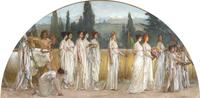
Thesmophoria
Francis Davis Millet
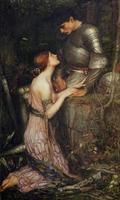
Lamia and the Soldier
John William Waterhouse
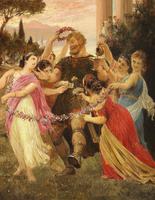
From the Ballet Valkyrien. Bjørn is Dancing with Female Elves
Otto Bache
ALLEGORY OF THE SETTLEMENT OF THE WEST
Thomas Buchanan Read
Earth Mother
Edward Burne-Jones
Cupid Finding Psyche
Edward Burne-Jones
Venus and Cupid
Evelyn De Morgan
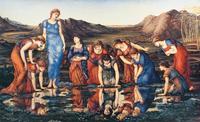
The Mirror of Venus
Edward Burne-Jones
Naomi entreating Ruth and Orpah to return to the land of Moab
William Blake
By the Waters of Babylon
Evelyn De Morgan
Between Art and Nature (detail)
Pierre Puvis de Chavannes
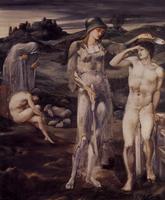
The Calling of Perseus
Edward Burne-Jones
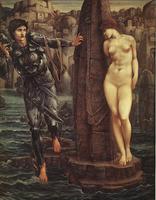
The Rock of Doom
Edward Burne-Jones
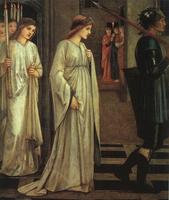
The Princess Sabra Led to the Dragon Painting
Edward Burne-Jones
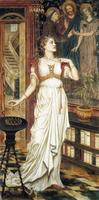
The Crown of Glory
Evelyn De Morgan
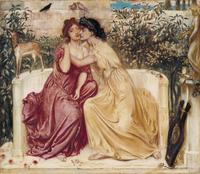
Sappho and Erinna in a Garden at Mytilene
Simeon Solomon