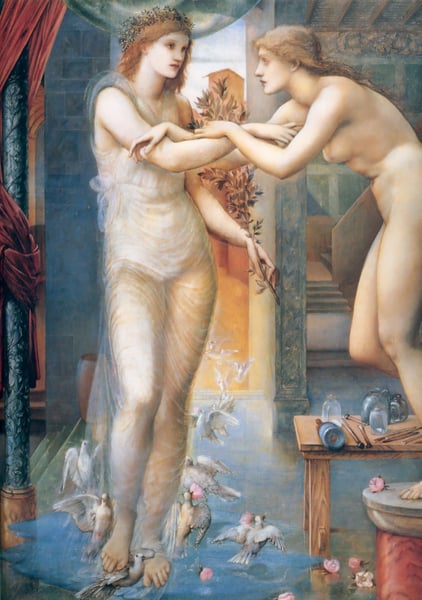
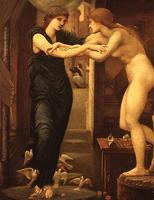
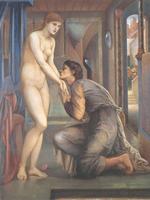
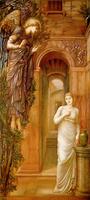
Analysis of "Pygmalion and the Image III: The Godhead Fires" by Edward Burne-Jones
This work is a pivotal mythological painting within the Romantic style, capturing the climactic moment of the Pygmalion myth. The scene depicts the instant divine intervention transforms the ivory statue into living flesh—the "godhead fires" literally igniting the union of art and life.
Significance within Romanticism:
The painting exemplifies Romanticism’s emphasis on powerful emotion, the sublime, and the transcendence of mortal limits through art and love. The viewer is drawn into the charged, anticipatory stillness before the climax, a hallmark of Romantic tension. Burne-Jones uses rich, atmospheric color and idealized, elongated figures to evoke a dreamlike, otherworldly quality, aligning with the Romantic fascination with the supernatural and the mythical.
Mythological and symbolic resonance:
As a mythological painting, it reimagines an ancient story to explore themes of creative obsession, desire, and the boundary between reality and imagination. The “Godhead Fires” specifically represent the moment when the artist’s vision is granted life by a higher power—a potent metaphor for the Romantic belief in the artist as a divinely inspired creator. This work stands out for its dramatic fusion of human passion and divine fire, making it a quintessential example of how Romanticism used classical myth to probe the deepest yearnings of the human soul.