
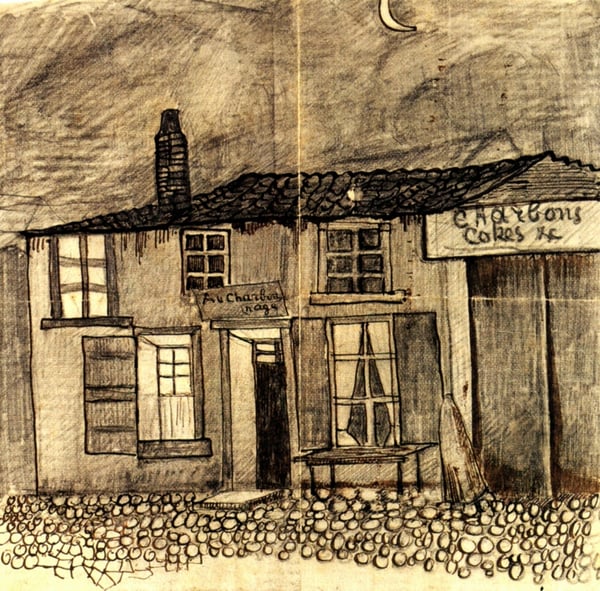
Analyse experte de “Au Charbonnage” Café de Vincent van Gogh
Style : Realism · Genre : cityscape
Expert Analysis of “Au Charbonnage” Café by Vincent van Gogh
Context within van Gogh’s Oeuvre
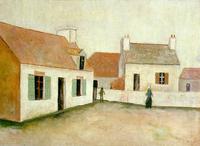
Though Vincent van Gogh is celebrated as a pioneering Post-Impressionist, “Au Charbonnage” Café belongs to his formative period (roughly 1881–1885) when he worked firmly within the Realist tradition. This early phase, often called his “Dutch period,” was deeply influenced by the dark tonalities of artists like Jean-François Millet and the Hague School. The work’s subject—a café near a coal mine—directly reflects van Gogh’s commitment to depicting the lives of laborers and the rural/industrial poor, a central concern of Realism.
Significance within the Realist Style
- Social Documentation: The “charbonnage” (coal mine) setting anchors the piece in the gritty, unidealized world of 19th-century industrial labor. Realism sought to portray everyday life without romanticism, and van Gogh’s choice of a miners’ café—a place of rest and community for exhausted workers—exemplifies this ethos.
- Somber Palette and Atmosphere: True to Realist principles, van Gogh employed a muted, earthy palette dominated by browns, grays, and deep shadows. The lack of bright color or dramatic lighting emphasizes the weary, mundane reality of the scene, steering clear of the emotional intensity and vivid hues that would define his later work.
- Empathetic Observation: Unlike some Realists who maintained a detached gaze, van Gogh’s brushwork already hints at his personal empathy—a quality that would later explode into expressive vigor. Here, however, that empathy is channeled through quiet, precise observation of architecture, signage, and the figures’ postures.
Placement in Art History
“Au Charbonnage” Café is significant as a bridge piece. It demonstrates van Gogh’s training in the Realist tradition (inherited from Courbet and the Barbizon school) while foreshadowing his shift toward a more personal, symbolic, and eventually Post-Impressionist vocabulary. The work stands as a testament to his belief that art should speak for the voiceless—a conviction that never left him, even as his style transformed. In this cityscape, the café is not merely a structure; it is a monument to the dignity of labor, rendered with a sober truthfulness that marks van Gogh’s earliest mature efforts.
Museum / Gallery
Visuellement similaire
20 œuvres à la composition et à la palette proches
Queen's Mews Court, Store Street, Dublin
Harry Aaron Kernoff
Fontenay Aux Roses, probablement la cour intérieure du 24 rue Boucicaut
Fernand Combes
Chimney Pots (Brittany)
Grace Albee
Le peintre à Montmartre
Louis Vivin
Square of Brussels
Arturo Souto
Horse
Arturo Souto
Rue de la Tombe-Issoire, Paris
Mstislav Dobuzhinsky
Route traversant village
Theophile Steinlen
Italian's house at Monmartre
Maurice Utrillo
Old Dieppe
Kuzma Petrov-Vodkin
Pons, Charente-Maritime
Albert Marquet
Blue and Orange: The Sweet Shop
James McNeill Whistler
Bistros in a Suburb
Maurice Utrillo
Mont-Cenis street
Maurice Utrillo
Fresnel. The peasant farm
Zinaida Serebriakova
Cottages
Paul Cezanne
Mother Catherine's Restaurant in Montmartre
Maurice Utrillo
Parizs Cosmos Kávézó
Bela Czobel
Restaurant Bibet at Saint Bernard
Maurice Utrillo
Houses in Ouessant
Maurice Utrillo