
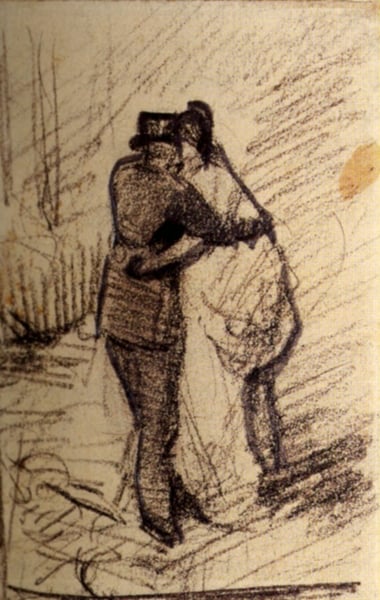
Expert analysis of Vincent van Gogh’s A Man and a Woman Seen from the Back
Style: Post-Impressionism · Genre: sketch and study
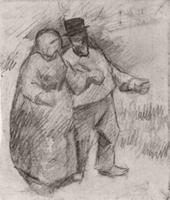
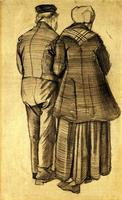
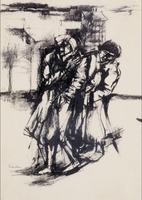
This sketch-study, A Man and a Woman Seen from the Back, is a revealing glimpse into Vincent van Gogh’s working process within the Post-Impressionist movement. As a non-finished figure study, its significance lies not in grand narrative or color, but in the raw immediacy of observation and the expressive potential of line.
Within the Post-Impressionist context, the piece exemplifies a shift away from the casual spontaneity of Impressionism toward a more structured, often psychologically charged, depiction of reality. Van Gogh, like other Post-Impressionists—Cézanne, Seurat, Gauguin—sought to imbue everyday scenes with deeper meaning or subjective feeling. Here, the choice to show the figures from the back is deliberate: it strips away facial expression, forcing the viewer to read emotion from posture, contour, and the energetic quality of the draftsmanship itself. The anonymity of the couple transforms them into universal types, yet their specific poses likely hint at the rural or working-class subjects van Gogh so frequently championed.
As a sketch and study, this work is significant for demonstrating van Gogh’s relentless discipline. Even in a rapid, unfinished drawing, one can see his characteristic graphic energy—the short, rhythmic hatchings, the bold outlines, and the way he suggests volume through direction of stroke. Such studies were essential preparatory steps for his more famous paintings, allowing him to test composition, anatomy, and spatial relationships. They reveal an artist obsessed with capturing not just appearance, but the underlying structure and movement of life.
Finally, the work’s focus on the backs of figures connects to a broader Post-Impressionist interest in the unseen—the interior lives of people and the artist’s own emotional response. By denying us faces, van Gogh emphasizes the ordinary, even humble, act of walking together, and invites contemplation of the mute intimacy shared by two anonymous individuals. In this modest study, we witness the core of his artistic mission: to make the mundane monumental through passionate, personal observation.
Museum / Gallery
Visually similar
20 works with related composition and palette
Au Bord de L'Eau Preliminary drawing
Theophile Steinlen
Country Dance
Pierre-Auguste Renoir
Woman in Dark Dress, Walking
Vincent van Gogh
Musettes-gross
Theophile Steinlen
A l'Atelier Preliminary drawing
Theophile Steinlen
Study of a Gentleman, Called Dr. Johnson
John Flaxman
Deux Gigolettes et Deux Gigolos
Theophile Steinlen
Ton Nez
Theophile Steinlen
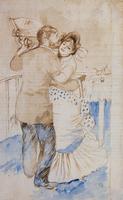
Country Dance (study)
Pierre-Auguste Renoir
Sonnez Musettes
Theophile Steinlen
The cover of Fernand Chezell's Chansons Aigres-Douces
Louis Abel-Truchet
La Promeneuse
Theophile Steinlen
Walking Couple
Vincent van Gogh
Chansons de Coeur
Theophile Steinlen
Peasant
Vincent van Gogh
Amorous Conversation
Paul-Albert Besnard
Portrait
George Bouzianis
Ginger and Fred 4
Gazmend Freitag
Man and Woman Seen from the Back
Vincent van Gogh
Kondor Béla, Férfiak
Kondor Béla