
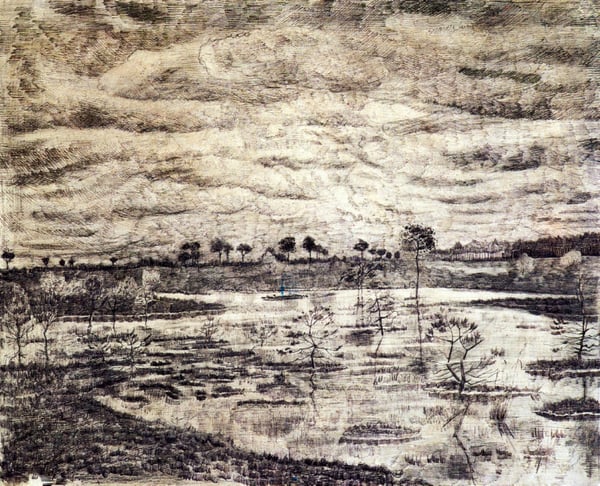
Expert analysis of Vincent van Gogh’s A Marsh
Style: Realism · Genre: landscape
Analysis of "A Marsh" by Vincent van Gogh
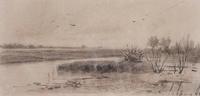
Although Vincent van Gogh is predominantly celebrated as a Post-Impressionist, the supplied facts place this work firmly within the Realist movement and the landscape genre. This classification invites a focused examination of how van Gogh, even early in his career, engaged with Realist principles while subtly infusing his emerging personal vision.
Significance within Realism and Landscape Painting:
-
Devotion to Direct Observation: As a Realist landscape, "A Marsh" would be grounded in the artist’s immediate, unidealized perception of nature. Marshes were not traditionally considered “picturesque” subjects; they were often muddy, flat, and teeming with modest plant life. By choosing such a subject, van Gogh aligns with Realism’s core mission to depict everyday, often overlooked environments with honesty and without romantic embellishment. This elevates the marsh—a liminal, waterlogged terrain—to a worthy subject of serious artistic study.
-
Influence of the Barbizon School and Millet: Van Gogh’s early work was deeply influenced by French Realists, especially Jean-François Millet and the Barbizon painters, who championed rural landscapes and the labor of ordinary life. "A Marsh" likely shares their somber earth tones, careful modeling of land and water, and attention to atmospheric conditions. The painting would emphasize the damp, heavy air, the play of light across still water, and the dense growth of reeds or grasses—all rendered with the patient, descriptive brushwork characteristic of Realism.
-
Transitional Bridging to Impressionism and Post-Impressionism: Even within a Realist framework, van Gogh’s treatment of light and texture in "A Marsh" may hint at his later innovations. The marsh’s reflective surface would have demanded a study of flickering light and shifting color, foreshadowing the Impressionist palette he would later embrace. Moreover, his handling of the tangled vegetation could reveal an early tendency toward the expressive, rhythmic strokes that define his mature style. Thus, the painting is significant as a document of van Gogh’s evolution, showing how Realism’s empirical observation of nature laid the groundwork for his eventual break into expressive color and form.
-
Thematic Resonance—Solitude and the Natural Cycle: Marshes are ecosystems of decay and renewal, a theme that resonates with Realism’s acceptance of nature’s raw processes. Van Gogh, even in this early work, often sought emotional and spiritual meaning in landscape. "A Marsh" may convey a quiet, almost melancholic solitude—a feeling of being absorbed in a damp, silent world. This aligns with the Realist penchant for capturing the mundane yet profound moments of existence, and it anticipates van Gogh’s lifelong search for the sacred within the ordinary.
In summary, "A Marsh" is significant as an example of van Gogh engaging with the Realist tradition on its own terms. It demonstrates his commitment to faithful representation of an unglamorous natural setting, while also offering early clues to the intense personal vision that would later revolutionize modern art. Within the broader context of 19th-century landscape painting, the work stands as a testament to the power of Realism to find beauty and truth in the most humble of terrains.
Museum / Gallery
Visually similar
20 works with related composition and palette
Pine Trees in the Fen
Vincent van Gogh
Вечер в Тундре. 1893
Vitold Byalynitsky-Birulya
Marsh with Water Lillies
Vincent van Gogh
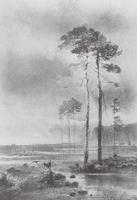
Pine in marsh
Aleksey Savrasov
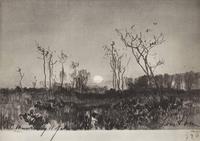
Landscape with moon
Isaac Levitan
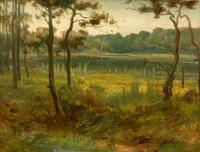
Landscape
George Hemming Mason
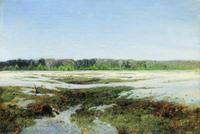
Early spring
Isaac Levitan
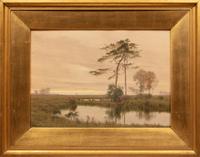
Landscape with Creek
Henry Farrer
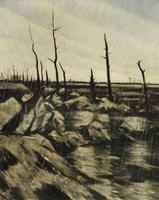
Rain and Mud After the Battle
C. R. W. Nevinson
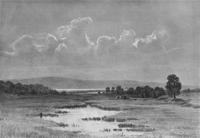
Swamp
Ivan Shishkin
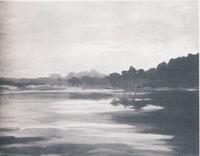
Evening Glow at Mimizan
Winston Churchill
Autumn Landscape
Levi Wells Prentice
In Late winter
Efim Volkov
Beaver Pond
Neil Welliver
Pond Giverny
Willard Metcalf
Der Ligger Tjernet I Svartbudalen
Theodor Severin Kittelsen
Evening. Sunset.
Isaac Levitan
First steps of Prospectors in the Tundra
Konstantin Korovin
SPRING AWAKENING
JAROSLAV KELUC
Marshy river
Aleksey Savrasov