
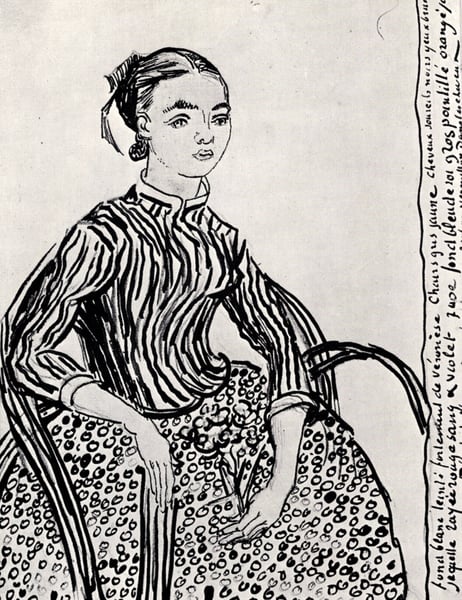
Expert analysis of Vincent van Gogh’s A mousmé, sitting
Style: Japonism · Genre: portrait
Expert Analysis: A Mousmé, Sitting by Vincent van Gogh
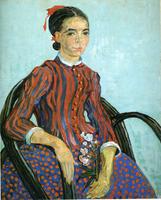
This portrait exemplifies van Gogh’s profound engagement with Japonism, the late‑19th‑century European fascination with Japanese art and culture. Painted during his Arles period (1888), the work reflects his deliberate adoption of Japanese compositional strategies—flattened pictorial space, bold contours, and a vibrant, unmodulated palette—to create a portrait that is both intimate and stylized.
Significance within Japonism and van Gogh’s Oeuvre
-
Subject as Cultural Symbol: The title A Mousmé, Sitting refers to a young Japanese girl or woman (from the French mousmé, derived from the Japanese musume). Van Gogh, who never visited Japan, relied on imported ukiyo‑e prints and literary descriptions to construct an idealized vision of Japanese life. The portrait is thus a fusion of observed reality (the model was likely a Provençal girl) and imagined exoticism, typical of European Japonism’s selective appropriation.
-
Stylistic Breakthroughs: Van Gogh eschews traditional Western modeling and chiaroscuro in favor of:
- Flat, decorative planes: The background is a simple, unshaded expanse of muted green, eliminating depth and focusing attention on the figure.
- Bold, dark outlines: The woman’s profile, collar, and sash are defined by thick, calligraphic lines reminiscent of Japanese ink brushwork or woodblock prints.
- Vibrant, contrasting colors: The coral‑red jacket, emerald‑green trim, and pale blue sash—applied in short, directional strokes—create a rhythmic surface pattern that echoes the flattened color fields of Hokusai or Hiroshige.
-
Portrait as Genre Experiment: While the painting is a portrait, van Gogh subordinates psychological depth to decorative harmony. The girl’s direct gaze and slight smile are present, but her features are simplified into geometric arcs (eyebrows, mouth) that align with Japanese ideals of cuteness and composure (kawaii). This marks a radical departure from the intense, emotive portraits for which van Gogh is famous (e.g., The Potato Eaters), showing instead his ability to synthesize Japonist aesthetics with his own expressive brushwork.
-
Historical Context: Painted in August 1888, A Mousmé, Sitting belongs to a series of portraits intended to capture “types” rather than individuals—a concept van Gogh borrowed from the Japanese print tradition of depicting actors, courtesans, or everyday figures. The work underscores his belief that Japanese art offered a way to break free from academic naturalism and re‑envision painting as pure design and color.
Conclusion: A Mousmé, Sitting is significant as a masterful synthesis of Western post‑impressionist technique and Eastern decorative principles. It demonstrates how van Gogh, through Japonism, achieved a new visual language—one that prioritizes surface pattern, bold outline, and symbolic color—while still grounding the work in the portrait genre. The painting stands as a testament to his innovative cross‑cultural dialogue and his enduring influence on modern art.
Visually similar
20 works with related composition and palette
A mousmé, sitting
Vincent van Gogh
Countess Charles d'Agoult and her daughter Claire d'Agoult
Jean Auguste Dominique Ingres
Figura Femenina
Rosario Weiss Zorrilla
Girl with Straw Hat, Sitting in the Wheat
Vincent van Gogh
La mousme
Vincent van Gogh
Portrait of Mme Borg de Balsan
Theodore Chasseriau
The Fitting
Mary Cassatt
Three Ladies: Teatime
Gerda Wegener
Fee verschijnt aan Assepoester
Lucien Pissarro
Portrait of unknown woman with violet dress
Taras Shevchenko
Helene Rouart (Mme. Marin)
Edgar Degas
Les Parents Terribles series: This one paints...
Paul Gavarni
Lady Pauline Garcia-Viardot
Achille Devéria
Woman on a Sofa
Edgar Degas
Edith Schiele, Seated
Egon Schiele
Portrait of a Lady
Johann Baptist Clarot
Girl seated, wearing hat
Grace Cossington Smith
Rosalie Reisener
Berthe Morisot
The Lady behind the Desk (Anonymous Letter)
Konstantin Somov
Portrait of M. Ye. Shishmareva
Pavel Fedotov