
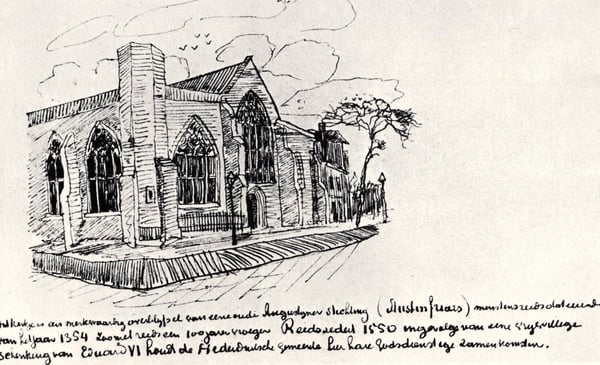
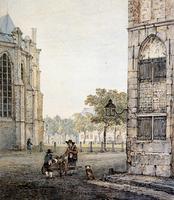
Expert analysis of Vincent van Gogh’s Austin Friars Church, London
Style: Realism · Genre: sketch and study
This analysis is based solely on the provided facts: the artwork is "Austin Friars Church, London" by Vincent van Gogh, executed in the Realism style under the genre of sketch and study.
Significance within Realism:
As a sketch and study produced in a Realist mode, this work is significant for documenting van Gogh’s early dedication to direct observation and architectural precision. Realism, which flourished in the mid-19th century, demanded that artists capture unidealized, everyday subjects with scrupulous accuracy. Here, van Gogh applies this principle to a specific London landmark—the Austin Friars Church—rather than the more typical peasant or urban scenes of his contemporaries. The work’s value lies in its function as a study: it reveals van Gogh’s disciplined training in perspective, proportion, and linear depiction, far removed from the expressive brushwork of his later Post-Impressionist period.
Period Context and Artistic Development:
This sketch belongs to van Gogh’s relatively little-known early Realist phase, predating his move to Arles and the vibrant colorism for which he is famous. By focusing on a sketch, the artist emphasizes the architectural structure and light values rather than emotional resonance or painterly texture. In this regard, the work is significant as a foundational exercise—a rigorous, analytical record of a real place that demonstrates van Gogh’s ability to subordinate personal style in favor of documentary fidelity. It also reflects the broader Realist commitment to depicting the modern cityscape, aligning van Gogh with artists who found beauty in the factual, unembellished world. While not a finished masterpiece, the sketch is crucial evidence of the technical grounding that later fueled his revolutionary departures from Realism.
Genre
Style
Visually similar
20 works with related composition and palette
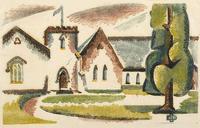
The Parish Hall
Dorrit Black
A Picturesque and Descriptive view of the City of Dublin A set of twenty-five views of Dublin Hand
James Malton
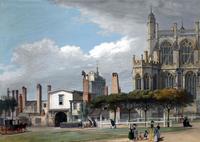
Saint George's Chapel, Windsor, and the Entrance to the Singing Men's Cloister
Paul Sandby
East Bergholt Church
John Constable
Brelevenez, Lannion, Cote du Nord, France
Childe Hassam
THE ENTRANCE TO THE HORSESHOE CLOISTER WITH THE WEST END OF ST. GEORGE'S CHAPEL, WINDSOR
Paul Sandby
Melrose Abbey
James Ward
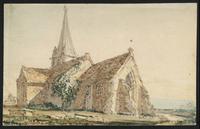
Kidwelly Church, Caermarthenshire
Thomas Girtin
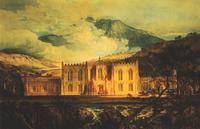
Hafod
J.M.W. Turner
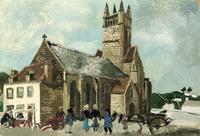
Church and Market, Brittany
Christopher Wood
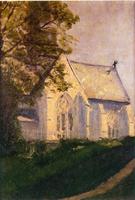
Church at Blainville
Marcel Duchamp
The Kirk and Devil's Stone, Cortachy
Richard Doyle
Eton College Chapel
Canaletto
Après l'Office à l'Eglise de la Ste-Trinité
Jean Béraud
the Apse of the Church of St. Martin-sur-renelle
Charles Meryon
The Chapel of Eton College
Canaletto
Handsworth Old Church, Birmingham
David Cox
Louth, Lincolnshire
J.M.W. Turner
Arda In Flanders
Adolf Hitler
Grotekerksplein in Dordrecht
Jacob van Strij