
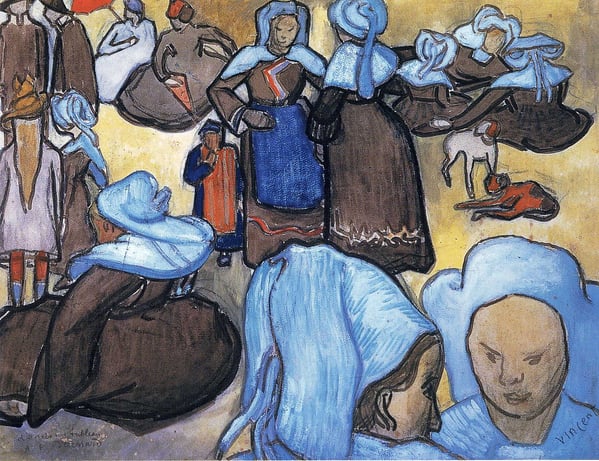
Breton Women
Détails
Analyse experte de Breton Women de Vincent van Gogh
Style : Cloisonnism · Genre : genre painting
Expert Analysis: "Breton Women" by Vincent van Gogh
Painted in 1888, "Breton Women" stands as a remarkable intersection of Vincent van Gogh’s evolving practice and the avant-garde aesthetic of Cloisonnism. While van Gogh is most famous for his expressive, impasto-laden Post-Impressionism, this work reveals his deliberate engagement with the synthetic, flat-patterned style championed by his contemporaries Émile Bernard and Paul Gauguin during their time in Pont-Aven.
Stylistic Significance within Cloisonnism
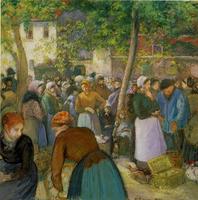
The painting exemplifies Cloisonnism’s core principles: bold, dark outlines (resembling the metal cloisonné work in enamel) that enclose areas of pure, unmodulated color. Van Gogh applies this technique to depict a group of Breton women in traditional dress, likely in a pastoral or market scene. Instead of modeling figures through light and shadow, he uses thick, black contours to define their silhouettes, dresses, and headdresses. The colors—deep blues, earthy browns, and muted whites—are largely flat and decorative, suppressing perspective and volume. This flattening of space is a deliberate break from Impressionist naturalism, prioritizing symbolic and emotional resonance over optical truth. The composition is orderly and frieze-like, echoing the cloisonné aesthetic and suggesting a timeless, almost iconic view of rural life.
Genre Painting and Cultural Context
As a genre painting, "Breton Women" captures a moment in the daily lives of the rural people of Brittany, a region that attracted many artists for its perceived authenticity and spiritual traditions. Van Gogh, however, does not aim for documentary accuracy. Instead, he transforms the women into expressive, stylized figures that embody a sense of quiet dignity and connection to tradition. The simplified forms and strong outlines give the work a medieval or folk-art character, aligning with Cloisonnism’s interest in “primitive” and non-Western art forms. This approach reflects the broader Symbolist concern with inner vision over outward reality.
Significance in van Gogh’s Oeuvre
What makes "Breton Women" particularly significant is van Gogh’s rare and thoughtful adoption of a style he did not permanently embrace. Executed during his stay in Arles, this work shows his openness to collaborative experimentation—especially with Bernard and Gauguin—while retaining his own emotional intensity. The restrained palette and disciplined outlines contrast sharply with his more famous works like "Starry Night" or "Sunflowers," yet the rhythmic, almost pulsating arrangement of figures hints at his underlying energy. It demonstrates that van Gogh could masterfully deploy synthetic, decorative methods without sacrificing psychological depth.
In summary, "Breton Women" is a crucial piece that bridges van Gogh’s personal vision with the Cloisonnist revolution. It stands as a testament to his versatility and his ability to synthesize diverse influences into a uniquely powerful statement about tradition, community, and the spiritual dimension of everyday life.
Museum / Gallery
Visuellement similaire
20 œuvres à la composition et à la palette proches
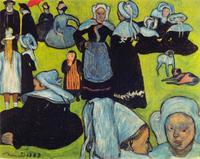
Breton Women in the Meadow
Emile Bernard
Market Scene
Maurice Prendergast
Composition with Peasant Women
Ion Theodorescu-Sion
Village Holiday
George Stefanescu
Poultry Market, Pontoise
Camille Pissarro
Bretons
Emile Bernard
Sketch for the Painting Carousel
Oleksandr Murashko
Planting potatoes
Natalia Goncharova
Breton Women with Parasols
Emile Bernard
Picnic
Maurice Prendergast
Fête Foraine En Bretagne
Ferdinand du Puigaudeau
Three Breton Women in the Forest
Georges Lacombe
Marketplace, Gisors
Camille Pissarro
The Cove
Maurice Prendergast
At the Edge of the Field
Dumitru Ghiatza
Seated Peasant and Knitting Peasant
Camille Pissarro
Village Market in Cardoso
Amadeo de Souza-Cardoso
Laundresses Carrying Linen in Town
Edgar Degas
Sonntag
Mario Comensoli
The Poultry Market
Camille Pissarro