
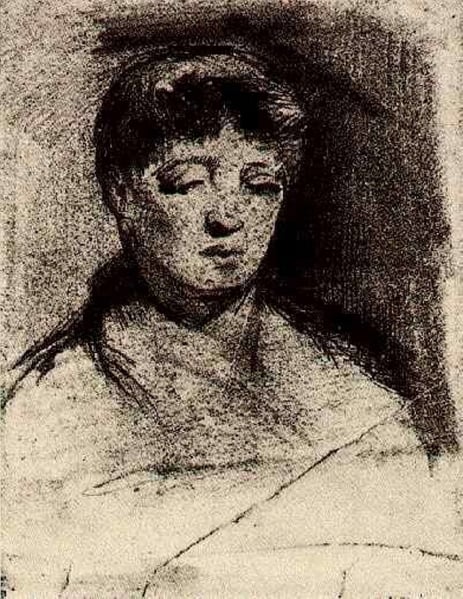
Analisi esperta di Head of a Woman di Vincent van Gogh
Stile: Post-Impressionism · Genere: sketch and study
Expert Analysis of Vincent van Gogh’s "Head of a Woman" (c. 1884–1885)
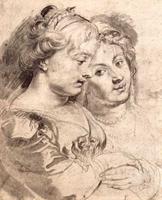
As a sketch and study executed within the Post-Impressionist movement, "Head of a Woman" is a revealing example of van Gogh’s rigorous preparatory process and his evolving approach to capturing human character. While Post-Impressionism is often associated with vivid color and expressive brushwork, van Gogh’s early studies—particularly those from his Nuenen period—demonstrate his deep commitment to drawing as a foundation for emotional and psychological depth.
Significance within Post-Impressionism and van Gogh’s Oeuvre
-
Emphasis on Expressive Line over Academic Precision
Unlike the polished, idealized portraits of the Impressionists or academic tradition, this sketch foregrounds rugged, searching lines. Van Gogh uses hatched and cross-hatched strokes to model the woman’s face, building form through rhythmic, almost tactile marks. This technique anticipates the energetic, swirling brushwork of his later masterpieces, but here it is stripped to its raw, graphic essence—showcasing how line alone can convey tension, weariness, and solidity. -
Connection to Van Gogh’s Peasant Portraits
The study likely belongs to his series of peasant heads, which culminated in The Potato Eaters. Van Gogh deliberately sought to depict the "coarse" features of working-class subjects, rejecting prettiness in favor of authenticity. The woman’s heavy-lidded eyes, prominent cheekbones, and downcast or weary expression reflect van Gogh’s conviction that inner life is written on the face. Even in a sketch, he imbues her with a quiet dignity, aligning with Post-Impressionism’s move toward subjective, emotional realism. -
Technical Experimentation
As a study, this work reveals van Gogh’s disciplined approach to tonal contrast and structure. Shadows are built from dense, parallel lines, while lighter areas are left as blank paper—a method borrowed from Dutch masters like Rembrandt, but filtered through a modern, expressive lens. This fusion of tradition and innovation is key to Post-Impressionism: the artist does not simply record nature but translates it through his own hand and vision. -
Gateway to Van Gogh’s Mature Style
This sketch is significant because it documents van Gogh’s transition from the dark, earthy palette of his Dutch period toward the luminous, dynamic works of Arles. The head is solidly modeled, yet there is a nascent restlessness in the handling—the lines seem to push outward, as if the form itself is alive. It is a study in seeing: not just a likeness, but a psychological portrait rendered through the urgency of the artist’s touch.
In sum, "Head of a Woman" is not merely a preparatory exercise; it is a concentrated demonstration of Post-Impressionist principles—subjectivity, expressive mark-making, and a profound attentiveness to the human condition. It shows van Gogh learning to make every stroke matter, long before his fame would rest on that very skill.
Museum / Gallery
Visivamente simili
20 opere con composizione e palette affini
Portrait of a Woman
Henri de Toulouse-Lautrec
Portrait Of The Artist's Daughter Maud
Adolf Hirémy-Hirschl
Gumersinda Goicoechea, Goya's Daughter in Law
Francisco Goya
Peppina
Paul-Albert Besnard
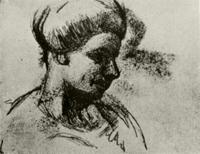
Head of a Woman
Vincent van Gogh
Josephine Bonaparte (study)
Pierre-Paul Prud'hon
Study of a Woman's Head
Antoine Watteau
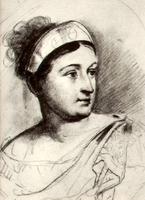
Portrait of Ekaterina Semenova
Orest Kiprensky
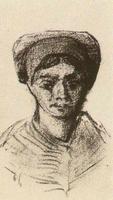
Peasant Woman, Head
Vincent van Gogh
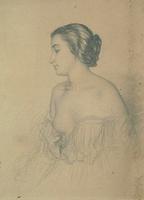
Study for the portrait of Marie Daubrée Delessert
Ernest Hébert
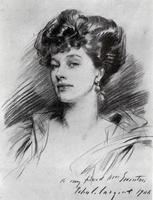
Mrs. George Swinton
John Singer Sargent
Schepkina Yelena
Vasily Tropinin
Head of young woman
Luc-Olivier Merson
Portrait of Ekaterina Semenova
Orest Kiprensky
Portrait of a Girl
Giovanni Boldini
Portrait of Nadezhda Zabela-Vrubel
Mikhail Vrubel
Portrait of Anna Staal
Valentin Serov
Study of the portrait
Maurice Quentin de La Tour
Elsie Bibby
Edward Robert Hughes
Two young women with a dog
Peter Paul Rubens