
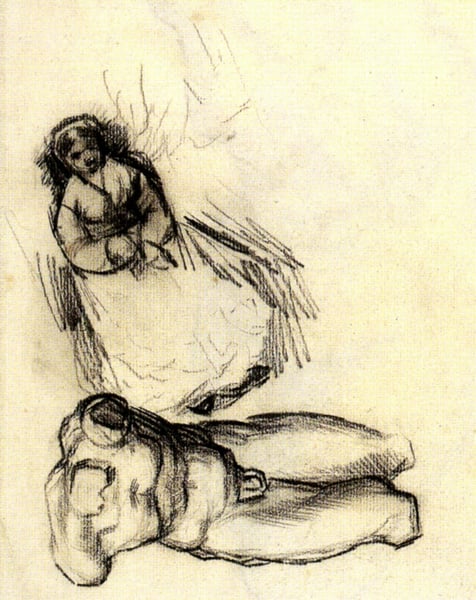
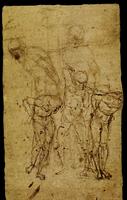
Male Torso and Study for Portrait of a Woman with Flowers
Ayrıntılar
Vincent van Gogh sanatçısının Male Torso and Study for Portrait of a Woman with Flowers eseri hakkında uzman analizi
Tarz: Post-Impressionism · Tür: sketch and study
Expert Analysis: Vincent van Gogh’s Male Torso and Study for Portrait of a Woman with Flowers
This work stands as a revealing window into Vincent van Gogh’s working method during his Post-Impressionist period, embodying the raw, exploratory energy that defines his most significant drawings and studies. As a double-sided sketch and study, it compresses two distinct artistic investigations onto a single sheet, offering unique insight into how van Gogh balanced anatomical discipline with expressive portraiture.
Significance within Post-Impressionism
Van Gogh’s oeuvre is often celebrated for its vibrant color and emotional intensity in finished paintings, but his studies reveal the rigorous foundation beneath that spontaneity. Male Torso and Study for Portrait of a Woman with Flowers exemplifies the Post-Impressionist shift away from naturalistic reproduction toward subjective expression and structural experimentation. Here, van Gogh grapples with the human figure through rapid, searching lines—the male torso rendered with an almost sculptural attention to musculature and shadow, while the study of a woman with flowers anticipates his later, more iconic flower-and-figure compositions. The contrasting subjects (a classical nude male versus a contemporary female portrait with floral motifs) demonstrate his range, from academic draftsmanship to intimate character studies.
Artistic Process and Innovation
What makes this work particularly significant is its status as a workshop document. The coexistence of both studies on one sheet—likely a page from a sketchbook—captures van Gogh’s restless creative process: he moves from a careful, structural study of the torso (highlighting his interest in anatomy, partly influenced by his time in Antwerp and his admiration for Michelangelo) to a more fluid, gestural portrait study. The “woman with flowers” motif prefigures his celebrated flower still lifes and portraits that blend nature and human presence, such as Madame Roulin or L’Arlésienne. The sketch-format reveals how van Gogh used rapid notation to capture character, posture, and emotion before translating these elements into oil paintings, where brushwork and color would amplify the psychological charge.
Place in van Gogh’s Evolution
This piece is also a testament to van Gogh’s self-education. Even as a Post-Impressionist pioneer, he constantly studied traditional figure drawing—echoing the influence of Dutch Realism and French academic training—while infusing each line with his own nervous, rhythmic energy. The Male Torso shows his commitment to mastering the body, often a struggle for him, while the female portrait study points toward his mature style, where subjects are defined by contour and expressive simplification rather than detailed modeling. Together, they bridge his early, darker palette with the bright, increasingly symbolic work of his later years.
In sum, Male Torso and Study for Portrait of a Woman with Flowers matters not as a finished masterpiece but as a core document of van Gogh’s artistic DNA—evidence of a mind forever sketching, revising, and pushing the boundaries of how line could convey life. It is a rare artifact of Post-Impressionism’s deepest creative process.
Museum / Gallery
Görsel olarak benzer
İlişkili kompozisyon ve renk paletine sahip 20 eser
Dying Slave and Figures at a Table
Vincent van Gogh
My Son
Suzanne Valadon
Figure study to Mermaid
Koloman Moser
Bereny Robert, Nude Study 1911
Berény Róbert
Nude Study (reclining Female Figure)
Henry Tonks
Three studies elongated figures
Andrea Mantegna
Study of a Terrified Woman
Honore Daumier
Reclining Female Nude (Mileva Roller)
Koloman Moser
Torso of Venus and a Landscape
Vincent van Gogh
Seated Female Nude
Vincent van Gogh
Study of the Nailing of Christ to the Cross
Jacopo Pontormo
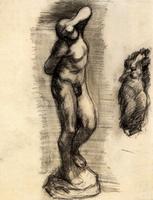
Young Slave
Vincent van Gogh
Female Nude, Seated
Vincent van Gogh
Seated Nude
Paul Cezanne
Standing Male Nude
Vincent van Gogh
Studies of a Female Figure
Noè Bordignon
Untitled
Willem de Kooning
Bela Czobel, Nude Resting
Bela Czobel
Minerva
Auguste Rodin
Study for a Flagellation
Andrea Mantegna