
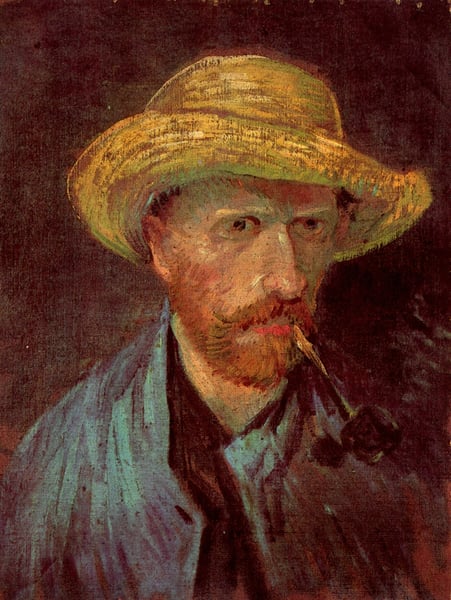
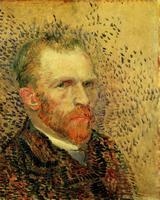
Self-Portrait with Straw Hat and Pipe
Dettagli
Analisi esperta di Self-Portrait with Straw Hat and Pipe di Vincent van Gogh
Stile: Post-Impressionism, Neo-Impressionism · Genere: self-portrait
This self-portrait, painted in 1887 during Vincent van Gogh’s transformative Paris period, stands as a pivotal example of his synthesis of Post-Impressionist emotional intensity with the systematic color theory of Neo-Impressionism. The work is significant for several reasons:
-
Technical Fusion: Van Gogh adopts the Pointillist technique of small, separate brushstrokes—derived from Georges Seurat and Paul Signac—but infuses them with a restless, kinetic energy that is distinctly his own. The straw hat is built from daubs of yellow, orange, and green, while the face is modeled with short, cross-hatching strokes of pink, blue, and white. This marriage of scientific color division with expressive, almost palpable brushwork marks a key moment in van Gogh’s evolution from the darker tones of his Dutch period toward the luminous, emotionally charged palette of his later work.
-
Symbolic Self-Presentation: The straw hat and pipe are more than props—they are markers of van Gogh’s deliberate self-mythology. The straw hat, a rustic accessory, aligns him with the rural working class he often painted, while the pipe (a frequent subject in his still lifes) suggests introspection. Together, they create an image of the artist as both a laborer and a thinker, grounded yet contemplative. This self-fashioning was part of his broader aim to elevate the ordinary into the spiritual.
-
Psychological Depth: Unlike many formal self-portraits of the era, van Gogh’s gaze is direct but slightly unfocused, as if looking inward. The vibrant, unnatural colors (the green of his jacket, the yellow-green of his face) convey not literal appearance but emotional state—a restless, searching energy that foreshadows the intense expressivity of his later works, such as Starry Night. This painting is among the first where his brushstroke and color become a direct vehicle for inner feeling.
-
Historical Context: Created during his stay in Paris alongside Bernard, Gauguin, and other avant-garde artists, this self-portrait reflects van Gogh’s brief but intense engagement with Neo-Impressionism. Yet, he quickly abandoned its rigid rules to forge his own path. Thus, the work is a snapshot of a restless genius absorbing and then transcending a key movement, marking the birth of his mature style. It is a testament to how Post-Impressionism could channel scientific color theory into raw, personal expression.
Museum / Gallery
Visivamente simili
20 opere con composizione e palette affini
Self-Portrait with Straw Hat
Vincent van Gogh
Self Portrait
Vincent van Gogh
Self Portrait with a Grey Felt Hat
Vincent van Gogh
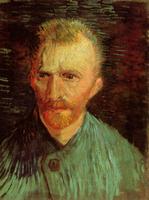
Self-Portrait
Vincent van Gogh
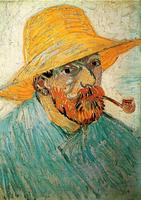
Self Portrait
Vincent van Gogh
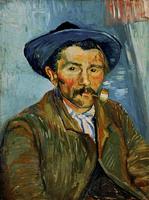
The Smoker (Peasant)
Vincent van Gogh
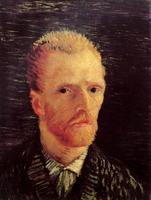
Self-Portrait
Vincent van Gogh
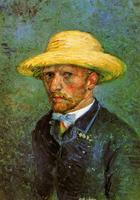
Self-Portrait with Straw Hat
Vincent van Gogh
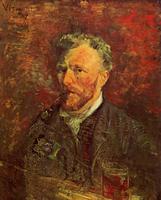
Self-Portrait with Pipe and Glass
Vincent van Gogh
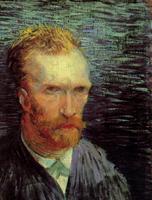
Self-Portrait
Vincent van Gogh
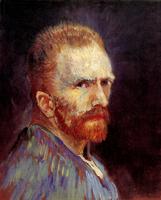
Self-Portrait
Vincent van Gogh
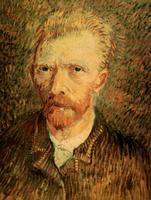
Self-Portrait
Vincent van Gogh
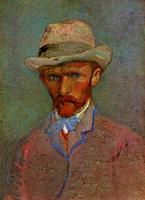
Self-Portrait with Gray Felt Hat
Vincent van Gogh
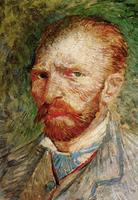
Self-Portrait
Vincent van Gogh
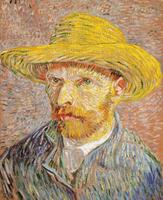
Self-Portrait with Straw Hat
Vincent van Gogh
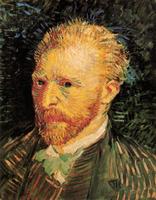
Self-Portrait
Vincent van Gogh
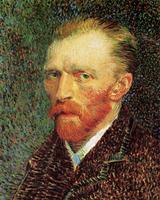
Self-Portrait
Vincent van Gogh
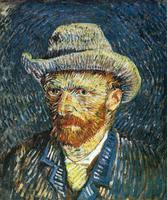
Self Portrait with Felt Hat
Vincent van Gogh
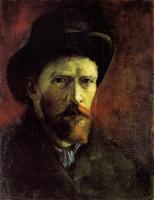
Self-Portrait with Dark Felt Hat
Vincent van Gogh
Self-Portrait
Vincent van Gogh