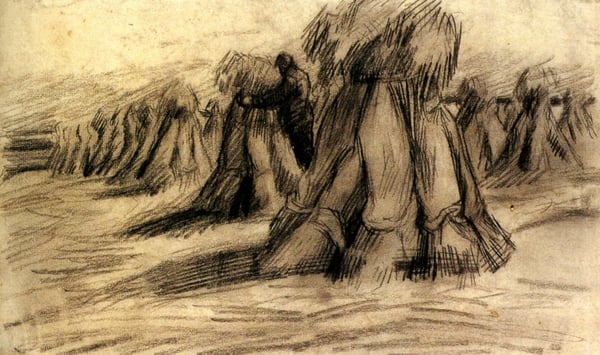
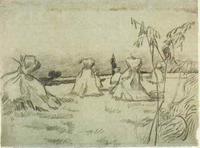
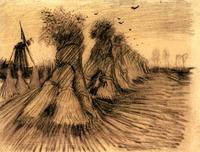
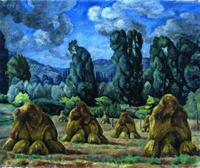
Expert Analysis of "Stooks and a Peasant Stacking Sheaves" by Vincent van Gogh
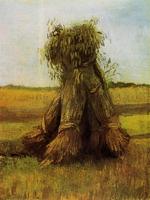
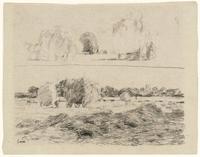
This work, a sketch and study executed in a realist style, holds particular significance as a window into van Gogh’s early artistic formation. Created during his Nuenen period (1883–1885), it predates his vibrant Post-Impressionist palette and instead reveals his foundational commitment to depicting the dignity of rural labor—a theme he inherited from Jean-François Millet. The piece is a preparatory study, likely for a larger composition, and its importance lies in its raw, unpolished immediacy: the bold, economical lines capture the rhythmic movement of stacking sheaves, while the dense, crosshatched shading models the peasant’s form against the plain ground. This focus on direct observation and manual technique underscores van Gogh’s realist training, emphasizing weight, posture, and the tactile relationship between worker and earth. As a study, it demonstrates his methodical process of building compositions from life—a discipline that would later fuel his expressive power. In the context of 19th-century realism, the artwork is significant for documenting van Gogh’s early empathy for peasant subjects, a social consciousness that anchors his entire oeuvre.