
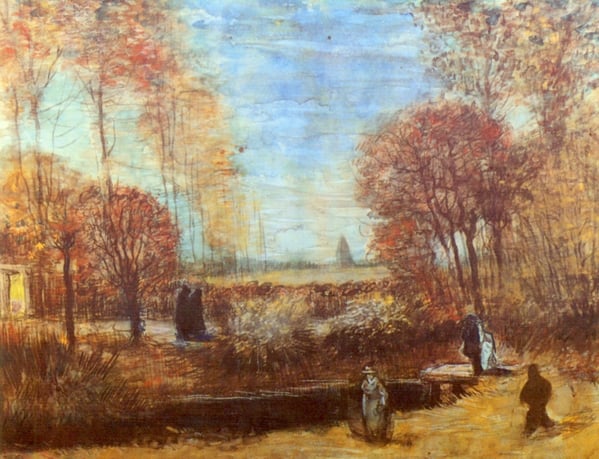
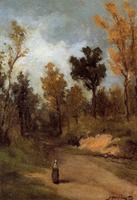
The Parsonage Garden at Nuenen with Pond and Figures
Details
Expert analysis of Vincent van Gogh’s The Parsonage Garden at Nuenen with Pond and Figures
Style: Realism · Genre: landscape
Expert Analysis: "The Parsonage Garden at Nuenen with Pond and Figures" (1884) by Vincent van Gogh
This work is a significant early example of van Gogh’s engagement with Realism, a style that grounds the painting in meticulous observation of daily life and the Dutch landscape. Painted during his two-year stay in Nuenen (1883–1885), the piece predates his more famous Post-Impressionist works, yet it already reveals his deep commitment to capturing the authentic, unidealized world around him.
What makes it significant within its style and period:
-
A masterclass in Realist landscape painting
The composition is carefully structured: the pond anchors the foreground, while the parsonage garden and figures are placed in the middle ground, leading the eye into the depth of the scene. The muted, earthy palette—dull greens, browns, and grays—reflects the artist’s dedication to the natural tones of the Dutch countryside, eschewing the dramatic colors he would later embrace. This restraint aligns perfectly with Realism’s rejection of romantic excess. -
Everyday life as subject
Unlike the grand historical or mythological subjects favored by academic painting, van Gogh focuses on a humble, private garden and the ordinary people within it. The figures—perhaps local villagers or family—are not idealized but rendered with a quiet dignity, suggesting the artist’s empathy for rural existence. This focus on the commonplace is a hallmark of Realist practice, influenced by artists such as Jean-François Millet. -
A bridge to van Gogh’s later genius
While the brushwork is still relatively controlled and subdued, one can see the seeds of his future expressive style. The textured handling of foliage and the careful play of light on the pond foreshadow the vigorous, emotionally charged mark-making of his Arles period. As such, the painting is not merely a derivative Realist work but a foundational piece that documents van Gogh’s evolution from a sober observer of reality to a master of psychological intensity through landscape.
In summary, The Parsonage Garden at Nuenen with Pond and Figures stands as a vital testament to van Gogh’s early commitment to Realism—a style that allowed him to develop his observational skills and deepen his connection to the rural world, all while laying the groundwork for the revolutionary vision he would soon unleash.
Visually similar
20 works with related composition and palette
Girl Reading by the Water
Camille Corot
Canal in Picardi
Camille Corot
The Small Arm of the Seine at Argenteuil
Claude Monet
Afterglow (Summer Evening)
Frederick McCubbin
A Cow Grazing beneath a Birch Tree
Camille Corot
Morning by the Water
Camille Corot
Autumn landscape
Theodor Philipsen
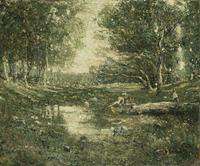
Bathers, Woodland
Ernest Lawson
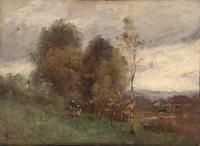
Landscape
Paul Trouillebert
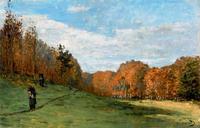
Woodbearers in Fontainebleau Forest
Claude Monet
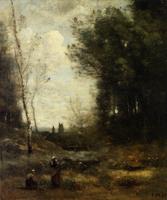
The Valley
Camille Corot
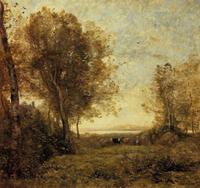
Morning, Woman Hearding Cows
Camille Corot
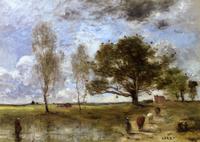
The Cow Path
Camille Corot
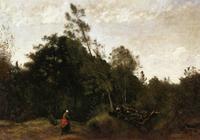
Forest Clearing in the Limousin
Camille Corot
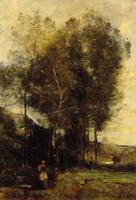
Cowherd in a Dell, Souvenir of Brittany
Camille Corot
Souvenir of Brittany
Camille Corot
Summer Path
Rudolf Schweitzer-Cumpana
Return of the Hayers to Marcoussis
Camille Corot
Two Figures Working in the Fields
Camille Corot
The Forest Path
Paul Gauguin