
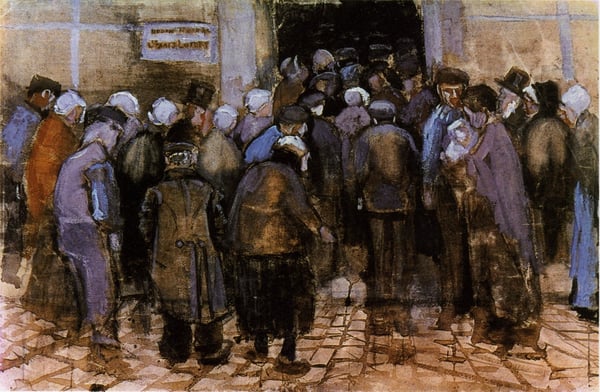
The State Lottery
Details
Expert analysis of Vincent van Gogh’s The State Lottery
Style: Realism · Genre: genre painting
Analysis of "The State Lottery" by Vincent van Gogh
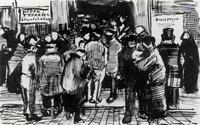
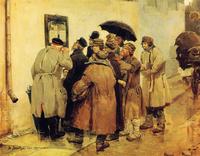
This work is a notable example of van Gogh’s early engagement with Realism, a style he explored during his Dutch period before his later Post-Impressionist breakthroughs. As a genre painting, it depicts a scene from everyday life—specifically, the gathering of people at a state lottery office—with a focus on honest, unidealized representation.
Significance within the Realist style:
Van Gogh employs the core Realist principles of documenting ordinary, often working-class, experiences without romanticism. The composition likely emphasizes the tension, hope, and desperation of lottery participants, mirroring the social commentary found in the works of Realist masters like Jean-François Millet (whom van Gogh admired) and Gustave Courbet. The subject matter—a state-run lottery—serves as a critique of economic inequality and the false promise of sudden wealth for the poor. This aligns with Realism’s mission to reveal the harsh truths of contemporary life.
Contribution to van Gogh’s development:
While van Gogh is primarily known for his vibrant Post-Impressionist style, "The State Lottery" showcases his foundational skills in subdued earth tones, careful observation, and empathetic human portrayal. The painting reflects his deep compassion for the marginalized, a theme that would persist throughout his career. Its unvarnished depiction of waiting figures, perhaps including the elderly, the poor, or the anxious, demonstrates his ability to find dignity and pathos in mundane moments—a hallmark of the genre painting tradition.
Artistic significance:
Unlike later works driven by expressive color and brushwork, this Realist piece relies on precise line, chiaroscuro, and narrative clarity to convey social realism. It stands as a key document of van Gogh’s artistic roots, proving that his later innovations were built on a strong foundation of observational truth and moral engagement. In the context of 19th-century art, it contributes to the Realist movement’s goal of turning the camera-like eye of painting onto the struggles and rituals of ordinary people, making the invisible visible.
Museum / Gallery
Visually similar
20 works with related composition and palette
In the queue for bread. First World War.
Ivan Vladimirov
People Strolling on the Beach
Vincent van Gogh
Today's square
Giacomo Favretto
Aux Vrais Pauvres- Les Mauvais Riches
Theophile Steinlen
A Doctor's Waiting Room
L. S. Lowry
Egry József, Éjjel Menhely Elött
Egry József
Queuing for Bread
Nicolae Tonitza
Paris Under Occupation, the Line for Milk
Edgar Chahine
State Lottery Office
Vincent van Gogh
In the township board
Ilya Repin
Berény Róbert, Budapest Felszabadítása
Berény Róbert
La Catastrophe
Theophile Steinlen
La Soupe Populaire
Theophile Steinlen
Study to "Boyarynya Morozova"
Vasily Surikov
les Adieux
Theophile Steinlen
Market at Pontoise
Camille Pissarro
Pit Tragedy
L. S. Lowry
The Market in Gisors
Camille Pissarro
At Maize Share
Stefan Luchian
News from the Front
Viktor Vasnetsov