
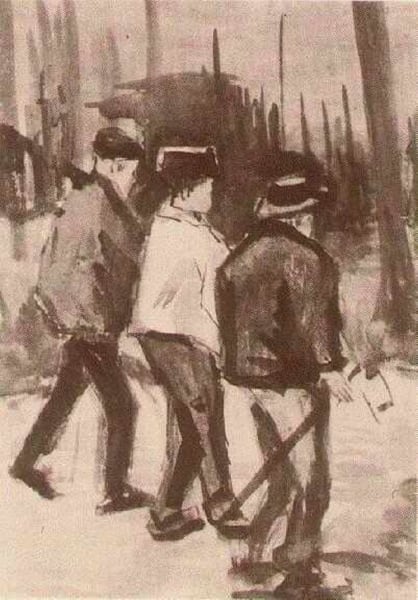
Three Woodcutters Walking
Ayrıntılar
Vincent van Gogh sanatçısının Three Woodcutters Walking eseri hakkında uzman analizi
Tarz: Realism · Tür: genre painting
Expert Analysis of "Three Woodcutters Walking" by Vincent van Gogh
Although Vincent van Gogh is most widely celebrated for his vivid Post-Impressionist works, Three Woodcutters Walking belongs to his early, comparatively underappreciated Realist phase. The painting’s significance lies in how it anchors van Gogh’s artistic roots in the social and stylistic concerns of 19th-century Realism, while simultaneously foreshadowing his lifelong empathy for the working poor.
Context and Style Executed during van Gogh’s Dutch period (c. 1881–1885), this genre painting depicts three laborers trudging homeward after a day’s work. The composition is deliberately unglamorous: the woodcutters are shown mid-stride, burdened by their loads, their figures silhouetted against a muted landscape. Van Gogh employs the earthy palette—browns, ochres, deep greens—that characterizes his early Realist output. The brushwork is restrained and descriptive, prioritizing the honest rendering of posture and environment over expressive impasto.
Significance within Realism As a Realist work, Three Woodcutters Walking aligns with the movement’s mission to portray the unidealized lives of ordinary people. Unlike the romanticized rural scenes of earlier periods, van Gogh’s composition emphasizes the physical toll of manual labor: the stooped shoulders, the heavy strides, the anonymous faces. This direct, unsentimental approach connects the painting to the social commentary of artists like Jean-François Millet, whose influence on van Gogh was profound. However, van Gogh pushes beyond Millet’s monumental dignity; here the figures are not heroicized but presented as part of an unending cycle of work.
Early Indicators of van Gogh’s Vision What makes Three Woodcutters Walking especially significant is the tension it reveals between van Gogh’s emerging personal voice and the conventions of Realism. The repetitive diagonal lines of the woodcutters’ axes and the rhythmic placement of their bodies introduce a quasi-musical structure, hinting at the expressive rhythm that would later define his Post-Impressionist style. Moreover, the atmospheric sky, painted in muted grays and ochers, suggests a deep, empathetic connection to the landscape—a trait that would mature into the charged, luminous fields of The Potato Eaters and later Arles.
Legacy While van Gogh’s Realist works are less famous than his later masterpieces, Three Woodcutters Walking is crucial for understanding his artistic journey. It demonstrates that his commitment to depicting the dignity of labor and the beauty of the ordinary was not a late development but a foundational concern. The painting stands as a testament to van Gogh’s ability to find profound significance in the simplest human actions—a quality that would eventually transform his art—and the world’s perception of it.
Görsel olarak benzer
İlişkili kompozisyon ve renk paletine sahip 20 eser
Orphans
Vincent van Gogh
Night on the Outskirts of Town
Istvan Farkas
René Princeteau
Henri de Toulouse-Lautrec
Workers on their way home I
Edvard Munch
L'Exode
Theophile Steinlen
Five Men and a Child in the Snow
Vincent van Gogh
Woman with Child and Girls on a Road
August Macke
Egry József Munka Után 1911
Egry József
Szentendre
Kmetty János
Les Trimardeurs
Theophile Steinlen
La Misere Sous La Neige
Theophile Steinlen
Picnic
Maurice Prendergast
Several Figures on a Road with Trees
Vincent van Gogh
Chemineau Sous La Pluie
Theophile Steinlen
Study for a Portrait of Van Gogh IV
Francis Bacon
Aux Vrais Pauvres- Les Mauvais Riches
Theophile Steinlen
Springtime Work
Lucian Grigorescu
People Walking on the Beach
Vincent van Gogh
Center
Nikola Tanev
Trouville
Eugene Boudin