
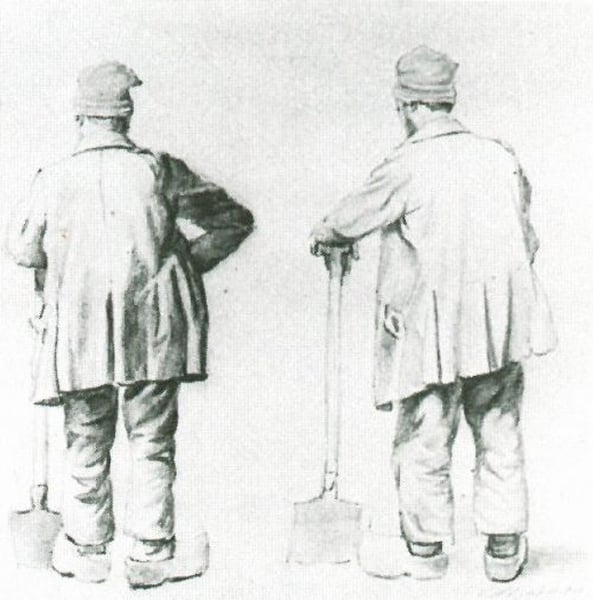
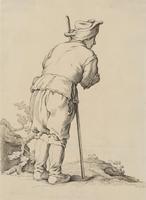
Two Sketches of a Man Leaning on His Spade
Dettagli
Analisi esperta di Two Sketches of a Man Leaning on His Spade di Vincent van Gogh
Stile: Realism · Genere: sketch and study
This sketch study by Vincent van Gogh, executed in a Realist mode, offers a window into the artist’s disciplined exploration of form, labor, and human dignity—themes that would ground his later, more expressionistic masterpieces.
Style and Period Significance
Though van Gogh is most celebrated as a Post-Impressionist, his early commitment to Realism was crucial to his development. Here, the subject—a peasant leaning on a spade—reflects the artist’s deep admiration for Jean-François Millet and the Dutch Realist tradition of portraying rural life with unflinching truth. The work is not a finished painting but a study, which makes it significant because it reveals van Gogh’s methodical approach to capturing the weight and rhythm of physical labor. The repeated figure (two sketches of the same pose) demonstrates his effort to distill the essential posture: the slump of the shoulders, the grip on the shaft, the momentary rest that speaks to the exhaustion and stoicism of the working class.
Within the Realist Genre
As a sketch and study, this piece exemplifies Realism’s focus on direct observation and the unidealized human condition. Van Gogh uses minimal, rapid lines to define volume, not yet relying on the thick, swirling brushstrokes of his later years. The spade, angled against the body, anchors the composition; the man’s face is left vague, redirecting attention to the broader gesture of labor rather than individual identity. This aligns with Realism’s creed of portraying the typology of the worker—the “everyman” of the soil.
Artistic Significance
What makes this drawing compelling is its status as a preparatory exercise for van Gogh’s great early work The Potato Eaters and his many studies of peasants digging. It documents his rigorous training in proportion and anatomy, but also his empathetic eye: the man is not a mere model but a being whose life is etched into the very curve of his spine. The sketch’s roughness is not a sign of incompletion but a testament to van Gogh’s belief that truth resides in the raw, unpolished moment. In this way, the work bridges his Dutch Realist roots and the expressive force that would soon follow, and it underscores his lifelong commitment to depicting the sacred dignity of ordinary toil.
Visivamente simili
20 opere con composizione e palette affini
Man with Rake
Vincent van Gogh
Digger
Vincent van Gogh
Study of Two Peasants
Vincent van Gogh
Orphan Man with Long Overcoat and Umbrella, Seen from the Back
Vincent van Gogh
Digger
Vincent van Gogh
Peasant Boy, Digging
Vincent van Gogh
Orphan Man with Cap, Seen from the Back
Vincent van Gogh
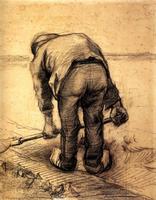
Peasant Lifting Beet
Vincent van Gogh
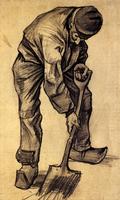
Digger
Vincent van Gogh
Orphan Man with Long Overcoat and Umbrella, Seen from the Back 2
Vincent van Gogh
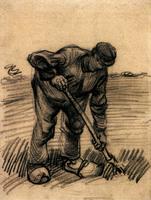
Peasant Lifting Potatoes
Vincent van Gogh
Farmer Leaning on his Spade
Vincent van Gogh
Young Man with a Broom
Vincent van Gogh
Peasant with Sickle, Seen from the Back
Vincent van Gogh
Sower
Vincent van Gogh
Peasant Woman with Spade
Vincent van Gogh
Studies of Three Peasants and a Head
Vincent van Gogh
Orphan Man, Wearing a Blouse, with Broom and Pipe
Vincent van Gogh
Peasant Woman, Digging, Seen from the Side
Vincent van Gogh
Shepherd with staff
Johann Heinrich Wilhelm Tischbein