
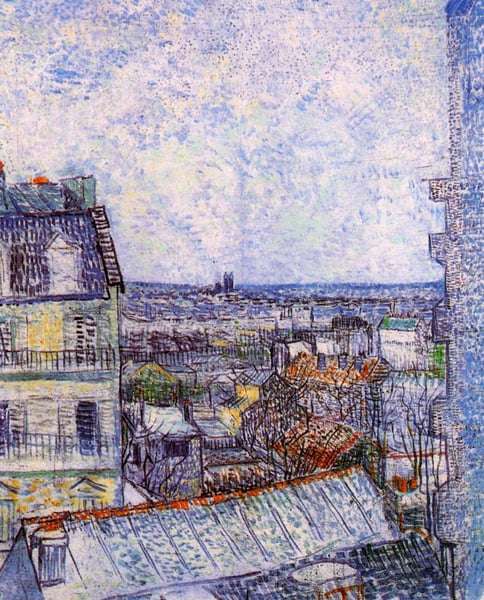
View from Vincent's room in the Rue Lepic
Details
Expertenanalyse zu Vincent van Goghs View from Vincent's room in the Rue Lepic
Stil: Post-Impressionism, Neo-Impressionism · Genre: cityscape
Expert Analysis: View from Vincent's Room in the Rue Lepic
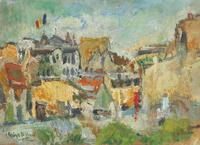
Vincent van Gogh’s View from Vincent’s Room in the Rue Lepic (c. 1887) is a remarkable cityscape that captures a pivotal moment in the artist’s stylistic evolution. Painted during his two-year stay in Paris (1886–1888), this work exemplifies the fusion of Post-Impressionist emotional intensity with Neo-Impressionist techniques, marking van Gogh’s transition from the dark, earthy palette of his Dutch period to the luminous, vibrant colors that would define his mature works.
The painting depicts the rooftops and chimneys of Montmartre as seen from the window of his apartment at 54 Rue Lepic. The composition is deliberately cropped and dynamic, with diagonal rooflines and twisting chimney pots that draw the eye upward into a sky brushed with short, rhythmic strokes. Van Gogh’s brushwork here is both structured and expressive—shorter, dot-like touches reveal the influence of Georges Seurat and Paul Signac, yet the artist infuses the scene with his own restless energy. The sky is not a passive backdrop but a swirling field of blues and whites, foreshadowing the turbulent skies of his later Starry Night.
What makes this work significant is its role as a laboratory for van Gogh’s optical synthesis—he merges the Neo-Impressionist concern with scientific color theory (complementary contrasts, broken color) with a deeply subjective emotional charge. The rooftops are rendered in earthy ochres, browns, and muted greens, but they are enlivened by stippled accents of blue, pink, and yellow, creating a palpable sense of light and atmosphere. This is not a calm, objective view of Paris; it is a view filtered through van Gogh’s own psyche—the chimneys seem to breathe, the sky vibrates, and the mundane cityscape becomes a carrier of feeling.
Historically, this painting belongs to a series of window views van Gogh made in Paris, a motif that allowed him to experiment with perspective and the interplay between interior and exterior space. It also documents his engagement with modern urban life—not the grand boulevards of Haussmann’s Paris, but the intimate, everyday rooftops of the working-class Montmartre hill. The work thus stands as a crucial link between Impressionist spontaneity and the more symbolic, psychologically charged landscapes of Post-Impressionism.
In sum, View from Vincent’s Room in the Rue Lepic is significant because it reveals van Gogh as both a student of Neo-Impressionist theory and a uniquely expressive force. It is a testament to his ability to transform a simple view from a window into a throbbing, personal vision—a quality that would soon culminate in the masterpieces of Arles.
Museum / Gallery
Visuell ähnlich
20 Werke mit ähnlicher Komposition und Farbpalette
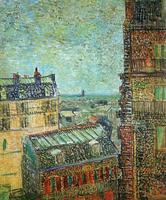
View of Paris from Vincent's Room in the Rue Lepic
Vincent van Gogh
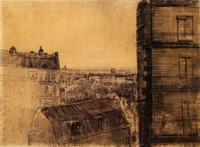
View from the Apartment in the Rue Lepic
Vincent van Gogh
Denfert Street, Roofs Under the Snow
Maximilien Luce
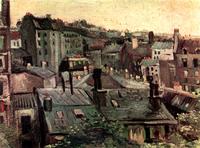
View of Roofs and Backs of Houses
Vincent van Gogh
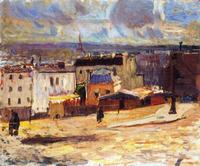
View of Paris from Monmartre
Raoul Dufy
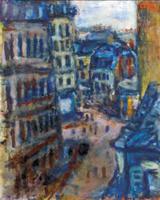
Czóbel Parizsi Utca
Bela Czobel
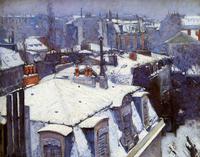
View of Roofs (Snow Effect) or Roofs under Snow
Gustave Caillebotte
Chaudoin House
Maurice Utrillo
Rooftops Seen from Sf. Gheorghe Square
Lucian Grigorescu
The Berlioz House
Maurice Utrillo
Renoir`s Garden
Maurice Utrillo
Paris suburbs
Maurice Utrillo
Rue Lepic
Maurice Utrillo
Paris. Boulevard des Capucines
Konstantin Korovin
Boulevard des Batignolles
Pierre Bonnard
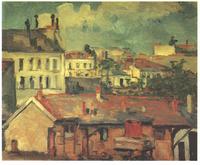
The roofs
Paul Cezanne
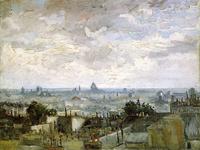
The Roofs of Paris
Vincent van Gogh
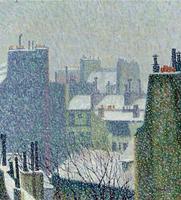
The Roofs of Paris in the Snow
Auguste Herbin
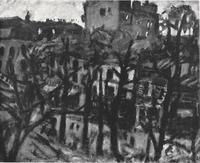
Bela Czobel , Avenue Du Maine 1925
Bela Czobel
Old Bucharest Seen from Sf. Spiridon
Lucian Grigorescu