
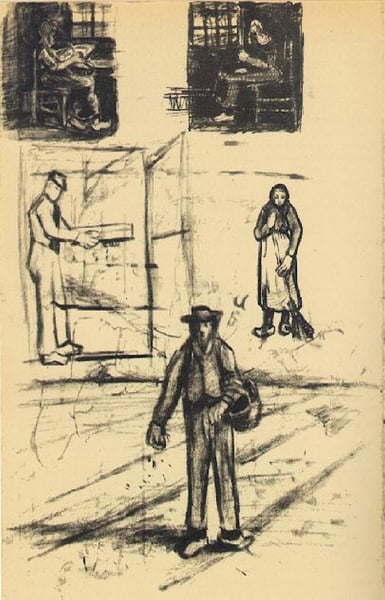
Woman near a Window twice, Man with Winnow, Sower, and Woman with Broom
Details
Expert analysis of Vincent van Gogh’s Woman near a Window twice, Man with Winnow, Sower, and Woman with Broom
Style: Post-Impressionism · Genre: sketch and study
Expert Analysis: "Woman near a Window twice, Man with Winnow, Sower, and Woman with Broom" (Vincent van Gogh)
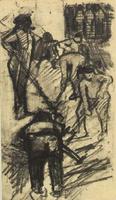
This work is a rare glimpse into van Gogh’s creative process—a sketch and study that compresses multiple figures and motifs onto a single sheet. Its significance lies not in a finished composition, but in how it reveals the artist’s intense, iterative search for form and meaning within the Post-Impressionist idiom.
Compositional Experimentation
The title itself indicates repetition: “Woman near a Window twice” suggests van Gogh was testing variations of a single pose, perhaps adjusting the figure’s relation to light or the domestic interior. By juxtaposing a “Sower” (a theme he returned to obsessively after Jean-François Millet) with a “Man with Winnow” and a “Woman with Broom,” he juxtaposes agricultural labor and household work—two pillars of peasant life. This clustering of ideas on one page shows him working through the relationships between different types of physical toil, using rapid, energetic lines to capture movement and posture rather than detail.
Post-Impressionist Characteristics
Even in a sketch, van Gogh’s distinct Post-Impressionist traits emerge: the thick, directional hatching and broken outlines that anticipate his later painted brushstrokes. The figures are simplified but charged with expressive tension—the sower’s forward stride, the winnower’s rhythmic gesture, the broom-woman’s stoop. This is not a mere academic drawing; it is a rhythmic exploration of human labor as a spiritual act, a hallmark of van Gogh’s late-1880s work.
Significance within van Gogh’s Oeuvre
Such studies are precious because they document the artist’s working method: he often made multiple rapid sketches from life or memory before composing larger, more symbolic paintings. Here, the combination of four distinct subjects on one sheet hints at a possible composite composition—or a record of ideas he intended to develop separately. The “Sower” and “Man with Winnow” directly reference his famous paintings of wheat fields, while the “Woman with Broom” and “Woman near a Window” connect to his intimate interiors. By uniting them in a single study, van Gogh underscores the interconnectedness of all forms of human effort.
In summary, this sketch is significant as a microcosm of van Gogh’s Post-Impressionist vision: energetic, repetitive, and deeply empathetic, capturing the dignity of work through raw, unfinished linework. It stands as a vital document of how he translated observation into the expressive, personal language that defines his legacy.
Visually similar
20 works with related composition and palette
Refugees
Theophile Steinlen
Family Portrait
Salvador Dali
A l'Atelier Preliminary drawing
Theophile Steinlen
Two Men
Theophile Steinlen
The Public Soup Kitchen
Vincent van Gogh
Sheet with Figures at a Table, a Sower, Clogs, etc
Vincent van Gogh
Sheet with Many Sketches of Figures
Vincent van Gogh
Scheveningen Woman Standing
Vincent van Gogh
L'Arlesienne, Portrait of Madame Ginoux
Vincent van Gogh
Illustration for literary review "Shtrom heftn"
Marc Chagall
Vissers En Vrouwen Aan De Oever
Hendrick Avercamp
Woman in Dark Dress, Walking
Vincent van Gogh
Sketch of a Lady with Striped Dress and Hat and of Another Lady, Half-Figure
Vincent van Gogh
Study of Three Peasants, One Sitting
Vincent van Gogh
Na trgu
Matej Sternen
Woman Standing
Vincent van Gogh
Study of a Gentleman, Called Dr. Johnson
John Flaxman
Sheet with a Few Sketches of Figures
Vincent van Gogh
Studies of the Interior of a Cottage, and a Sketch of The Potato Eaters
Vincent van Gogh
Diggers in Torn-Up Street
Vincent van Gogh