Expertenanalyse zu Parmigianinos Actaeon
Stil: Mannerism (Late Renaissance) · Genre: mythological painting
Expert Analysis of Parmigianino’s Actaeon (c. 1520s–1530s)
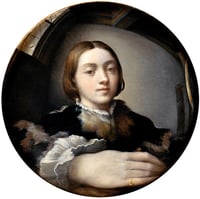
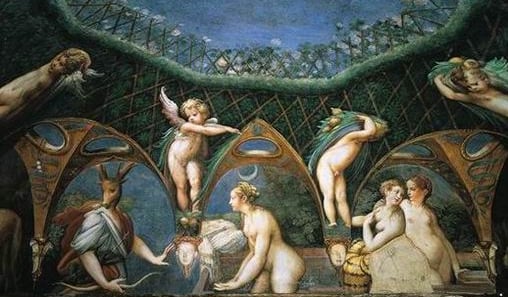
As a defining work of Mannerism—the self-consciously artifice-driven style that emerged in the Late Renaissance—Parmigianino’s Actaeon transforms a familiar mythological narrative into a showcase of the period’s aesthetic ideals. The painting depicts the moment from Ovid’s Metamorphoses when the hunter Actaeon, having stumbled upon the goddess Diana bathing, is punished by being transformed into a stag about to be devoured by his own hounds.
What makes this painting significant is its rejection of High Renaissance naturalism in favor of Mannerism’s signature traits: elegant artificiality, exaggerated proportions, and spatial ambiguity. Parmigianino elongates the figures—Actaeon’s limbs appear serpentine, his torso sinuous—emphasizing grace over anatomical accuracy. Diana and her nymphs are similarly refined, their poses poised and theatrical, as if performing a courtly ballet rather than reacting with shock. The composition is deliberately crowded and disjointed, a hallmark of Mannerist figura serpentinata that creates a sense of tension and instability.
The mythological subject allows Parmigianino to explore eroticism and voyeurism through a lens of cultivated sophistication. The palette—cool silvers, pale blues, and soft flesh tones—lends a dreamlike, almost porcelain quality, distancing the violence of the story. Space is compressed: figures overlap without clear recession, and the background remains sketchy, focusing attention on the elegant, unnatural forms.
As a Mannerist masterpiece, Actaeon exemplifies the style’s break from classical balance, prioritizing intellectual elegance and emotional detachment over narrative clarity. It stands as a testament to Parmigianino’s fascination with refined distortion, making the painting not merely a mythological illustration but a deliberate manifesto of Mannerist ideals.
Visuell ähnlich
20 Werke mit ähnlicher Komposition und Farbpalette
Three Nudes with Cupid
John Singer Sargent
Banquet of Amor and Psyche
Giulio Romano
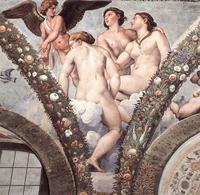
Cupid and the Three Graces
Raphael
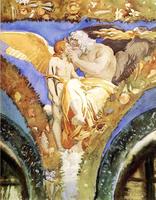
Jupiter Beseeching Eros
John Singer Sargent
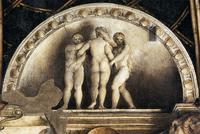
Three Graces
Correggio
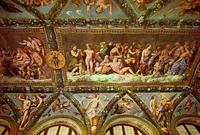
Ceiling of the Loggia of Psyche
Raphael
Joseph and Potiphar's wife
Tintoretto
Adoration of the Cross with the Brazen Serpent
Agnolo Bronzino
The philosophical works of Voltaire (L'Encyclopédie, les Essais, Les Pensées)
Albert Maignan
Archangel Raphael with Adam and Eve
William Blake
Scenes of allegories of the cardinal virtues
Agnolo Bronzino
Resurrection of the Dead
Luca Signorelli
The Parnassus, from the Stanza delle Segnatura
Raphael
The Golden Age
Jean Auguste Dominique Ingres
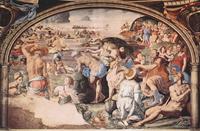
The Israelites crossing the Red Sea
Agnolo Bronzino
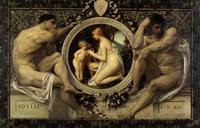
Idylle (Idylls)
Gustav Klimt
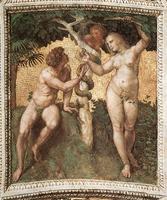
Adam and Eve, from the 'Stanza della Segnatura'
Raphael
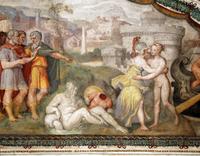
Stanza Di Apollo
Francesco de' Rossi (Francesco Salviati), "Cecchino"
Sleeping Venus
Annibale Carracci
Venus and Mars Bathing
Giulio Romano