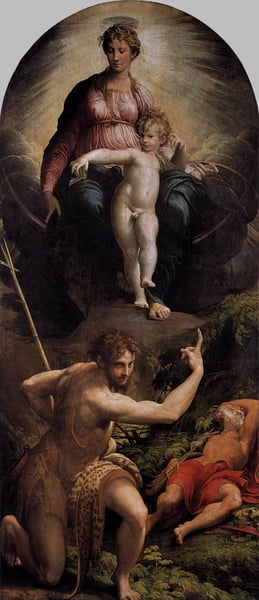
Madonna and Child with St. John the Baptist and St. Jerome
Dettagli
Analisi esperta di Madonna and Child with St. John the Baptist and St. Jerome di Parmigianino
Stile: Mannerism (Late Renaissance) · Genere: religious painting
Expert Art Historical Analysis
Artwork: Madonna and Child with St. John the Baptist and St. Jerome
Artist: Parmigianino (Girolamo Francesco Maria Mazzola, 1503–1540)
Style: Mannerism (Late Renaissance)
Genre: Religious painting
Significance within the Mannerist Period
Parmigianino’s Madonna and Child with St. John the Baptist and St. Jerome is a quintessential example of the Mannerist shift away from the balanced naturalism of the High Renaissance toward an art of refined artifice, intellectual sophistication, and emotional detachment. The painting encapsulates the core Mannerist preoccupations: elegance over clarity, elongation over proportion, and a self-consciously artificial beauty that elevates form above mere representation.
1. Elongated Figures and Unnatural Proportions
Parmigianino’s figures are characteristically stretched—long-limbed, with small heads and slender hands—creating a graceful, almost ethereal silhouette. Madonna’s neck is notably extended, a hallmark of the artist’s style (compare his famous Madonna of the Long Neck). This distortion is not anatomical error but a deliberate device to convey spiritual otherworldliness and courtly elegance. The Child, St. John, and St. Jerome share this refined elongation, unifying the composition in a rhythm of sinuous curves that defy gravity and naturalism.
2. Complex, Interlocking Poses
The figures are arranged in a serpentine, spiraling composition typical of Mannerist figura serpentinata. The Madonna gently twists, her body forming a graceful S-curve, while the infant John and the young Jesus reach toward each other. St. Jerome—usually depicted as an aged hermit—is here transformed into a youthful, contemplative figure, his sideways glance and folded hands echoing the introspective mood. This interlocking of gestures creates a sense of elegant motion without narrative immediacy; the viewer is invited to admire the choreography rather than follow a story.
3. Artificial Color and Cool, Polished Handling
Parmigianino employs a palette of cool, silvery tones—muted blues, pale pinks, soft greens, and pearly flesh—that heighten the work’s dreamlike quality. The brushwork is smooth and enamel-like, removing any trace of painterly spontaneity. This polished finish reinforces the Mannerist ideal of art as a product of the intellect, not of raw emotional expression. The light is diffuse and sculptural, modeling the forms with a gentle, even glow that further distances the scene from earthly reality.
4. Unstable, Asymmetrical Space
Unlike the stable, pyramidal compositions of Raphael or Leonardo, Parmigianino’s spatial arrangement feels deliberately precarious. The figures are pushed to the foreground, while the background recedes into ambiguous, atmospheric depths—perhaps a darkened landscape or a shallow niche. The lack of clear perspective or grounding creates a sense of floating, reinforcing the otherworldly, almost hallucinatory mood. Space is manipulated for visual elegance rather than logical depth.
5. Ambiguous, Intellectual Expressiveness
The saints’ expressions are remote, their gazes averted or inward-directed. St. John (often identified by his reed cross) and St. Jerome appear not as active participants in a sacred event but as silent, elegant witnesses. There is no overt drama or emotion; instead, the painting communicates a refined, melancholic spirituality that prizes contemplation over action. This emotional coolness is a defining Mannerist trait, reflecting the period’s fascination with grace, wit, and artistic self-awareness.
Significance in Parmigianino’s Oeuvre and Mannerism
This work exemplifies Parmigianino’s role as a leading Mannerist innovator. By synthesizing Correggio’s soft sfumato with Raphael’s classicism and then deliberately subverting both, he created an art that is at once exquisitely beautiful and intellectually challenging. The painting stands as a testament to Mannerism’s core ambition: to perfect nature through artifice, to prioritize grazia (grace) over verità (truth), and to transform religious subjects into vehicles for aesthetic exploration. In doing so, it helped define the late Renaissance’s shift toward a more subjective, self-conscious, and courtly visual language—a language that would deeply influence the Baroque and later European art.
Museum / Gallery
Visivamente simili
20 opere con composizione e palette affini
Saint Michael dedicating his weapons to the Virgin
Le Nain brothers
The Virgin Appears to St. Luke and Catherine
Annibale Carracci
Apollo and Daphne
Luca Giordano
The Temptation of St Anthony
Tintoretto
Rinaldo and Armida
Anthony van Dyck
Apparition De La Vierge Et De L’enfant-jésus À Saint Antoine
Simon Vouet
2. The Birth of the Princess
Peter Paul Rubens
The Triumph of Truth
Peter Paul Rubens
21. The Triumph of Truth
Peter Paul Rubens
The Resurrection of Christ
Tintoretto
Diana and Endymion
Luca Giordano
The Amazement of the Gods
Hans von Aachen
The Baptism of Christ
Adam Elsheimer
Diana and Endymion
Giambattista Pittoni
Diana and Endymion
Giambattista Pittoni
Mercury and Paris
Heinrich Schonfeld
The Sacrifice of Abraham
Giuseppe Maria Crespi
St. John the Evangelist on Patmos
Titian
The Judgement of Midas
Jacob Jordaens
Neptune and Amphritrite
James Thornhill