
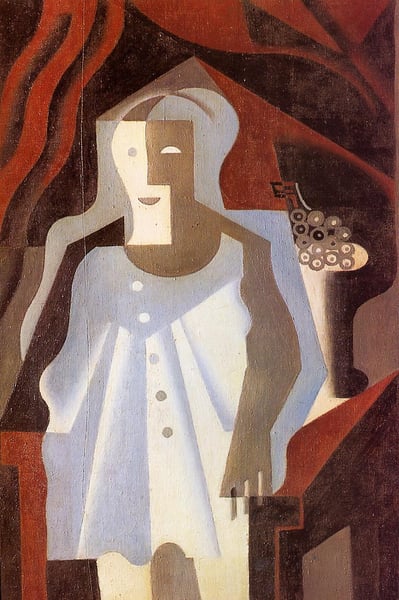
Analyse experte de Clown de Juan Gris
Style : Cubism · Genre : portrait
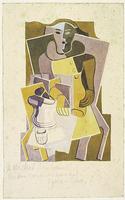
As an art historian, I will analyze "Clown" by Juan Gris based solely on the provided structured facts: it is a Cubist portrait.
The significance of this work lies in its role as a quintessential example of Synthetic Cubism—a phase of the movement defined by bold simplification, flattened planes, and a refined sense of color harmony. Unlike the earlier, more fractured Analytic Cubism of Picasso and Braque, Gris’s portraits bring a newfound clarity and cohesion to the subject.
In "Clown," Gris takes a traditional genre—the portrait—and transforms it using Cubist principles. The figure of the clown (a symbol of theatricality and disguise) becomes a geometric scaffold of interlocking shapes, often rendered in muted grays, browns, and cooler tones, punctuated by localized color. Gris’s unique contribution was his mathematical approach to composition: he would construct the painting from geometric bases, ensuring that every line, curve, and overlapping plane serves both the structural integrity of the canvas and the essence of the sitter.
What makes this portrait significant within Cubism is its legibility. Where earlier Cubist works risked dissolving the subject entirely, Gris maintains a clear, almost diagrammatic relationship between the clown’s features—the conical hat, the collar, the mask-like face—and the abstract system of squares, triangles, and arcs that contain them. The clown’s identity is not lost but reinvented through synthesis: multiple viewpoints are condensed into a single, readable image.
Furthermore, Gris’s use of the clown motif connects to the rich tradition of the commedia dell'arte in modern art, but he strips it of narrative sentiment. Instead, the clown becomes a vehicle for pure pictorial investigation—a reminder that Cubism, even in portraiture, was ultimately about the structure of vision itself. This work stands as a masterful blend of emotional coolness and intellectual rigor, marking Gris as the “third man” of Cubism who perfected its later, more decorative vocabulary.
Visuellement similaire
20 œuvres à la composition et à la palette proches
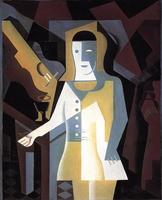
Pierrot
Juan Gris
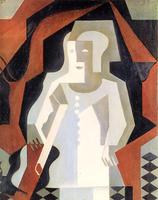
Pierrot
Juan Gris
The Musician
Georges Braque
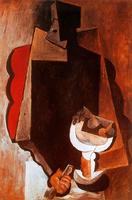
Figure with fruit dish
Pablo Picasso
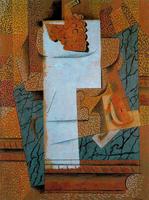
Fruit vase and bunch of grapes
Pablo Picasso
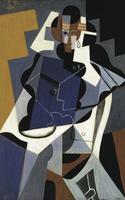
Seated Woman
Juan Gris
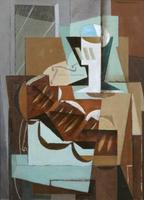
Rain
Louis Marcoussis
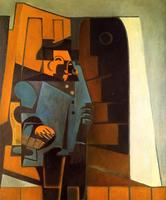
The Miller
Juan Gris
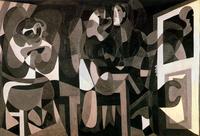
Milliners (Workshop of the milliner)
Pablo Picasso
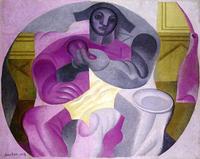
Seated Harlequin
Juan Gris
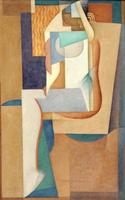
Cubist Composition. Sitting Woman
Vytautas Kairiukstis
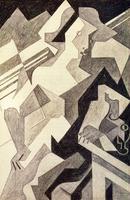
Harlequin at Table
Juan Gris
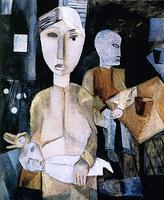
Armut
Lasar Segall
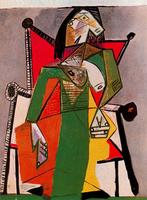
Woman sitting in an armchair
Pablo Picasso
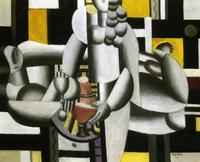
Two Women and still life 1st state
Fernand Leger
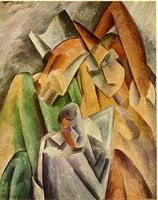
Harlequin's family
Pablo Picasso
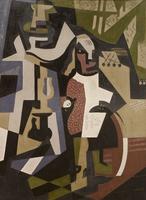
Composición Con Personaje
Maria Blanchard
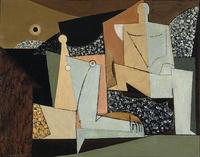
Figures on a Beach
Louis Marcoussis
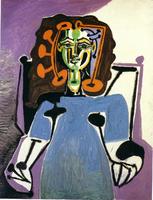
Seated Francoise with blue dress
Pablo Picasso
Harlequin
Juan Gris