
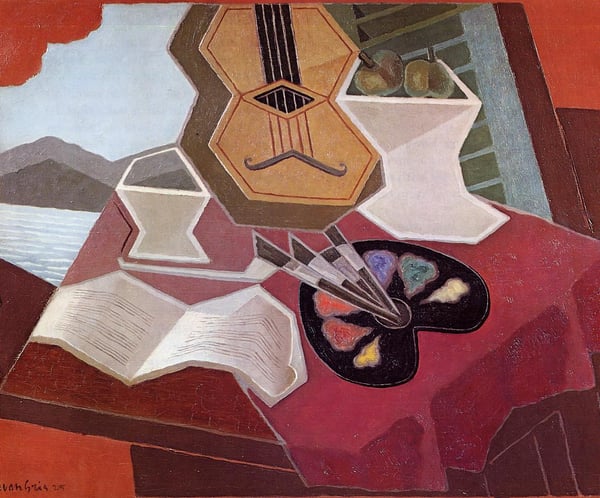
Экспертный разбор работы «Table Overlooking the Sea» художника Juan Gris
Стиль: Cubism · Жанр: still life
Expert Analysis: Table Overlooking the Sea by Juan Gris
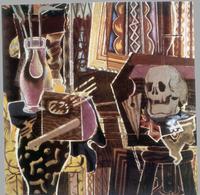
Juan Gris’s Table Overlooking the Sea (ca. 1915) stands as a pivotal example of Synthetic Cubism, a phase in which Gris, alongside Picasso and Braque, moved beyond the analytical deconstruction of form toward a more constructive, collage-like assembly of shapes and colors. While the genre is ostensibly a still life—a table with objects—the title and composition deliberately evoke a landscape view, merging interior and exterior space in a way that challenges traditional genre boundaries.
Significance within Cubism:
-
Synthesis of Interior and Exterior – Gris integrates the tabletop still life with a window-like vista of the sea, a motif he often employed. The sea is suggested through rhythmic bands of blue and white, while the table’s objects (a glass, bottle, fruit, sheet music) are flattened into geometric planes that interact with the “backdrop.” This duality breaks down the distinction between near and far, subject and setting—a hallmark of Cubist spatial ambiguity.
-
Color as Structural Element – Unlike the muted earth tones of early Analytical Cubism, Gris uses a vibrant palette of blues, greens, ochres, and whites. These colors are not merely decorative; they define intersecting planes and create a harmonious yet dynamic tension. The bold blue of the sea is echoed in the tablecloth, tying the composition together through color rhymes—a technique central to Synthetic Cubism’s emphasis on pictorial unity.
-
Geometric Abstraction and Reality – Gris’s objects are reduced to faceted, angular forms that still retain legibility. The glass and bottle are recognizable through their contours, yet they are fragmented into tilted facets that force the viewer to assemble the image. This balance between abstraction and representation distinguishes Gris: he preserves the identity of objects while subverting their conventional depiction, making Table Overlooking the Sea a masterwork of controlled disorder.
-
Synthetic Composition – The painting exemplifies how Synthetic Cubism builds a picture from simple, almost flat shapes arranged in a grid-like structure. Gris’s use of parallel diagonal lines and overlapping planes creates a shallow, frieze-like space that still suggests depth through overlapping—a technique derived from collage, even though this work is in oil. The composition feels both rigorous and lyrical, with the sea’s horizon line anchoring the otherwise fractured scene.
In sum, Table Overlooking the Sea is significant because it reconciles two Cubist impulses: the analytical urge to fragment reality and the synthetic urge to construct a new, coherent visual language. Gris’s subtle incorporation of landscape within still life expands Cubism’s thematic range, while his refined sense of color and geometry marks a high point in the movement’s development toward abstraction.
Museum / Gallery
Жанр
Стиль
Визуально похожие
20 работ с близкой композицией и палитрой
Still Life at the Open Window
Juan Gris

The Painter`s Window
Juan Gris
Natură statică cu paletă
Ion Pacea
Still life with bust and palette
Pablo Picasso

Still Life. The guitar.
Pyotr Konchalovsky
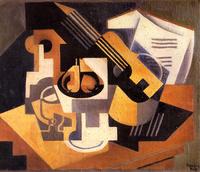
Guitar and Fruit Bowl on a Table
Juan Gris

Guitarra Y Frutero
Maria Blanchard
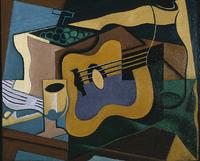
Still Life with Guitar
Juan Gris
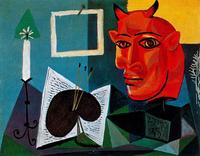
Candle, palette, head of red bull
Pablo Picasso
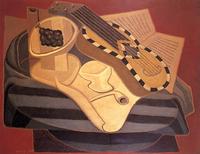
The Guitar with Inlay
Juan Gris
Still life with Guitar
Pablo Picasso
Guitar, Glass and Fruit Dish with Fruit
Pablo Picasso
Guitar and Pipe
Juan Gris
Sketch a still life with guitar
Pyotr Konchalovsky
Self-Portrait with Seven Digits
Marc Chagall

Still life
Andre Derain
Guitar
Lyubov Popova
Still Life
Endre Balint
Sketch a still life with guitar
Pyotr Konchalovsky
Balustre et Crane
Georges Braque