
Analisi esperta di The Sleeper di Tamara de Lempicka
Stile: Art Deco · Genere: portrait
Expert Analysis: "The Sleeper" by Tamara de Lempicka
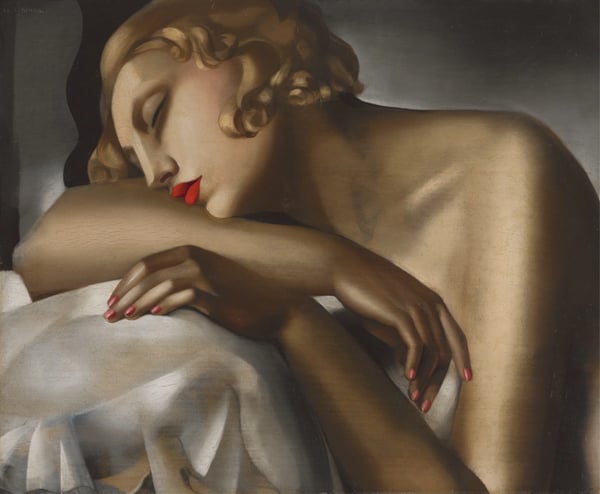
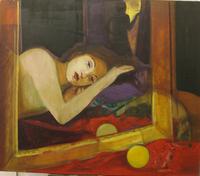
Tamara de Lempicka’s “The Sleeper” stands as a quintessential example of Art Deco portraiture, a genre she helped define through her distinctive synthesis of Neoclassical precision, Cubist geometry, and modernist glamour. Executed in her signature polished, almost metallic brushwork, the painting captures the era’s fascination with sleek luxury, eroticism, and psychological detachment.
Significance within Art Deco:
- Stylized Modernism: Lempicka’s treatment of the sleeping figure embodies the Art Deco ethos of streamlined elegance. The subject’s form is reduced to sharp, angular planes and smooth, curving contours—a balance that echoes the decorative movement’s love of geometric order and opulent streamlining. The taut, sculptural quality of the skin and drapery reflects the era’s obsession with machine-age perfection.
- Gender and Power: Unlike traditional passive reclining nudes, Lempicka’s sleeper exudes a cool, sovereign sensuality. The composition emphasizes the subject’s self-possession: the closed eyes suggest an inner realm inaccessible to the viewer, while the exaggerated, elongated limbs and immaculate makeup (typical of Lempicka’s figures) project a modern, autonomous femininity. This contrasts with earlier academic nudes, making the work a landmark in Art Deco’s redefinition of female identity.
- Formal Synthesis: The painting merges portrait intimacy with abstract pattern. The bed linens, perhaps reduced to sharp diagonal bands, create a rhythmic, decorative surface that flattens space—a nod to Cubist structure—while the modeled face and hands retain a sculptural solidity. This dualism is central to Lempicka’s contribution to Art Deco: a high‑gloss realism that never sacrifices bold design for naturalism.
Interpretation of the Sleeper Motif: The title itself invites contemplation of the boundary between conscious performance and unconscious vulnerability. In the context of 1920s–30s Art Deco culture—a time of jazz, speed, and dazzling nightlife—the sleeping figure becomes a paradoxical emblem: stillness frozen within a dynamic, polished surface. Lempicka’s sleeper is not truly resting; she is held in a state of aesthetic suspension, a composed image of repose that remains hyper‑alert to its own appearance.
In summary, "The Sleeper" exemplifies Lempicka’s ability to infuse portraiture with the spirit of Art Deco—where sensuality is channeled through precision, the human form becomes an architectural ideal, and every surface gleams with a controlled, hypnotic sheen. The work remains significant for its flawless execution of the period’s core values: luxury, modernity, and a tension between classical calm and restless glamour.
Visivamente simili
20 opere con composizione e palette affini

Sleeping Woman (Kizette)
Tamara de Lempicka
Sleeping Girl
Tamara de Lempicka

Sleeping Girl
Alexey Venetsianov
Reclining Nude I
Tamara de Lempicka

Figure at a Table (Portrait of My Sister)
Salvador Dali

Omnia vanitas
William Dyce

JM
Johannes Meintjes

Suzanne Bathing
Tamara de Lempicka

Woman in Red (Portrait of Mrs. Bush)
Tamara de Lempicka

Mary Magdalene in the Desert
Emmanuel Benner

Three women at a fountain (study)
Pablo Picasso

Portrait of Romana de La Salle
Tamara de Lempicka
The nap
Jose de Almada-Negreiros

Girl Asleep
Giorgio de Chirico
Ayna
Artin Demirci

Red Head
Jacob Collins

Sleeping girl
Friedrich von Amerling

Young Gardener
Orest Kiprensky

The Pillow
John Currin

Boy Bitten by a Lizard
Caravaggio