
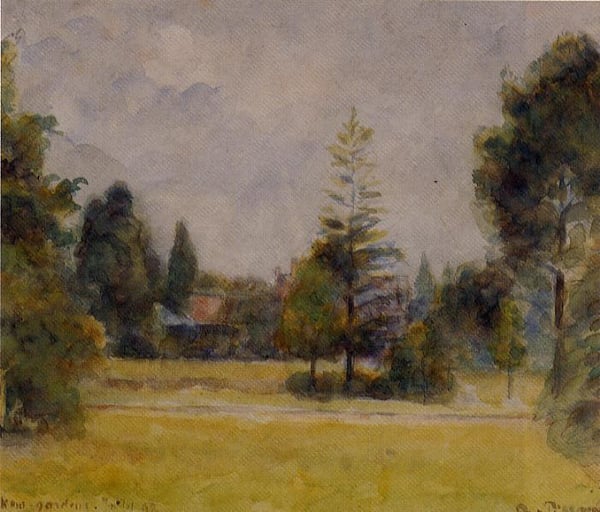
Análisis experto de Kew Gardens 2 de Camille Pissarro
Estilo: Impressionism · Género: landscape
Expert Analysis of "Kew Gardens 2" by Camille Pissarro
Camille Pissarro’s Kew Gardens 2 stands as a quintessential example of Impressionist landscape painting, demonstrating the artist’s lifelong commitment to capturing the transient effects of light, atmosphere, and everyday natural beauty. Painted during one of his visits to London—likely in the 1890s—the work reflects Pissarro’s mature Impressionist technique and his fascination with garden scenes, a subject that allowed him to explore the interplay between cultivated nature and shifting weather conditions.
Significance within Impressionism:
-
Mastery of Light and Atmosphere
Pissarro, often called the “father of Impressionism,” was unwavering in his pursuit of optical truth. In Kew Gardens 2, he employs his characteristic broken brushwork and a high-keyed palette to render the dappled sunlight filtering through tree canopies, the soft haze of English humidity, and the vibrant greens of lawns and flowerbeds. The scene is not a static record but a fleeting moment in time—a core tenet of Impressionist philosophy. -
The Garden as a Modern Subject
While earlier Impressionists focused on Parisian boulevards or rural farmland, Pissarro’s choice of Kew Gardens reflects a distinctly modern appreciation for public parks and botanic gardens as spaces of leisure and natural order. By painting a famous London landmark, he also bridges French Impressionism with British landscape traditions, showing how the movement could adapt to new environments. -
Series and Variation
Kew Gardens 2 is part of a small series Pissarro devoted to these gardens. Like his later series of Rouen Cathedral or the Boulevard Montmartre, this repetition allowed him to explore how changing seasons, times of day, and weather conditions transformed a single locale. The “2” in the title suggests a deliberate study of variation, reinforcing the Impressionist goal of capturing ephemeral perceptual experiences. -
Pissarro’s Role as Mentor and Innovator
As the only artist to exhibit in all eight Impressionist exhibitions, Pissarro was a stabilizing force and mentor to younger painters. Kew Gardens 2 exemplifies his balanced approach: avoiding the overly romantic or dramatic, he instead presents a harmonious, almost meditative view of nature. This work shows his influence on later Post-Impressionists like Cézanne and Gauguin, who admired his structural clarity even within loose brushwork.
In summary, Kew Gardens 2 is not merely a charming garden view but a deliberate exercise in Impressionist methodology. Pissarro’s ability to blend meticulous observation with painterly freedom makes this work a significant document of the movement’s mature phase—a testament to the artist’s belief that beauty lies in the ordinary, the atmospheric, and the fleeting.
Museum / Gallery
Visualmente similares
20 obras con composición y paleta relacionadas
Landscape
Camille Pissarro
Study of a Landscape
John Henry Twachtman
Summer Landscape
Ethel Léontine Gabain
Далекі гори
Trush Ivan Ivanovych
Eragny, Twilight
Camille Pissarro
Hampstead
John Constable
Connecticut Landscape
John Henry Twachtman
River Scene
Frank W. Benson
Autumn Landscape
Stefan Popescu
Edge of the Forest. Ligovo
Konstantin Somov
“Paysage, probablement la Normandie”
Ker-Xavier Roussel

La Plaine Aux Environs De Rolleboise
Maximilien Luce
Landscape
John Henry Twachtman
Landscape from Liminka
Vilho Lampi
Autumn. Steppe
Arkhyp Kuindzhi

Landscape
Thomas Eakins
The field
Nicolae Tonitza
Landscape with grey sky
Thomas Pollock Anshutz
Trees in a Field
Edouard Vuillard
Landscape
Pierre-Auguste Renoir