
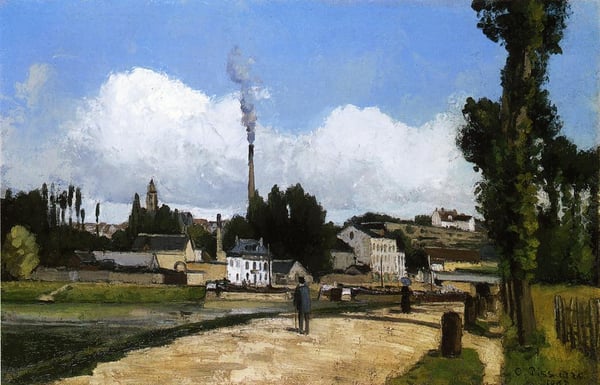
Expert analysis of Camille Pissarro’s Landscape with Factory
Style: Realism · Genre: landscape
Expert Analysis: "Landscape with Factory" by Camille Pissarro
Camille Pissarro’s Landscape with Factory stands as a compelling example of Realist landscape painting in the mid-to-late 19th century, distinguished by its direct engagement with the changing face of the rural environment. While Pissarro would later become a central figure in Impressionism, this work belongs to his earlier Realist phase, where he applied the movement’s core tenets—truthful observation, unidealized subject matter, and social awareness—to the pastoral genre.
The significance of the painting lies in Pissarro’s refusal to romanticize nature. Instead of a pristine, timeless vista, he presents a landscape marked by industrialization: the factory chimney rises as a stark, modern intrusion amid fields and trees. This juxtaposition is a hallmark of Realism’s commitment to depicting the contemporary world, capturing the quiet yet profound transformation of the French countryside during the Second Empire. By treating the factory not as an aberration but as a natural part of the landscape, Pissarro forces the viewer to confront the economic and social shifts reshaping rural life.
Stylistically, the work demonstrates Realism’s emphasis on earthy palettes, solid forms, and a subdued atmosphere, avoiding the dramatic lighting or allegorical overtones of Romanticism. The composition balances the traditional foreground of fields and paths with the geometrical, man-made structure in the middle distance, creating a tension between nature and progress. This direct, unvarnished observation anticipates the later Impressionist concern with modern subjects, but within a more structured, socially conscious framework.
In art historical terms, Landscape with Factory is significant because it expands the scope of landscape painting from mere pastoral retreat to a document of modernity. Pissarro’s Realist approach here—grounded in the specific place and its industrial marker—affirms the movement’s broader mission: to represent life as it is, without sentimentality, and to elevate the ordinary—and often overlooked—aspects of contemporary existence to the level of art.
Museum / Gallery
Visually similar
20 works with related composition and palette
Riverbanks in Pontoise
Camille Pissarro
The River Oise near Pontoise
Camille Pissarro
View of Bonnieres
Paul Cezanne
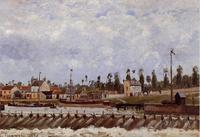
Pontoise Dam
Camille Pissarro
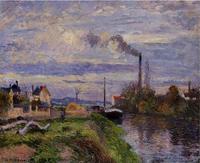
Quai du Pothuis, at Pontoise
Camille Pissarro
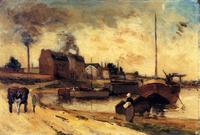
Cail Factories and Quai of Grenelle
Paul Gauguin
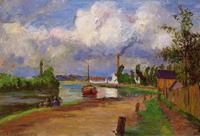
Fishermen on the Banks of the Oise
Camille Pissarro
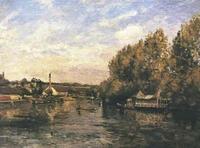
The froggybog at Bougival
Camille Pissarro
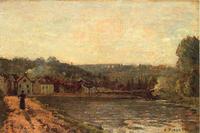
The Banks of the Seine at Bougival
Camille Pissarro
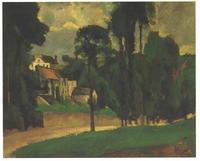
Road at Pontoise
Paul Cezanne
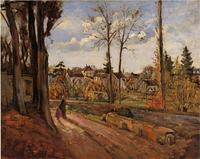
Louveciennes
Camille Pissarro
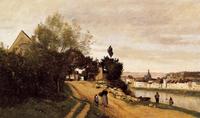
Chateau Thierry
Camille Corot
Riverbanks of the Seine
Fujishima Takeji
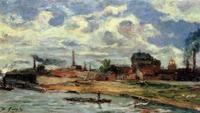
Port de Javel
Paul Gauguin
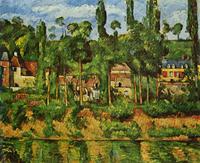
The Chateau de Medan
Paul Cezanne
Richmond, near London
Camille Corot
Factories at Argenteuil
Gustave Caillebotte
The Hermitage at Pontoise
Camille Pissarro
The Somme at Saint-Valery-sur-Somme
Eugene Boudin
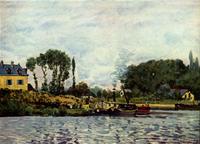
Boats at Bougival
Alfred Sisley