Camille Pissarro の Louveciennes Road Snow Effect の専門的な分析
スタイル:Impressionism · ジャンル:landscape
Expert Analysis: "Louveciennes Road Snow Effect" (c. 1870–1872) by Camille Pissarro
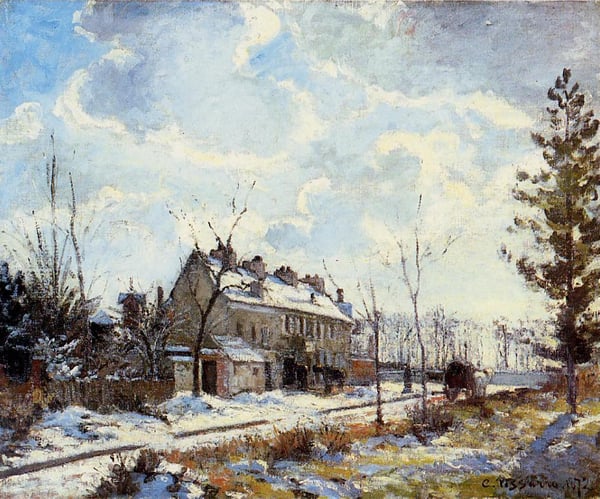
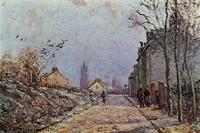
This quiet winter landscape stands as a quintessential example of early Impressionist innovation. Pissarro, often called the "dean" of the Impressionist movement, brings to this scene his deep commitment to capturing fleeting atmospheric conditions—here, the muffled, diffused light of a snowy day in the village of Louveciennes.
Significance within Impressionism:
- The Snow as a Laboratory for Light: Snow scenes were a favorite subject among Impressionists (Monet, Sisley, Renoir) because the white blanket acts as a natural reflector, intensifying subtle shifts in color and light. Pissarro uses a high-key palette of muted blues, pale violets, and off-whites to model the snow’s surface, rather than pure white. The road’s ruts and footprints catch warm ochres and cool shadows, demonstrating the Impressionist principle that even "white" contains a spectrum of hues.
- Broken Brushwork and Texture: The painting is built from short, distinct strokes—dabs of paint that blend optically when viewed from a distance. This technique, central to Impressionism, conveys the granular, slightly rough texture of snow and the way it softens outlines. The bare trees are rendered as delicate, scratchy marks, their branches etched against the pale sky.
- Ordinary Subject Elevated: Pissarro focuses on a modest country road, a typical Impressionist choice that rejects grand historical or mythological themes. The lone figure (a woman or child) and the distant cart emphasize human presence within nature, but the true subject is the momentary effect of snow transforming a familiar place into a shimmering, quiet tableau.
Art-Historical Context: Painted around the time of the Franco-Prussian War (Pissarro fled to London in 1870–71, but returned to Louveciennes in 1872), this work shows his shift from the more structured landscapes of his early career toward the looser, more spontaneous style that would define the first Impressionist exhibition in 1874. Louveciennes Road Snow Effect is a subtle masterpiece of observation—a frozen moment rendered with warmth and technical daring. It exemplifies how Pissarro and his peers found profound beauty in the transient, the mundane, and the atmospheric.
Museum / Gallery
視覚的に類似
構図やパレットが近い作品 20 件
The Road from Versalles to Saint Germain at Louveciennes
Camille Pissarro
The Road from Versailles to Saint Germain, Louveciennes. Snow Effect
Camille Pissarro
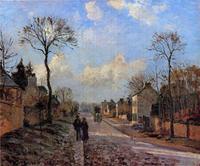
A Road in Louveciennes
Camille Pissarro
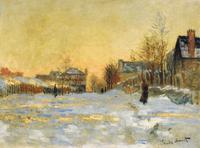
Snow Effect, The Street in Argentuil
Claude Monet
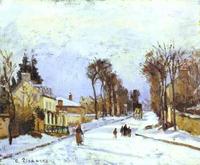
The Versailles Road at Louveciennes
Camille Pissarro
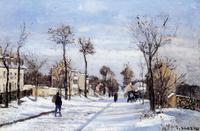
Street in the Snow, Louveciennes
Camille Pissarro
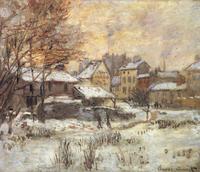
Snow Effect with Setting Sun
Claude Monet
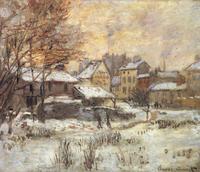
Snow Effect with Setting Sun
Claude Monet
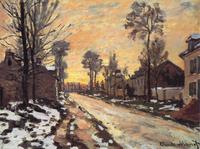
Road at Louveciennes, Melting Snow, Sunset
Claude Monet
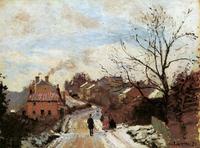
Lower Norwood
Camille Pissarro
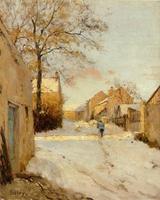
A Village Street in Winter
Alfred Sisley
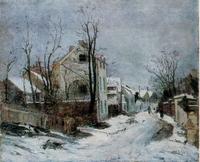
Winter at Barbizon
Ion Andreescu
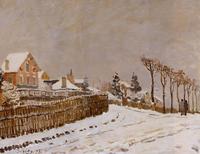
Snow at Louveciennes
Alfred Sisley
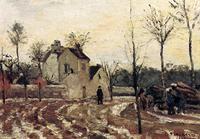
Thaw, Pontoise
Camille Pissarro
Snow Effect at Veneux
Alfred Sisley
The street of the Citadelle, Pontoise
Camille Pissarro
Snow Effect, The Road to Louveciennes
Claude Monet
Snow Effect, The Boulevard de Pontoise at Argenteuil
Claude Monet
Street Snow Effect
Camille Pissarro
The red painted house
Gustave Loiseau